
 1 month ago
30
1 month ago
30
RT looks at the key milestones that led to “no-limits” cooperation between Moscow and Beijing
Russian President Vladimir Putin has embarked on an official visit to China this week – the latest milestone in a relationship that Moscow and Beijing have described as a “no-limits partnership.”
Putin’s trip comes as the two countries celebrate the 30th anniversary of the China-Russia strategic partnership of coordination, and the 25th anniversary of the Treaty of Good-Neighborliness and Friendly Cooperation.
Here is how three decades of pragmatism, Western pressure, and mutual economic need allowed China and Russia to build one of the world’s most consequential partnerships outside of the traditional Western-dominated international system.
Soviet chapter: From comrades to combatants
The relationship between the Soviet Union and Communist China kicked off in the late 1940s and early 1950s as a bond of ideological brotherhood. The Soviet Union acted as China’s ‘elder brother,’ helping the country to recover from devastating consequences of World War II and Civil War, with Soviet technicians pouring into the mostly rural country, helping build factories, railways, and the rudiments of an industrial base.
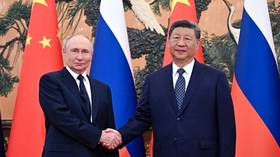
However, relations frayed in the mid-1950s after Soviet leader Nikita Khrushchev parted with the policies of Joseph Stalin – a close ideological ally of hardline Chinese leader Mao Zedong. In particular, Khrushchev denounced Stalin’s mass purges and cult of personality while gradually pivoting towards a policy of co-existence with the West.
Beijing subsequently accused Moscow of “revisionism” – an apostasy from orthodox Marxism-Leninism, with the two countries descending into open rivalry. The stand-off culminated in 1969 as the two nuclear powers engaged in an undeclared war over the border island of Damansky (known as Zhenbao in China) on the Ussuri river.
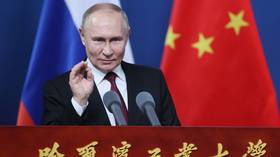
The Long Thaw
Ties started to normalize in the mid-1980s as reformers Mikhail Gorbachev and Deng Xiaoping ascended to power in their respective countries. Moscow and Beijing held a series of grinding talks on mitigating border disputes, with relations improving due to the Soviet decision to start pulling troops from Afghanistan and end support for Vietnam’s presence in Cambodia.
The new era of rapprochement began during Gorbachev’s trip to Beijing in 1989 – the first visit by a Soviet leader in 30 years.
Partnership takes shape
The Soviet Union’s collapse in 1991 did not derail an upward trend in relations, with China swiftly recognizing nascent Russia. The tendency was supported by both countries needing one another: China wanted shipments of sophisticated Soviet-designed weaponry and access to Russia’s vast resources, while Moscow – which was undergoing a painful transition to a market economy – needed cash.
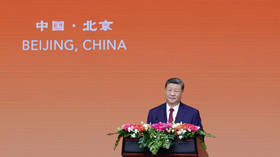
In April 1996, Russia and China moved towards the “strategic partnership of equality and trust oriented towards the 21st century.” In a joint declaration one year later, both countries articulated the concept of a “multipolar world,” which was widely seen as a counterweight to US hegemony on world stage. At around the same time, Moscow and Beijing were both growing increasingly uneasy about NATO’s expansion eastward.
Trade boom
In 2001, the two sides signed the Treaty of Good-Neighborliness and Friendly Cooperation, agreeing to cooperate on tackling common threats and improving global stability. A couple of years later, the sides extinguished the last remnants of the border dispute.
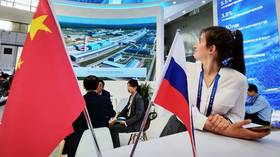
The political scaffolding paid off in commercial terms, with China’s total annual trade with Russia growing more than sevenfold, from just $8 billion to $60 billion, between 2000 and 2010. Russia was providing its neighbor with energy, coal, and raw materials, while China shipped machinery, consumer electronics, and cheap manufactured goods to Russia.
New era in energy cooperation
The start of the Ukraine crisis in 2014 and sweeping Western sanctions against Russia only drew Moscow and Beijing closer.
In May 2014, Gazprom and China National Petroleum Corporation (CNPC) signed a landmark 30-year $400 billion agreement to supply 38 billion cubic meters of natural gas annually through the Power of Siberia pipeline, which came online in December 2019.
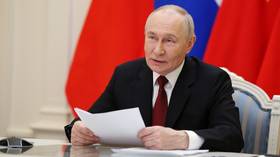
Bilateral trade also continued to soar, with the overall trade volume tripling between 2010 and 2022 to reach more than $180 billion. Both countries also accumulated grievances against Washington. Russia vehemently protested NATO expansion and Western support for Ukraine. China, meanwhile, remained at a stand-off with the US in the South China Sea as the two countries wrestled over trade tariffs and technology disputes.
“No limits partnership”
In early February 2022, less than three weeks before the escalation of the Ukraine conflict, Putin and Chinese leader Xi Jinping released a joint statement declaring that the “friendship between the two States has no limits” and that “there are no ‘forbidden’ areas of cooperation.”
China subsequently declined to condemn Moscow over its special military operation, refused to adopt Western sanctions, and blamed the conflict on NATO expansion. It also remained Moscow’s key economic partner, especially in the energy sector, as EU nations sought to cut economic and cultural ties with Russia.
In addition, China continued to ship cars, electronics, trucks, and other goods to Russia while filling the market vacuum left by the exodus of Western companies.
In a video address to the Chinese people prior to this week’s visit, Putin said that Russia-China trade turnover had exceeded $200 billion, with most transactions being carried out in national currencies.




 English (US) ·