
Russia on Tuesday test-fired a new intercontinental ballistic missile as part of efforts to modernize the country's nuclear forces, a launch hailed by President Vladimir Putin just days after his claim that the fighting in Ukraine is nearing an end.
Putin said that the nuclear-armed Sarmat missile would enter combat service at the end of the year. It was built to replace the aging Soviet-built Voyevoda.
"This is the most powerful missile in the world," Putin declared, claiming that the combined power of the Sarmat's individually targeted warheads is more than four times higher than that of any Western counterpart.
The Russian leader has repeatedly brandished the nuclear sword after sending troops into Ukraine in February 2022 to try to deter the West from ramping up support for Ukraine.
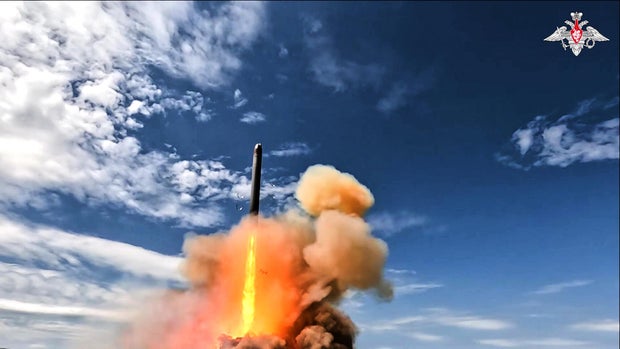 In this image made from video provided by Russian Defense Ministry Press Service on May 12, 2026, Russia's new Sarmat intercontinental ballistic missile is test launched at an unspecified location in Russia.
AP
In this image made from video provided by Russian Defense Ministry Press Service on May 12, 2026, Russia's new Sarmat intercontinental ballistic missile is test launched at an unspecified location in Russia.
AP
After overseeing a military parade on Red Square on Saturday commemorating the defeat of Nazi Germany in World War II, which for the first time in nearly two decades didn't include heavy weapons, Putin declared the conflict in Ukraine is coming to an end.
Since coming to power in 2000, Putin has overseen efforts to upgrade the Soviet-built components of the Russian nuclear triad - deploying hundreds of new, land-based intercontinental ballistic missiles, commissioning new nuclear submarines and modernizing nuclear-capable bombers.
Russia's effort to revamp its nuclear forces pushed the United States to launch a costly modernization of its arsenal.
Nuclear arms pact expired
The last remaining nuclear arms pact between Russia and the U.S. expired in February, leaving no caps on the world's two largest atomic arsenals for the first time in more than a half-century and fueling fears of an unconstrained nuclear arms race.
That same month, the U.S. and Russia agreed to reestablish formal, high-level military communications that were suspended in late 2021, prior to Russia's full-scale invasion of Ukraine.
The Sarmat — designated "Satan II" by NATO — is meant to replace about 40 Soviet-built Voyevoda missiles. Its development began in 2011 and before now, the missile had only one known successful test and reportedly suffered a massive explosion during an abortive test in 2024. A satellite image analyzed by CBS News at the time showed a large crater and remnants of a possible explosion on a launchpad at Plesetsk Cosmodrome in northern Russia.
The Sarmat is classified as a "heavy" ICBM and is capable of carrying up to 10 tons in payload, according to the Center for Strategic and International Studies' Missile Defense Project.
Putin said Tuesday that the Sarmat — part of a slew of new weapons that Putin revealed in 2018, claiming they would render any prospective U.S. missile defenses useless — is as powerful as the Voyevoda but with a higher precision. It is capable of suborbital flight, he said, giving it a range of more than 21,700 miles and an extended capability to penetrate any prospective missile defenses.
Moscow's new weapons include the Avangard hypersonic glide vehicle, capable of flying 27 times faster than the speed of sound. The first vehicles have already entered service.
Russia has also commissioned the new nuclear-capable Oreshnik intermediate-range ballistic missile, and used its conventionally-armed version twice to strike Ukraine. Oreshnik's range of up to 3,100 miles makes it capable of reaching any target in Europe.
Putin also announced Russia was in the "final stages" of the development of the nuclear-armed Poseidon underwater drone and the Burevestnik cruise missile powered by miniature atomic reactors. The Poseidon is designed to explode near enemy coastlines and cause a radioactive tsunami. The Burevestnik has virtually unlimited range thanks to nuclear propulsion, allowing it to loiter for days, circling air defenses and attacking from an unexpected direction.
Putin has described those new weapons as part of a Russian response to the U.S. missile shield that Washington developed after its 2001 withdrawal from a Cold War-era U.S.-Soviet pact that limited missile defenses.
Russian military planners have feared a missile shield could tempt Washington to launch a first strike that would knock out most of Moscow's nuclear arsenal in hopes of intercepting a small number of surviving missiles fired in retaliation.
"We were forced to consider ensuring our strategic security in the face of the new reality and the need to maintain a strategic balance of power and parity," Putin said.
The nuclear treaty that expired in February was a bilateral agreement between the U.S. and Russia, which have about 4,300 and 3,700 nuclear warheads respectively, according to the Federation of American Scientists.
Meanwhile, the governments of the U.S. and Ukraine have drafted a memorandum outlining the terms of a potential new drone defense deal between the countries, three sources familiar with the matter told CBS News.
Eleanor Watson contributed to this report.
In:
Key nuclear weapons treaty expires
Expert sounds alarm on uncertainty after expiring nuclear weapons treaty
(02:16)






 English (US) ·