
 1 month ago
38
1 month ago
38
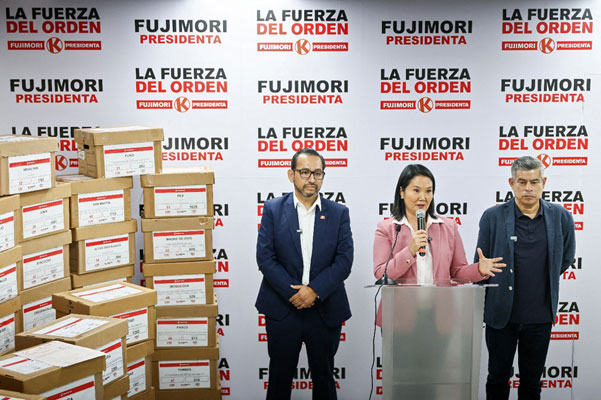 Credit: Connie France/AFP
MONTEVIDEO, Uruguay, July 3 (IPS) - Right-wing candidate Keiko Fujimori has won Peru’s presidential runoff, narrowly defeating leftist Roberto Sánchez to become the country’s ninth president in a decade. She inherits a system so engineered for dysfunction that rather than making compromises, she may decide the concentration of power is her only means of survival. The constitution that created this trap was written by her father.
A system built to fail
Keiko, daughter of authoritarian former president Alberto Fujimori, has finally succeeded in her fourth consecutive runoff, having lost in 2011, 2016 and 2021. She won with a margin of roughly a quarter of a percentage point over a candidate who is a close ally of jailed former president Pedro Castillo. Both sides alleged fraud, filed claims and sent their supporters onto the streets.
Peru is often described as a democracy without parties. The party system disintegrated in the 1990s and was never rebuilt. In its place came a sequence of improvised candidacies and personal electoral vehicles that rise and fall with their founders. For the first-round vote on 12 April, the largest ballot paper in Peru’s history listed 35 candidates. Fujimori came first with just 17.19 per cent. Ultimately, most Peruvians didn’t vote for either candidate who made the runoff. A president elected on that basis has a mandate so weak that rivals can dispute it from day one, and they do.
Congressional seats scatter across dozens of parties, none of which dominates. But parties can combine to reach the two-thirds threshold needed to invoke a constitutional clause to impeach and remove a president on the grounds of ‘permanent moral incapacity’, a mechanism Peru’s constitution leaves deliberately vague. The Congress elected in 2021 removed three presidents in one term.
Authoritarian incentives
The constitutional mechanism that enables political instability is the reason Fujimori’s presidency could be dangerous. As she enters office with a razor-thin margin and no congressional majority, she faces an immediate strategic choice. She can seek compromise with her opponents, but this might signal that the threat of impeachment works, inviting it. Or she can move to concentrate power and weaken the institutions that constrain the executive, denying her opponents the tools they could use to remove her.
Everything points towards the second option. Most presidents recently removed by Congress were, at the time of their removal, attempting to govern within the rules, and the rules were weaponised against them. Pedro Castillo tried a different approach, dissolving Congress pre-emptively to forestall his impeachment. He was immediately arrested and removed. A politician who has watched this dynamic consume eight predecessors might conclude that the only way to survive is to change the game.
Keiko’s father ruled Peru from 1990 to 2000 as an elected president who progressively dismantled the institutions that constrained him. Two years into his first term, citing the simultaneous crises of hyperinflation and insurgency, he dissolved Congress and suspended the constitution. The emergency was real, but it was also an opportunity. Fujimori rewrote the constitution to entrench executive power, won re-election in 1995 and then won a fraud-tainted third term before being forced from office within months. His government became synonymous with grand corruption and human rights atrocities, including the forced sterilisation of over 272,000 mostly Indigenous women. After he was forced out in 2000, he was convicted of homicide and kidnapping, and imprisoned.
The constitution Alberto Fujimori wrote to entrench his power is still in force. The moral incapacity clause that the 1993 constitution retained – useful to Fujimori when he controlled Congress – has become the primary weapon congressional majorities have used to remove president after president. The most significant recent constitutional change, the reinstatement of a two-chamber Congress, may end up increasing congressional power. This is the system Keiko now has to deal with.
The costs of dysfunction
Peru’s dysfunction has long been sustained by a comforting fiction: that while politics is chaotic, the economy runs itself. Macro fundamentals have remained relatively stable. Inflation in 2025 ran at around 1.5 per cent, and the economy grew 3.4 per cent in 2024. But economic growth has roughly halved over a decade of turmoil. Poverty, at 27.6 per cent in 2024, remains above pre-pandemic levels. Homicides stand at 10.7 per 100,000 people, alongside an epidemic of extortion.
Freedoms are deteriorating and those who protest pay the highest price. In 2025, attempts to change the pension system triggered Gen Z-led protests that quickly expressed broader anger at corruption, insecurity and political dysfunction. Security forces responded with violence. In December 2024, the CIVICUS Monitor, which tracks civic space conditions globally, downgraded Peru to repressed status, its second-worst rating, citing years of escalating state violence and the systematic harassment of human rights defenders and journalists, who political figures routinely smear as terrorists and traitors.
In March 2025, Congress passed a law giving the Peruvian Agency for International Cooperation extensive powers to control, censor and persecute civil society organisations that receive foreign funding, threatening fines of up to US$720,000 and criminalising any use of foreign funds to support legal action against the Peruvian state. It is, in effect, a law against accountability.
Danger ahead
Keiko Fujimori ran a law-and-order campaign under the slogan ‘Fujimori returns, order returns’, casting the fight against organised crime as a sequel to her father’s 1990s war against insurgency and promising mass deployments of police and military forces. Her party championed a 2025 amnesty law shielding security forces and civilian armed groups from prosecution for disappearances, killings and torture during that conflict, in direct defiance of the Inter-American Court of Human Rights. Keiko has been evasive about her father’s atrocities and has recast human rights as a matter of access to basic services rather than accountability for past abuses. Her record offers no grounds for optimism about civic space or democratic norms.
Keiko’s father justified breaking the rules that constrained him by pointing to insurgency and economic collapse. Keiko faces no insurgency and no hyperinflation, so if she moves to concentrate power, she will have to find her own justification, perhaps in a crime wave, a security emergency or a conspiracy of her enemies. The Fujimorist playbook could come back with a vengeance.
Inés M. Pousadela is CIVICUS Head of Research and Analysis, co-director and writer for CIVICUS Lens and co-author of the State of Civil Society Report. She is also a Professor of Comparative Politics at Universidad ORT Uruguay.
For interviews or more information, please contact [email protected]
© Inter Press Service (20260703180109) — All Rights Reserved. Original source: Inter Press Service







 English (US) ·