
 1 month ago
39
1 month ago
39
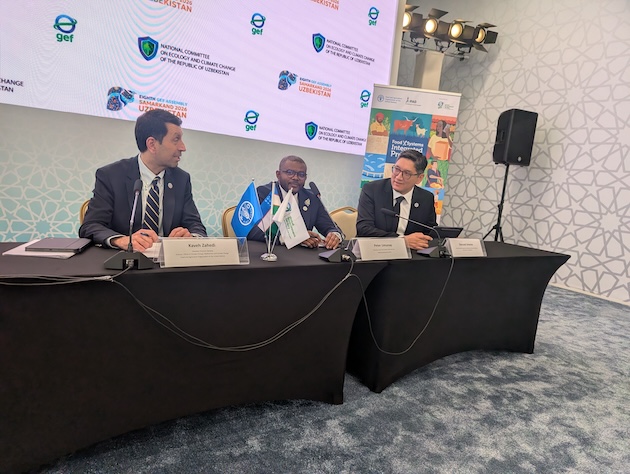 Kaveh Zahed, Assistant Director-General and Director of FAO’s Office of Climate Change, Biodiversity and Environment (left), speaks during a press briefing on agri-food system solutions at the GEF Assembly in Samarkand, Uzbekistan, where he emphasised that agriculture can play a central role in addressing climate and biodiversity challenges. Credit: Kizito Makoye/IPS
 SAMARKAND, Uzbekistan, June 11 (IPS) - The Global Environment Facility (GEF) has approved USD 6.4 million for a new conservation initiative in Papua New Guinea that seeks to protect 700,000 hectares of critical highland ecosystems by placing Indigenous Peoples and local communities at the centre of conserving and managing their ancestral lands.
Implemented by the Food and Agriculture Organization (FAO) and with expected USD 16.7 million in co-financing, the project aims to strengthen biodiversity corridors, support peacebuilding and improve environmental management across protected and productive landscapes. It is expected to improve management effectiveness across more than 276,000 hectares of protected areas, extend sustainable environmental practices to 1.6 million hectares, directly benefit 21,000 people and avoid nearly one million tonnes of carbon emissions.
The initiative reflects a broader shift in conservation thinking in Papua New Guinea and internationally – away from externally driven protection efforts and toward approaches that connect biodiversity conservation with livelihoods, land rights and local governance.
That shift is especially significant in Papua New Guinea, where roughly 97 percent of land remains under customary ownership, making conservation efforts dependent on local consent and participation.
“In a culturally rich and highly diverse country that is both geographically isolated and challenging to access, community empowerment is essential for achieving sustainable social and economic development,” Aaron Becker, FAO-GEF Regional Coordinator for Asia and the Pacific, told IPS.
“The key to successful conservation efforts in Papua New Guinea is recognising and respecting that 97 percent of the country’s land is held under customary ownership,” Becker said.
According to project designers, conservation in Papua New Guinea can only succeed when it is rooted in customary land systems, respects local cultural realities and builds upon traditional natural resource management practices rather than bypassing communities.
Under the project’s community-led landscape model, local people will determine which areas should be protected, which can continue supporting livelihoods and what conservation rules should apply. The initiative is expected to support recognition of 10 community-led conservation areas across biodiversity hotspots.
The programme will rely on participatory processes grounded in Free, Prior and Informed Consent (FPIC) and the Voluntary Guidelines on the Responsible Governance of Tenure (VGGT) while helping communities strengthen governance systems and develop land-use plans informed by traditional knowledge.
“This project provides the facilitation, training, equipment, and access to finance — and keeps the decisions within the community,” Becker said.
“Importantly, communities are not being asked to implement somebody else’s conservation agenda.”
Project officials say the initiative has also been designed to avoid intensifying land disputes or creating new social tensions.
“The project is designed carefully to avoid making tensions, such as around natural resources, worse,” Becker said, adding that site selection takes into account governance conditions, conflict risks and community readiness.
The emphasis on community ownership reflects a broader evolution in global conservation policy, according to Kaveh Zahed, Assistant Director-General and Director of FAO’s Office of Climate Change, Biodiversity and Environment.
“It’s not just about protecting biodiversity – it is about conservation, regeneration and sustainable use of biodiversity,” Zahed told journalists on the sidelines of the GEF Assembly.
“That’s a recognition that much of this biodiversity is linked to people and to livelihoods – and nowhere is that demonstrated better than with agriculture and agricultural communities, who are custodians of a great deal of that biodiversity.”
Rather than treating conservation as a restriction on development, the project combines environmental protection with biodiversity-friendly livelihoods, including sustainable agriculture, agroforestry, coffee systems, non-timber forest products, ecotourism and small-scale livestock.
Zahed said agriculture and food systems can become part of the solution rather than a source of tension between conservation and economic development.
“That’s where the beauty of agri-food system solutions lies,” he said. “They are interventions that are about food security, producing more with less, and helping communities maintain that food security while at the same time bringing biodiversity and climate benefits.”
For Becker, the broader lesson extends beyond Papua New Guinea.
“So, the message is simple: conservation should not create new insecurity,” he said. “Done well, it will reinforce land rights, support livelihoods, and build cooperation across landscapes that communities already know, use and manage.”
Note: This feature is published with the support of the GEF. IPS is solely responsible for the editorial content, and it does not necessarily reflect the views of the GEF.
IPS UN Bureau Report
© Inter Press Service (20260611122319) — All Rights Reserved. Original source: Inter Press Service




 English (US) ·