
We are bombarded, lured, or both, as hotels, airlines, social media influencers, cruise companies, and our own friends curate, post and tempt us to travel. What's often cropped out are the crowds and long lines – the frustrations that can come with vacationing today, or living in a vacation destination.
"Where we see neighborhoods starting to serve tourists more than residents, that's where we start to see problems," said Paris-based writer Paige McClanahan. "And that's where we start to see pushbacks, like we've seen some anti-tourism protests in places like Barcelona."
McClanahan, who has covered travel and tourism for decades, says tourism is a huge economic force. "Globally, tourism is 10% of the global economy," she said. "It's about one in 10 jobs around the world."
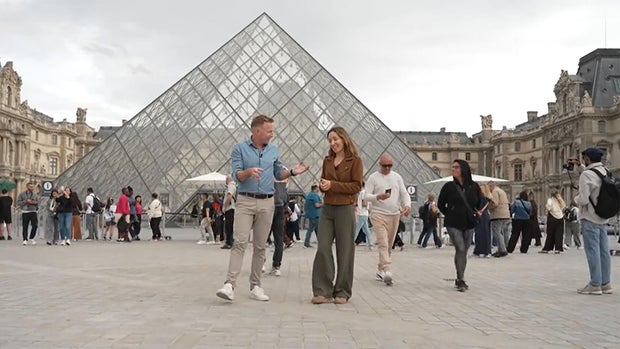 Correspondent Seth Doane with journalist Paige McClanahan outside the Louvre Museum in Paris.
CBS News
Correspondent Seth Doane with journalist Paige McClanahan outside the Louvre Museum in Paris.
CBS News
In her book, "The New Tourist," McClanahan traces how guidebooks, low-cost airlines, and now social media are fueling a surge in travel. In 1950, there were 25 million tourist arrivals around the world. Today there's more than 1.5 billion.
One place on many tourists' checklists: The Louvre in Paris. It's the world's most-visited museum. "It's obviously an iconic spot," McClanahan said. "It's also a spot that really epitomizes some of the pressures that we've been talking about."
In June 2025, Louvre employees went on strike because of its inability to cope with the crowds.
"It feels like tourism is having a coming-of-age moment, where destinations are really waking up to the fact that tourism is something that needs regulation, it needs taxes, it needs urban planning laws, it needs physical infrastructure," said McClanahan. "At the same time, tourists, we travelers, are also waking up to the impact of our presence in places."
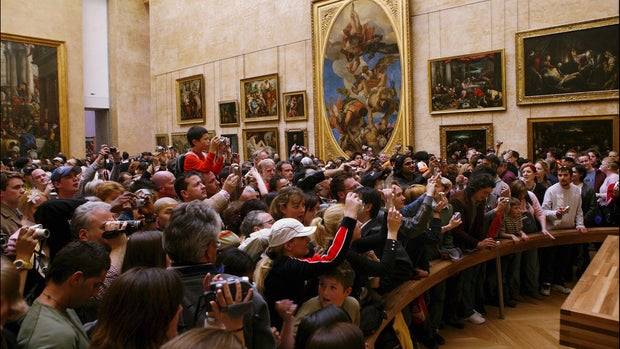 Visitors angle for a view of the Mona Lisa at the Louvre in Paris, April 6, 2005.
Raphael GAILLARDE/Gamma-Rapho via Getty Images
Visitors angle for a view of the Mona Lisa at the Louvre in Paris, April 6, 2005.
Raphael GAILLARDE/Gamma-Rapho via Getty Images
So, has social media been good or bad for travel? "Yes!" McClanahan replied. "Yes to both."
Consider this: A canyon in Iceland had to be closed after a Justin Bieber music video attracted too many tourists. A farmer in Italy's Dolomites protested crowds by installing a turnstile to charge to get to Instagrammable spots.
Then, there's this fragile city...
A flood of tourists in Venice
Each year around 30 million visitors come to Venice – that's about 600 times the local population. In 2024 the city implemented a fee for daytrippers of 5 to 10 Euros at peak times – one way to combat the crush of tourists.
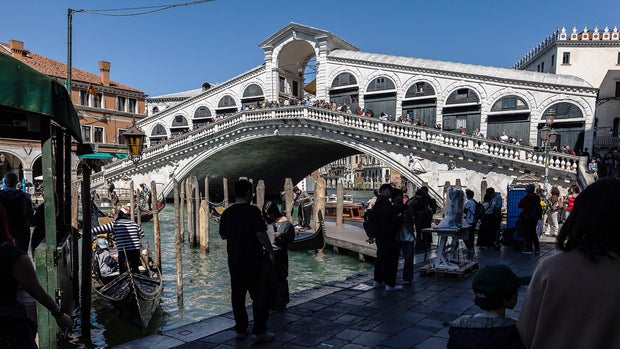 Tourists crowd onto the Ponte di Rialto bridge in Venice, April 3, 2026. The Italian city, a UNESCO World Heritage treasure, draws tens of millions of visitors.
Emanuele Cremaschi / Getty Images
Tourists crowd onto the Ponte di Rialto bridge in Venice, April 3, 2026. The Italian city, a UNESCO World Heritage treasure, draws tens of millions of visitors.
Emanuele Cremaschi / Getty Images
Venice has also tried banning massive cruise ships – but tourists still come. Portofino, on Italy's other coast, added new rules to manage the behavior of those already there.
Police commander Chiarello Giuseppina got new duties this past summer when Portofino banned drinking alcohol or sitting on the ground in main streets and squares. Also off-limits in peak times: being barefoot or shirtless. There's an up to 500 Euro fine.
Does she ever hear complaints from visitors? "No, we have no complaints," Giuseppina said. "In general, people understand. We explain that we are, yes, on the sea, but we are in a very famous center, and it's correct to respect and enjoy the town."
Across Europe, countries are trying to regulate tourism. Spain started removing tens of thousands of illegal Airbnbs, and introduced taxes which decrease over time to encourage longer stays.
Asked what tourist destinations and cities should do, McClanahan said, "It's not the sexiest topic really, but one really interesting tool is a tourism tax, and we're seeing that in Amsterdam. They've upped the tourist tax to 12.5%, which is currently the highest in Europe."
Amsterdam: Venice of the North
Amsterdam is known for its canals, and more and more its crowds. Home to fewer than one million residents, it saw a record 23 million tourists in 2024. "At a certain point, residents started to raise their voices," said Anouschka Trauschke, who used to manage what she calls a "typical" tour company. But she says she had an inner conflict: "You feel like an ambassador of the city. But on the other side, you were feeling that you were part of a problem."
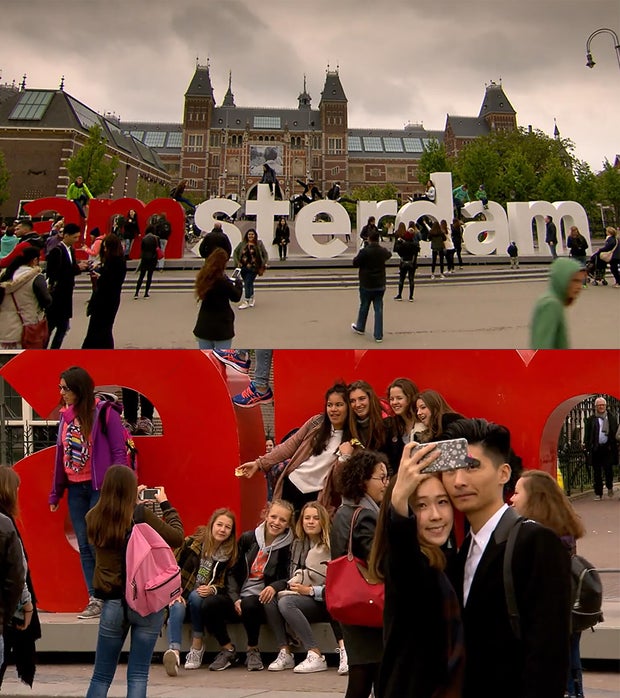 Amsterdam registered a record 23 million tourists in 2024.
CBS News
Amsterdam registered a record 23 million tourists in 2024.
CBS News
Trauschke organizes community sessions to brainstorm solutions to overtourism, and started Tours That Matter, which tailors visits, often touring less-trafficked spots, like taking the ferry to North Amsterdam, where a former shipyard is on one of her tours.
But is it just a drop in the bucket, considering the more than 20 million tourists that come to the city? "That's what you would think," she said, "but with Tours That Matter, we've been very much part of a pioneer movement. And then we still have this large, large tourism that is just asking for transition."
Edwin Scholvinck is pushing for that transition. For 33 years he's lived in the city's world-famous red-light district, known for its windows and sex workers. But he says his friends won't come visit anymore. Why? "Because there are too many tourists," he said.
Lately, he has been able to find a little more peace at home. Guided tours are no longer allowed in the often-noisy neighborhood, and bars must close earlier. He's also joined a community campaign called We Live Here. "The idea is to show the visitors to this area that there's not only party, but there's also a residential area," he said.
We Live Here is one of several different efforts underway. Economist Jasper van Dijk says, "I think those efforts are great. It's great, but it's not enough."
Van Dijk is part of a group trying to sue the city of Amsterdam for not adhering to an agreed-upon cap of 20 million tourists. "The city definitely took measures," he said, "and I think we're also one of the front-runners in Europe. But we're saying it's quite a little too late. We can do way more." He thinks even higher tourist taxes would cut down on the numbers.
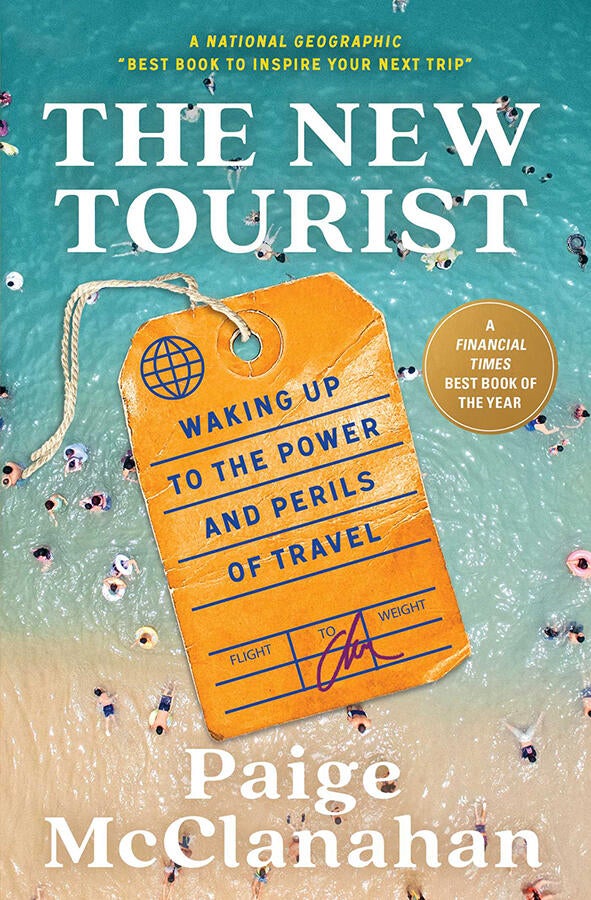 Scribner
"Sunday Morning" had plenty of questions for the City of Amsterdam, but could not get anyone to talk with us. The Mayor, the Deputy Mayor involved in tourism, even the marketing agency working with the city each declined our request to be interviewed.
The irony is that ten years ago, the city had so much success with its marketing campaign, I amsterdam, that it later launched another campaign encouraging rowdy visitors to stay away. Paige McClanahan said, "In too many cases you have to get to sort of a breaking point before the city wakes up and realizes they need to invest like this."
She says solutions need to be catered to each community, but some of the responsibility lies on those of us travelling. "Whether tourism is going to be more of a force for good in the world or more of a destructive force, a challenging force, is really up to us to decide," McClanahan said. "If we all come together and treat tourism with the respect and the scrutiny and the responsibility that it deserves, then we can use our power to turn tourism into a constructive force for humanity."
READ AN EXCERPT: "The New Tourist" by Paige McClanahan
For more info:
- "The New Tourist: Waking Up to the Power and Perils of Travel" by Paige McClanahan (Scribner), in Hardcover, Trade Paperback, eBook and Audio formats, available via Amazon, Barnes & Noble and Bookshop.org
- Paige McClanahan (Official site)
- Tours That Matter, Amsterdam
- We Live Here, Amsterdam
- Jasper van Dijk, economist, Utrecht University School of Economics
- Discover Amsterdam
- Portofino Tourism
Story produced by Jon Carras and Sabina Castelfranco. Editor: Jason Schmidt.
See also:
- How "overtourism" can strain popular tourist destinations ("CBS This Morning")
- Why anti-tourism protests are spreading across Europe
- David Sedaris on tourist attractions (small change required) ("Sunday Morning")
In:









 English (US) ·