
 3 weeks ago
14
3 weeks ago
14
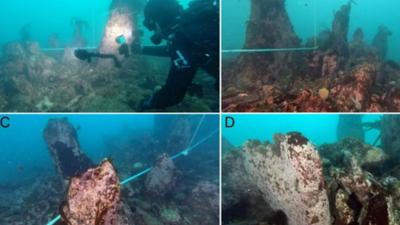
Photo credit: Hal Open Science
Marine archaeologists in France have discovered a massive 7,000-year-old wall under the sea off the western coast of Brittany, shedding new light on early coastal societies. The 120-metre-long granite structure, found near the Ile de Sein, is the largest underwater construction ever discovered in France.
It was accompanied by a dozen smaller manmade structures dating to the same period.The findings were published in the International Journal of Nautical Archaeology, offer new insights into early coastal settlements and their adaptation to rising sea levels."This is a very interesting discovery that opens up new prospects for underwater archaeology, helping us better understand how coastal societies were organised," Yvan Pailler, professor of archaeology at the University of Western Brittany and co-author of the report, told AFP.The wall was first identified in 2017 by retired geologist Yves Fouquet, who spotted it on undersea charts generated using laser technology. Divers explored the site between 2022 and 2024, confirming the presence of the granite structures. "Archaeologists did not expect to find such well-preserved structures in such a harsh setting," Fouquet said.Dating from between 5,800 and 5,300 BC, the wall lies about nine metres underwater.
At the time of its construction, sea levels were much lower, and the site would have been on the shoreline, between high and low tide marks. Archaeologists believe it may have served as a fish trap or a dyke to protect against rising seas.According to BBC, the wall is on average 20 metres wide and two metres high. Large granite monoliths protrude above the wall in two parallel lines, possibly supporting nets made of sticks and branches if it functioned as a fish trap.
With an estimated total mass of 3,300 tonnes, the structure would have required a substantial, well-organised community to construct it.Pailler noted the technical skills displayed by the builders were remarkable: "It was built by a very structured society of hunter-gatherers, of a kind that became sedentary when resources permitted. That or it was made by one of the Neolithic populations that arrived here around 5,000 BC."The BBC reports that the monoliths predate the famous Neolithic menhirs of Brittany, suggesting a transmission of stone-working knowledge from Mesolithic hunter-gatherers to incoming Neolithic agriculturists. Researchers also believe such submerged sites may have inspired Breton legends of sunken cities, including the mythical city of Ys, located a few kilometres east in the Bay of Douarnenez.








 English (US) ·