
 4 hours ago
1
4 hours ago
1
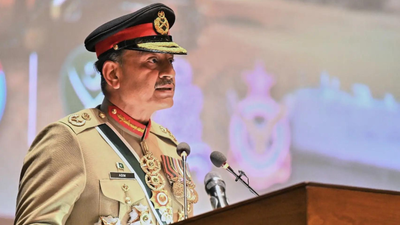
Pakistan army chief Asim Munir (AP file photo)
Pakistan's de facto state head and most powerful army chief in decades is facing the toughest test of his expanding stronghold in Islamabad power centre as the United States presses Islamabad to send troops to a Gaza stabilisation force, a move analysts told Reuters could spark strong domestic backlash.
It could also "annoy the US president" if Munir shows disinterest in contributing to the peace plan.Military chief Munir, who holds enormous influenceover Pakistan's political and economic decisions, is expected to travel to Washington in the coming weeks to meet US President Donald Trump. It would be their third meeting in six months and is likely to focus on Pakistan's possible role in Gaza, according to two sources familiar with the matter, one of whom is closely involved in Munir’s economic outreach to the US.Trump's proposed 20-point plan for Gaza calls for troops from Muslim-majority countries to oversee a transition period focused on reconstruction and economic recovery in the Palestinian territory. Gaza has been devastated by more than two years of Israeli military bombardment.Many countries are cautious about joining such a force because it could involve disarming Hamas, Gaza's Islamist militant group. Analysts say this risks pulling foreign troops deeper into the conflict and could inflame pro-Palestinian and anti-Israeli public opinion at home.
Munir, however, has developed close ties with Trump as part of an effort to repair years of strained relations between Washington and Islamabad. In June, Trump hosted Munir for a private lunch at the White House — the first time a US president met Pakistan’s army chief alone, without any civilian leaders present."Not contributing (to the Gaza stabilisation force) could annoy Trump, which is no small matter for a Pakistani state that appears quite keen to remain in his good graces - in great part to secure U.S.
investment and security aid," said Michael Kugelman, Senior Fellow, South Asia at the Washington-based Atlantic Council.
'Pressure to deliver'
Pakistan is the world's only Muslim-majority country with nuclear weapons and has a powerful, experienced military. It has fought three wars with rival India, a brief conflict earlier this year, and has long battled insurgencies in its remote regions. It is also currently fighting Islamist militants that it says operate from neighbouring Afghanistan.Because of this military capability, expectations are higher for Pakistan to contribute, said defence analyst and author Ayesha Siddiqa.Pakistan’s military strength means "there is a greater pressure on Munir to deliver his capacity," she said.Pakistan’s military, foreign office and information ministry did not respond to Reuters’ questions. The White House also did not reply to a request for comment.Foreign Minister Ishaq Dar said last month that Pakistan could consider contributing troops for peacekeeping, but made clear that disarming Hamas was not Islamabad’s responsibility.
Munir's unprecedented power
Earlier this month, Munir was appointed chief of the defence forces, placing the army, air force and navy under his command. He also received a job extension until 2030.Under constitutional amendments passed by Pakistan’s civilian government last month, Munir will retain his field marshal rank for life and enjoy lifetime immunity from criminal prosecution."Few people in Pakistan enjoy the luxury of being able to take risks more than Munir.
He has unbridled power, now constitutionally protected," Kugelman said.
Risks at home
In recent weeks, Munir has met leaders from Indonesia, Malaysia, Saudi Arabia, Turkey, Jordan, Egypt and Qatar, according to military statements. Siddiqa said these meetings appear aimed at consulting Muslim countries on the proposed Gaza force.At home, however, the biggest risk is political unrest. Any deployment of Pakistani troops to Gaza under a US-backed plan could revive protests by Islamist parties that strongly oppose the US and Israel.These groups have the ability to bring thousands of supporters onto the streets.In October, authorities banned a powerful and violent Islamist party known for pushing Pakistan’s strict blasphemy laws. Officials said its leaders were arrested, more than 1,500 supporters detained, and its assets and bank accounts seized. Despite the ban, analysts say the group’s ideology still has influence.Supporters of jailed former prime minister Imran Khan, whose party won the most seats in the 2024 elections, are also deeply hostile to Munir and could mobilise against him.Abdul Basit, Senior Associate Fellow at Singapore’s S. Rajaratnam School of International Studies, warned that any escalation after deployment could quickly spiral."People will say 'Asim Munir is doing Israel's bidding' - it will be foolhardy of anyone not to see it coming."






 English (US) ·