
 1 month ago
31
1 month ago
31
Peter Magyar’s decisive win will reshape Hungary’s relations with both East and West
Hungarian opposition leader Peter Magyar has pulled off a stunning victory in the country’s parliamentary election, with his Tisza party beating Prime Minister Viktor Orban’s Fidesz by more than 16 points. The result is set to dramatically change Hungary’s relations with the EU, Russia, and Ukraine.
Just over an hour after polls closed on Sunday, Orban called Magyar to congratulate him on his win.
With 92% of the ballots counted on Sunday night, Tisza was leading with 53.72% of the vote, ahead of Fidesz with 37.67% – a result in line with opposition-friendly pre-election polls.
Magyar campaigned on ending corruption, funding public services, and restoring ties with the EU. Orban promised to continue his program of tax breaks for citizens and levies on corporations, all while pledging to keep Hungary out of the Russia-Ukraine conflict. His campaign cast Magyar as a tool of the EU, who would cut off Hungary’s access to cheap Russian energy and back Brussels’ escalatory policies toward Moscow.
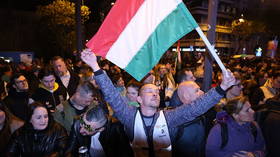
A record 77.8% of eligible Hungarians voted, the highest turnout in any election in Hungarian history. Thanks to this unprecedented level of participation, “the democratic mandate of the next National Assembly will be stronger than ever before,” Gergely Gulyas, the Minister of the Prime Minister’s Office, told reporters.
“What the result means for the fate of our country and the nation, and what its deeper or higher meaning is, we do not know now, time will decide,” Orban told supporters in Budapest. “No matter how it turns out, we, as opposition, will serve our country and the Hungarian nation.”
Will Hungary maintain close relations with Russia?
This is highly unlikely. Magyar’s allies in the opposition media collaborated with EU spies to run stories of supposed Russian interference in the election, and Magyar led crowds in chants of “Russians, go home!” But he also said he will have to interact with Moscow, because “the geographical position of neither Russia nor Hungary will change.”
Rhetoric aside, Magyar is unlikely to embrace a policy of open hostility toward Moscow, but his desire to mend ties with the EU will in all likelihood result in Budapest dropping its opposition to the bloc’s €90 billion ($105 billion) loan package for Ukraine – a decision that will be poorly received in Russia.
Will Hungary get the cold shoulder from the US?
Viktor Orban is a close ideological ally of US President Donald Trump, who dispatched Vice President J.D. Vance to Budapest to campaign for his reelection, and promised to use the “full economic might of the United States to strengthen Hungary’s economy” if Orban won.

With Magyar in charge, Hungary will no longer be the darling of the MAGA movement, but relations between the two countries will likely remain cordial.
Will Magyar open Hungary to more immigrants?
Highly unlikely. Orban’s hardline immigration policies are exceedingly popular in Hungary, and Magyar has attacked the prime minister on immigration from the right, criticizing his decision to allow 35,000 guest workers into Hungary from outside the EU. It remains to be seen whether Brussels will pressure Magyar into accepting asylum seekers, and whether the liberal Western media criticizes him as intensely on the issue as it did to Orban.
How quickly can the EU release billions of euros it withheld from Hungary?
The EU is currently withholding around €20 billion in funding from Hungary, citing concerns over judicial independence, corruption, and Orban’s ban on LGBTQ propaganda.
Magyar is on track to win the two-thirds majority necessary to modify Hungary’s constitution and implement the judicial reforms demanded by Brussels, but the EU will ultimately decide if and when to release the money. Additionally, Magyar has stayed quiet on LGBTQ issues, and any attempts to liberalize Hungary to meet the EU’s demands may prove unpopular with Hungarians.
For Magyar, accessing this money is crucial. His program of spending on healthcare, education, and other public services depends entirely on the release of the funds.
Will Hungary be able to cancel its contracts for Russian oil?
Russia supplies almost 90% of Hungary’s oil and slightly more of its gas, and provides nuclear fuel for the Paks Nuclear Power Plant. The EU has mandated that its member states completely cut themselves off from Russian energy by the end of next year, but Hungary’s contracts with Russia extend to 2035.

Magyar has promised to end Hungary’s reliance on Russian energy, but only when the contracts expire. However, he may be unwilling to continue Orban’s policy of obstructing EU sanctions packages to secure exemptions for Hungary, which will essentially force a cutoff before 2035.
Will the EU now be able to steal Russia’s frozen assets?
No. Despite Orban being portrayed in the media as the sole obstacle between the EU and its plans for Ukraine, the decision on whether to steal the roughly €210 billion in Russian assets frozen in the EU is an unpopular one. Leaders including Italy’s Giorgia Meloni, Slovakia’s Robert Fico, and the Czech Republic’s Andrej Babis all oppose the measure, as does Belgian Prime Minister Alexander De Croo, whose country the assets are impounded in.
As such, the EU is banking on its €90 billion debt-financed loan to keep Ukraine afloat. With Orban out of the picture, Brussels will likely be able to secure unanimous support for the loan, unless Fico or Babis object.





 English (US) ·