
France’s Budget Minister Amélie de Montchalin will become head of the country’s supreme audit body the Cour des Comptes, the French government announced on Wednesday – a decision that has sparked outcry among opposition politicians and accusations that Macron is trying to shore up his political legacy by placing allies in key institutions.
The Cour des Comptes is one of France’s most powerful oversight bodies, tasked with monitoring use of public money, evaluating public policy and auditing state and local authorities. It informs parliament, the government and the public about the regularity of accounts. However, its reports are not binding.
Critics say positioning de Montchalin, a longstanding Macron ally, as its leader undermines the institution’s independence, especially as the 40-year-old politician will have the right to hold the position until she retires at 68.
They have also raised fears that the president is using his allies to lock down multiple national institutions, which are supposed to be independent from party politics, to secure his legacy.
With the President’s term due to end in 2027, far-right leader Marine Le Pen on Wednesday accused Macron of manoeuvring to “place his loyalists in positions of power and disrupt the future democratic transition”.
‘Proximity to power’
Backlash against de Montchalin’s appointment – which comes into effect on February 23 and will make her the Cour des Comptes’ first female leader – is also due to a potential conflict of interests: as outgoing budget minister, she will be positioned to audit her own work in her new role.
The budget has been an ongoing source of political turmoil in France and a long-term thorn in Macron’s side, toppling two prime ministers before current premier Sébastien Lecornu forced it through parliament in January.
Read moreDelayed French 2026 budget finally through, paves way for Macron’s military spending boost
“How can the current minister give a credible opinion on the budget that she herself prepared?” asked Éric Coquerel, president of the National Assembly's finance committee, who has been battling with de Montchalin for months over the 2026 finance bill.
“The controversy is around de Montchalin's proximity to power, and the difficulty that others perceive in her remaining independent in her assessment of that power,” says Andrew W M Smith, historian of modern France at Queen Mary University, London.
“She was elected in 2017 as part of that first wave of Macronist figures – a relatively young deputy, coming into politics from the private sector – and her career is really seen as tied to Emmanuel Macron.”
The head of the Cour des Comptes may not have the power to reject a budget outright but would typically be able to “push back and query things that don’t add up”, he adds.
With this year’s controversial budget made up of a patchwork of concessions aimed at placating different factions of France’s divided parliament, many politicians may have hoped for such pushback to be significant.
Appointing loyalists
There are wider fears that de Montchalin’s appointment is part of a worrying trend of the president trying to wield political influence in national institutions.
De Montchalin’s career-long tenure at the Cour des Comptes is reminiscent of the politicisation of Supreme Court appointees in the US, says Smith, “because it really tips the balance in terms of the constitutional future of the country and the robustness of these institutions”.
In March the president appointed another key ally, former secretary of his Renaissance party Richard Ferrand, to lead the country’s highest constitutional authority, the Conseil Constitutionnel.
Ferrand, who had been forced to resign as minister due to accusations of nepotism, was approved for the role by a razor-thin parliamentary majority.
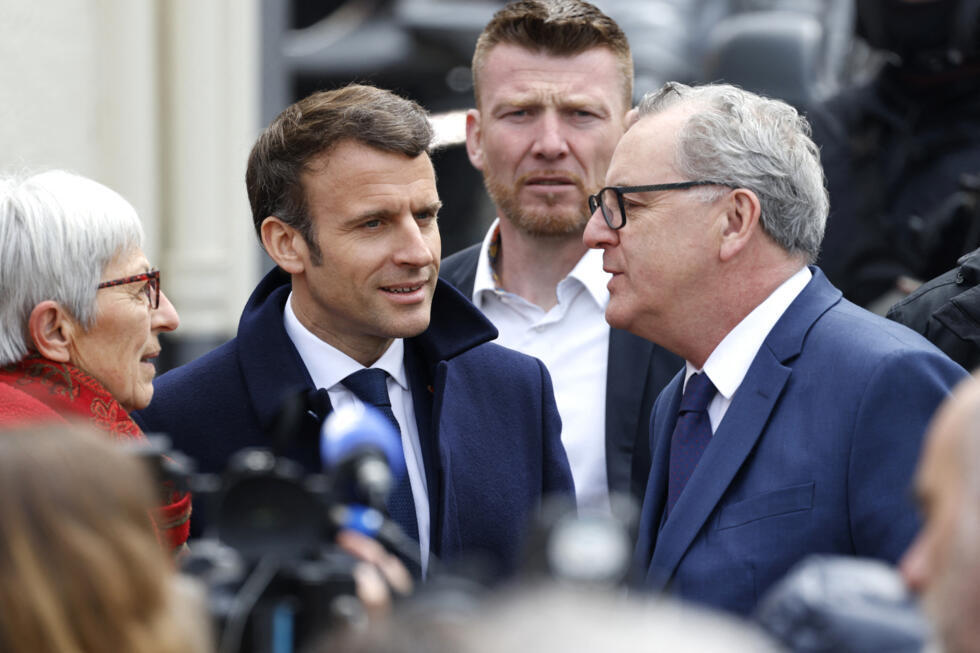 French President Emmanuel Macron speaks with Former-President of the French National Assembly Richard Ferrand as he arrives for a campaign visit in Spezet, western France, on April 5, 2022. © Ludovic Marin, AFP
And, in 2026, Macron will likely have the power to nominate two more key figures at national institutions as the current governor of the Bank of France and the vice-president of France’s supreme administrative court, the Conseil d’État, are both expected to step down.
These roles do not come with career-long tenure but nonetheless give Macron an opportunity to influence France’s political and economic landscape long after his presidential term ends.
Since his resignation, the outgoing governor of the Bank of France, François Villeroy de Galhau, has stressed the need for the nation’s central bank to retain its political independence.
So, will the president appoint yet more political loyalists?
“It would be very unusual for a president to appoint a completely neutral figure,” says Paul Smith, head of the department of Modern Languages at the University of Nottingham, UK.
There is also the fact that – despite being nearly ten years into his presidency – Macron is still something of a political newcomer. The presidency is the first office he has held.
“There are no Macronist veterans. He doesn't have a big reserve into which he can dig,” Paul Smith adds.
Within that reserve, some of Macron’s former heavyweights, including ex-prime ministers Edouard Philippe and Gabriel Attal, are now busy preparing their own presidential bids.
As such, appointing two loyalists to key institutional roles is “not shocking, but maybe quite cynical”, says Andrew W M Smith.
De Montchalin in particular could turn out to be a good choice. She has received praise from parliamentarians – including opposition figures – for the skills, experience and constructive approach she is expected to bring to her role.
“Nobody doubts her capacity as an economist,” says Paul Smith.
But were Macron to add a third or even fourth loyalist to the tally, “that might raise a real question mark around ideas of independence”, Andrew W M Smith says.









 English (US) ·