
It has been 10 days since US President Donald Trump warned Iran against cracking down on street protests, stressing that the United States was ready to "come to the rescue" of Iranian demonstrators.
As he put it, the US was “locked and loaded and ready to go”.
Trump has since repeated that threat and said he was looking at “very strong options” against Tehran – even as the death toll from the regime’s ferocious crackdown soared to more than 2,000, according to rights groups.
In a social media post on Tuesday, the US president urged Iranians to continue protesting and said “help is on its way”. He gave no details about what “help” he was leaning towards and when it might come.
The enigmatic message came a day after he exercised economic leverage by announcing 25 percent tariffs on any country that trades with Iran, and spoke of ways to restore internet access shut by Tehran.
Trump was to meet with senior advisers later on Tuesday to discuss possible course of action, with options reported to include military strikes, using secret cyber weapons, widening sanctions and providing online help to anti-government sources.
"Nobody knows what President Trump is going to do except for President Trump," White House Press Secretary Karoline Leavitt told reporters. "The world can keep waiting and guessing."
One-off strikes
Buoyed by the successful capture of Venezuela’s Nicolas Maduro earlier this month, Trump may be tempted to give America’s foes – and the wider world – another taste of US military might.
The US president has already proven his readiness to strike directly at Iran – first with the killing of Iran’s top military commander Qasem Soleimani in January 2020, and more recently with the strikes on Iranian nuclear sites last June.
To display this content from YouTube, you must enable advertisement tracking and audience measurement.
One of your browser extensions seems to be blocking the video player from loading. To watch this content, you may need to disable it on this site.
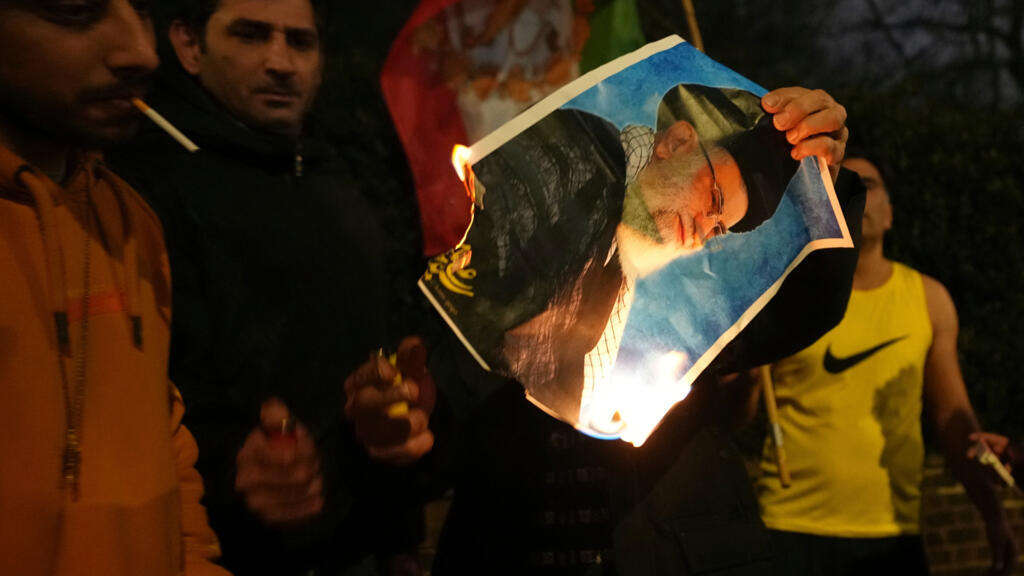 A picture of Ayatollah Ali Khamenei is set alight by protesters outside the Iranian embassy in London on January 12, 2026. © Alastair Grant, AP
05:42
The latter raid, which involved flying bunker-busting bombs from a base in Missouri and dropping them on two of Iran's most important nuclear sites, showed that Washington is perfectly capable of mounting large-scale operations from a distance.
Both attacks also reflected Trump’s preference, as seen again recently in Venezuela, for one-off military operations he quickly claims as successes.
“Trump clearly has the means to strike key targets within the Iranian regime, but he’s likely to want to do so in a manner that is both decisive and does not drag the US into something long-term and indefinite,” said Anthony Samrani, chief editor of Beirut-based publication L’Orient-Le Jour.
The trouble, Samrani added, “is that there’s no guarantee a US attack would knock out the regime or even coerce it into being more compliant.”
'Miscalculation’
Citing unnamed officials in the Trump administration, the New York Times reported on Sunday that the president was “seriously considering” military strikes against Iran but “has not made a final decision”.
The NYT said advisers presented Trump with a range of potential strike targets, including unspecified non-military sites in Tehran and facilities linked to Iranian security services involved in suppressing protests.
Read moreIran's hospitals, morgues fill after deadly crackdown on anti-regime protests
Striking military installations comes with a high risk. Some bases of elite military and security forces may be located in heavily populated areas so any attack ordered by Trump could inflict large civilian casualties.
Iranian authorities have vowed to retaliate against any attack, with parliament speaker Mohammad Bagher Qalibaf warning Washington against "a miscalculation".
“Let us be clear: in the case of an attack on Iran, the occupied territories (Israel) as well as all US bases and ships will be our legitimate target," said Qalibaf, a former commander in Iran's elite Revolutionary Guards.
Despite the damage incurred during last year’s 12-day war with Israel, Iran still has a significant arsenal of ballistic missiles. And while its regional proxies are much diminished, they are still capable of action.
Galvanising protesters – or the regime
Analysts say the scope of any US attack is likely to prove crucial in terms of either emboldening the protest movement or further hardening the regime’s response.
Ray Takeyh, a senior fellow at the Council on Foreign Relations, said Trump could target forces including the Revolutionary Guards that have taken the lead in repressing the protests. Such a move might ease Iranians' fears and “affect the fence-sitters in thinking about joining the protests or not”, he told AFP.
Others argue that the mere threat of US intervention has had the opposite effect, galvanising the regime’s crackdown on what it regards as foreign-backed “terrorists”.
“We've seen on the surface a consolidation of the government as well as no defections at all,” said Iran expert Trita Parsi, deputy head of the Washington-based Quincy Institute.
“The idea that threats would result in the Iranian regime backing off is not at all what we're seeing,” Parsi added. “On the contrary, we're probably seeing the most brutal level of violence used against people since the start of the Islamic Revolution.”
To display this content from YouTube, you must enable advertisement tracking and audience measurement.
One of your browser extensions seems to be blocking the video player from loading. To watch this content, you may need to disable it on this site.
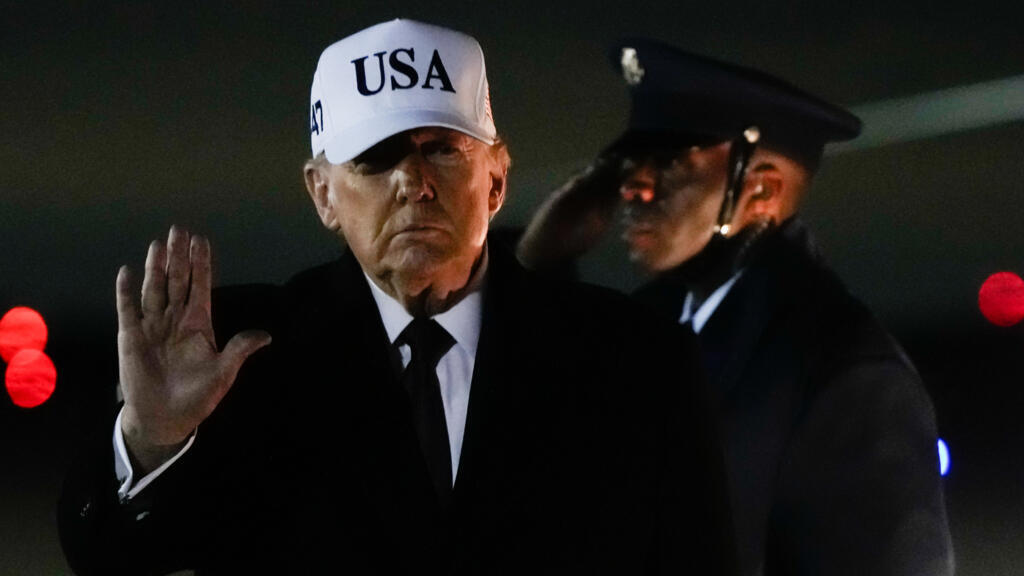 Donald Trump arrive sur la base aérienne Andrews, dans le Maryland le 11 janvier 2026. © Julia Demaree Nikhinson, AP
04:39
Senior lawmakers have also voiced contrasting opinions, with Republican Senator Lindsey Graham urging Trump to “embolden the protesters and scare the hell out of the regime”.
“If I were you, Mr. President, I would kill the leadership that are killing the people,” Graham, who has often touted a muscular approach to foreign policy, told Fox News on Sunday. “You’ve got to end this.”
But at least two Senate colleagues have sounded notes of caution.
“I don’t know that bombing Iran will have the effect that is intended,” Republican Senator Rand Paul told ABC News, warning that a military attack on Iran could rally the people against an outside enemy.
History shows the dangers of US intervention, added Democratic Senator Mark Warner, who argued that the US-backed 1953 overthrow of Iran's government set in motion a chain of events that gradually led to the rise of the country's Islamic regime.
'Little appetite for regime change’
Reza Pahlavi, whose father the late shah of Iran was overthrown during the 1979 Islamic Revolution, has been one of the most prominent voices calling for a US intervention in the country.
In a message designed to flatter and galvanise Trump, the exiled Pahlavi publicly encouraged the US president to choose a different course from his predecessor Barack Obama, who hesitated at supporting Iran’s massive protest movement in 2009 for fear of co-opting a homegrown movement.
To display this content from YouTube, you must enable advertisement tracking and audience measurement.
One of your browser extensions seems to be blocking the video player from loading. To watch this content, you may need to disable it on this site.
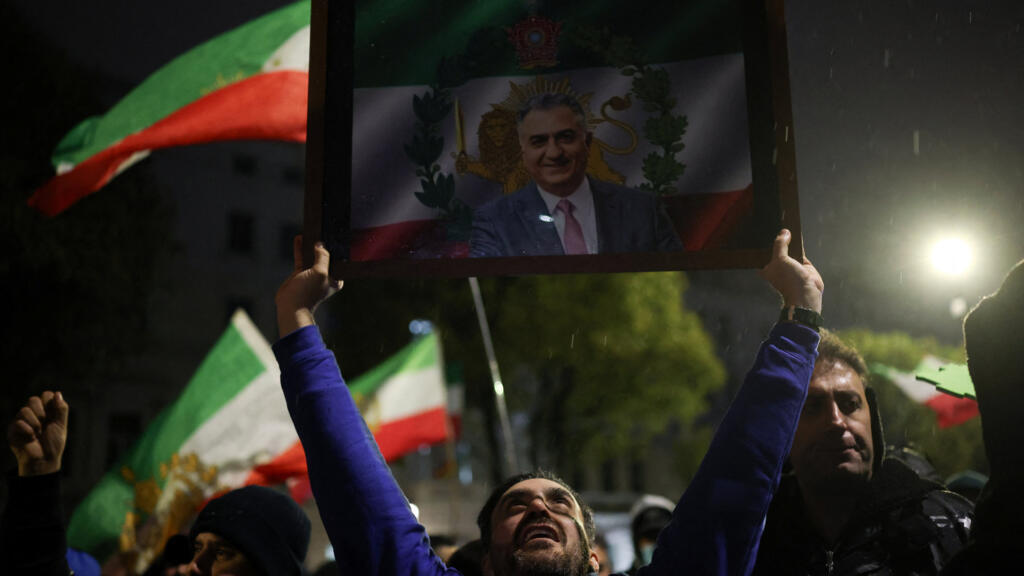 Un homme brandit une image de Reza Pahlavi, fils exilé du dernier chah d'Iran, lors d'un rassemblement de soutien aux manifestations nationales devant l'ambassade d'Iran, à Londres, dimanche 11 janvier 2026. © Isabel Infantes, Reuters
01:05
Pahlavi's name has surfaced in protesters’ slogans urging a restoration of the monarchy. On Sunday he said he was prepared to return to Iran to lead a shift to a democratic government.
Read moreUnderstanding Iran’s protest chants: What are demonstrators’ demands?
But Washington has given no indication so far that it plans to back the son of the shah, or indeed push for regime change.
“Unlike what happened in Afghanistan and Iraq in the early 2000s, there is little appetite within the Trump administration for regime change,” said Clément Therme, a historian and Iran expert at the Université Paul-Valéry in Montpellier.
“Instead, the administration’s preference goes to one-off operations aimed at destabilising opponents,” said Therme, noting that the Venezuelan opposition is no closer to power today than it was before Maduro’s capture.
He added: “I very much doubt that Trump will want to invest American military capital in the restoration of the Pahlavi dynasty.”







 English (US) ·