
A volunteer member of Iran's paramilitary Revolutionary Guard was killed in a western province during widening demonstrations sparked by the Islamic Republic's ailing economy, authorities said Thursday, marking the first fatality among security forces during the protests.
Spontaneous protests, driven by dissatisfaction at Iran's economic stagnation, began on Sunday in Tehran's largest mobile phone market, where shopkeepers shuttered their businesses, and have since drawn in students across the country.
The death Wednesday night of the 21-year-old volunteer in the Guard's Basij force may mark the start of a heavier-handed response by Iran's theocracy over the demonstrations, which have slowed in the capital, Tehran, but expanded to other provinces.
The state-run IRNA news agency reported on the Guard member’s death but did not elaborate. An Iranian news agency called the Student News Network, believed to be close to the Basij, directly blamed demonstrators for the Guard member's death, citing comments from Saeed Pourali, a deputy governor in Iran's Lorestan province.
The Guard member “was martyred ... at the hands of rioters during protests in this city in defence of public order”, he reportedly said. Another 13 Basij members and police officers suffered injuries, he added.
“The protests that have occurred are due to economic pressures, inflation and currency fluctuations, and are an expression of livelihood concerns," Pourali said. "The voices of citizens must be heard carefully and tactfully, but people must not allow their demands to be strained by profit-seeking individuals.”
The protests took place in the city of Kouhdasht, more than 400 kilometres southwest of Tehran.
Iran's government offers dialogue as protests spread to students
To display this content from YouTube, you must enable advertisement tracking and audience measurement.
One of your browser extensions seems to be blocking the video player from loading. To watch this content, you may need to disable it on this site.
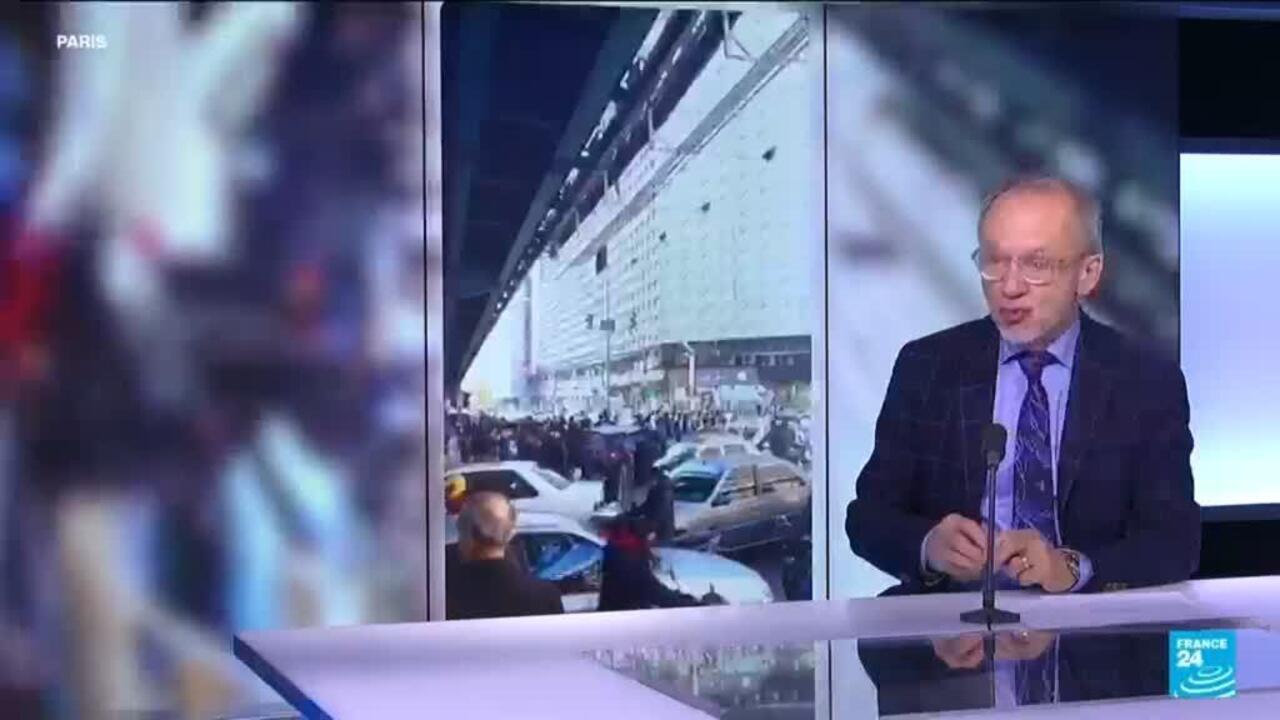 © France 24
03:39
A government building in southern Iran was also attacked on Wednesday, authorities said.
"A portion of the provincial governors' office door and its glass were destroyed in an attack by a number of people," said Hamed Ostovar, the head of the judiciary in the city of Fasa, as quoted by the justice ministry's Mizan agency, without specifying how the attack was carried out.
Iran's civilian government under reformist President Masoud Pezeshkian has been trying to signal it wants to negotiate with protesters. However, Pezeshkian has acknowledged there is not much he can do as Iran's rial currency has rapidly depreciated, with $1 now costing some 1.4 million rials.
Meanwhile, state television separately reported on the arrests of seven people, including five it described as monarchists and two others it said had linked to European-based groups. State TV also said another operation saw security forces confiscate 100 smuggled pistols, without elaborating.
The protests have yet to reach the scale of the 2022 nationwide protests triggered by the death of 22-year-old Mahsa Amini in police custody.
Iran's theocracy had declared Wednesday a public holiday across much of the country, citing cold weather, likely as a bid to get people out of the capital for a long weekend. The Iranian weekend is Thursday and Friday, while Saturday marks Imam Ali's birthday, another holiday for many.
Iran's economy has been in the doldrums for years, with heavy US and international sanctions over Tehran's nuclear programme weighing heavily on it.
The currency, the rial, has also plunged in recent months, losing more than a third of its value against the US dollar since last year.
In December, inflation stood at 52 percent year-on-year, according to official statistics.
Some basic necessities are becoming unaffordable for a portion of the population, which has been suffering from severe international sanctions against Iran for decades.
(FRANCE 24 with AP)







 English (US) ·