
A video shared on social media on October 13 shows eight men kneeling, their clothes torn and eyes blindfolded. Hamas members, AK-47s in hand, suddenly opened fire, cutting them down in a burst of automatic gunfire amid shouts of “Allahu akbar” and “traitors” from the surrounding crowd.
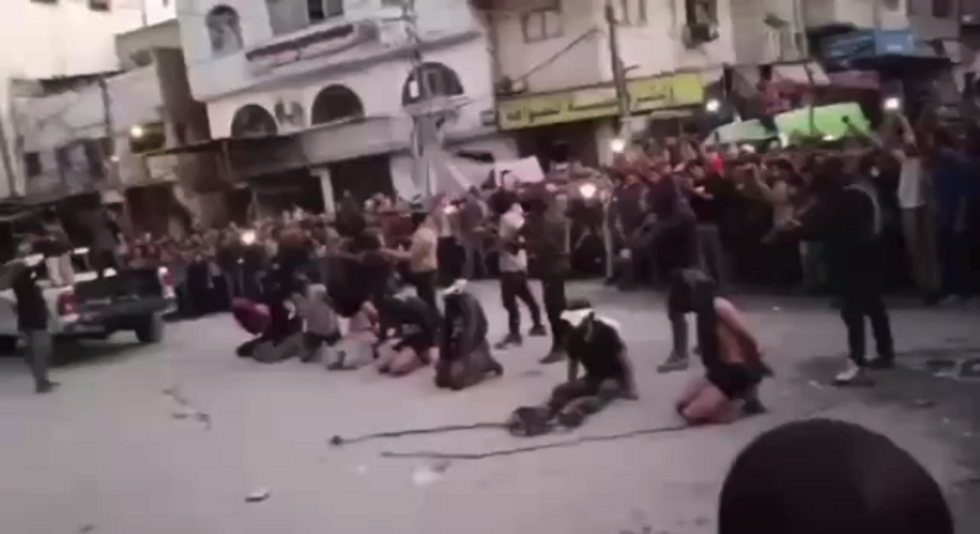
This was one of the latest violent scenes in the continuing conflict between Hamas and its rival groups. The public execution was staged on Omar al-Mukhtar Street in the Sabra neighbourhood of Gaza City, a deliberate show of force in a district where Hamas’s grip remains contested by other armed clans, particularly the Doghmush family. The identities of all the victims are not known; according to local sources, some were members of the Doghmush clan, and at least one was a high-ranking member of the Israeli-affiliated group known as the “Popular Forces”.
The execution followed three days of intense exchanges of fire between Hamas fighters and Doghmush clan gunmen in the Sabra neighbourhood, the Doghmush stronghold, which, according to varying reports, left between 19 and 52 Doghmush members and 8 to 12 Hamas members dead. Among those killed was Saleh al-Jafarawi, a well-known media figure, who was targeted during the fighting.
To display this content from Telegram, you must enable advertisement tracking and audience measurement.
It was not the first public execution carried out by Hamas in recent weeks. On September 22, before the ceasefire, the group executed three men outside Shifa hospital. The men were accused of collaborating with Israel — a charge Hamas routinely levels against its rivals and opponents.
Despite official denials and repeated post-ceasefire assurances that “Hamas would not allow a security vacuum in Gaza”, the group has in fact lost control of parts of the territory over the past two years. A senior officer in Hamas’s security forces told the BBC in July 2025 that Hamas had lost much of its hold on the Gaza Strip and that armed clans were filling the void.
Public executions as a show of power
According to experts, these public executions are Hamas’s way of signalling that business continues as usual under its rule. Hamza Howidy, a Palestinian affairs expert and human rights activist, explained:
With these executions, Hamas wants to say we still matter and we still have the power. Just before these executions, Hamas was attacked by the Doghmush or al-Majida families, who killed many of its members. So it’s Hamas’s way of saying: we are still powerful. They want to intimidate people and families so they don’t revolt against them.
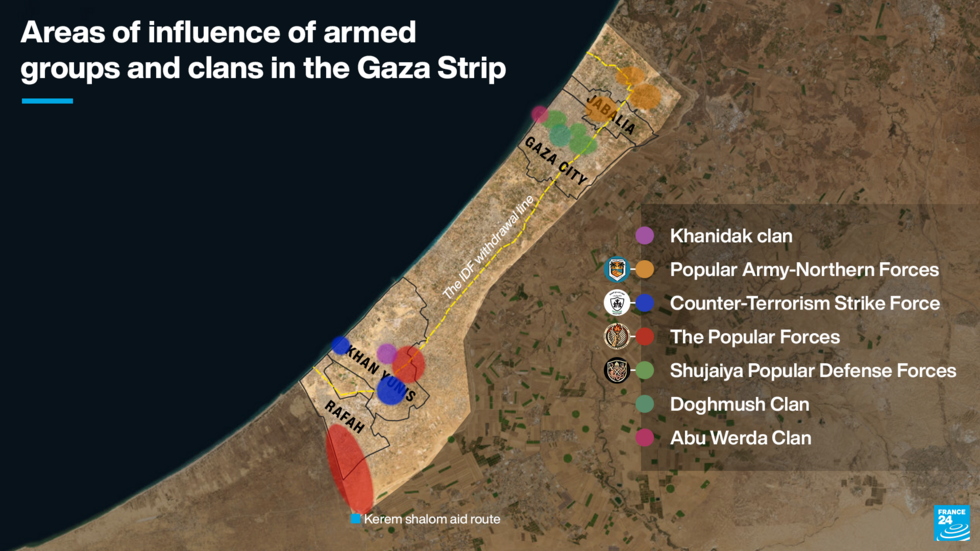
At least seven factions and clans now challenge Hamas’s authority, each controlling a small part of the Gaza Strip and trying to advance or push the movement back. While Hamas labels all of these groups “traitors” working with Israel, many have no such links, according to analysts. Khalil Sayegh, a Gaza-born expert on Palestinian affairs, explained:
We have groups who cooperate with Israel and groups who have no relation with Israel. For example, the Hellis clan or the Doghmush clan have no connection to the Israelis, and not necessarily even to criminal activities. These clans are simply prominent, patriotic Gazan families.
Doghmush Clan: A historic enemy
One of the largest and most powerful clans in the Gaza Strip, the Doghmush family has long been well armed and influential. Its de facto leader, Nizar Doghmush, heads the clan in Gaza City. The group has been in conflict with Hamas since the movement’s creation in the 1980s. Hamas has repeatedly tried and failed to disarm the clan, leading to several armed clashes between the two sides over the years. The Doghmush stronghold is in the heart of Gaza City, in the Sabra neighbourhood.
To display this content from Telegram, you must enable advertisement tracking and audience measurement.
In the first days of the Israeli assault on Gaza in 2023, Hamas executed Mukhtar Doghmush, leader of the clan’s northern branch.
The post-ceasefire clashes between Hamas and the Doghmush family erupted when Hamas deployed around 300 fighters into buildings in Sabra, where clan members were already positioned. Hamas claimed that Doghmush fighters affiliated with Israel had earlier killed two of its members.
The Doghmush clan has a long history of involvement with jihadist groups and armed activity. Mumtaz Doghmush, the clan’s historical leader, founded the Army of Islam in 2005 and declared allegiance with ISIS in 2015. Two years earlier, the clan had cooperated with Hamas in the abduction of Israeli soldier Gilad Shalit.
In early October, Nizar Doghmush, the clan’s current head told the Los Angeles Times that Israeli officials had approached him with a proposal: “The Israelis wanted us to take charge of a humanitarian zone in Gaza City, that we should recruit as many of our family members as we could, and they would provide logistical support, like arms, food and shelter,” a request he said he refused.
Hamas spokespersons described the Dogmush clan as an "outlaw gang" and also accused them of “high treason” after the recent armed conflicts with the Dogmush clan.
Khalil Sayegh said :
Hamas has committed a massacre against the Doghmush family. They used mortars and rockets to hit the families and killed women and children. Since the ceasefire, Hamas’s attacks have focused not on the militias linked to Israel, they didn’t attack those collaborating with Israel as much as they attacked the Doghmush or others who haven’t, because Hamas seems to see a greater threat from them. Despite that, they haven’t challenged Hamas’s rule. But Hamas wanted to show everyone its strength and spread terror, to tell everyone that you will submit. Even those who haven’t worked with Israel and still have weapons, Hamas won’t tolerate them holding any power.
"Israeli handmade groups"
Howidy described the so-called Israeli-created militia groups:
All the leaders of these militia groups have criminal backgrounds, Abu Shabab (Leader of the Popular Forces militia group), for example, is an illiterate former drug dealer; Ashraf al-Mansi (Leader of the People's Army Northern Forces militia group) is another. Many members of these groups are in the same situation. Some were part of ISIS, others were once members of Hamas with connections to Iran, and many were ordinary criminals. Some were even in prison when the war began, but were released after Israeli bombardments destroyed the jails.
For this Gaza-born expert, there is no doubt that at least five of these newly emerged militia groups are, in one way or another, supported, if not created by Israel.
They are Israeli handmade groups. Where do their guns come from? That’s the first question. The second question is: who’s paying their monthly salaries? When everyone in Gaza was facing hunger and starvation during the war, the only areas with food were those controlled by them. Where was that food coming from? The answer to these questions is Israel.
Independent analysts are not the only ones highlighting the criminal and terrorist background of these anti-Hamas groups and their links to Israel. Several Israeli media outlets have reported on this policy set by Israeli Prime Minister Benjamin Netanyahu.
Netanyahu has, on several occasions, acknowledged the policy of “activating” certain groups in Gaza and defended it, saying: “What’s bad about it? It’s only good, and it only saves the lives of Israel Defense Forces (IDF) soldiers.”
Israeli hostage negotiator Gershon Baskin told the CBS news channel that Israel “has empowered, with weapons and money, gangs of Palestinians who were involved in mostly illegal activities in the past, selling drugs, illegal smuggling”. Baskin added that they were empowered as an alternative to Hamas, though he called the strategy “not sustainable”.
Avigdor Liberman, opposition MP and former Israeli foreign minister, publicly accused Netanyahu in October 2025 of supplying weapons to armed militias with criminal backgrounds and ties to ISIS, an accusation the prime minister’s office did not deny.
“Israel is taking various steps to defeat Hamas, based on the recommendations of all security agency heads,” the office said in response.
But who are these clans and militias “activated” by the Israeli government?
"Popular Forces": The arch-foe of Hamas
Also known as the Anti-Terror Service, this group is led by 32-year-old Yasser Abu Shabab, widely regarded as the most prominent anti-Hamas militia leader. Before the October 7 2023 war, Abu Shabab was imprisoned by Hamas on drug-trafficking charges. According to various analyses, he now commands around 400 armed men.
In a video posted on social media in June 2024, Abu Shabab claimed he had formed the militia to protect civilians from “the de facto Hamas government’s terror”.
The group controls eastern Rafah, parts of eastern Khan Younis and the strategically vital aid route into Gaza, the Karem Shalom crossing.
Despite Abu Shabab’s official denials of “direct” cooperation with Israel, the group is widely believed to operate with Israeli backing.
Read moreIsrael admits support for anti-Hamas armed group accused of looting Gaza aid
Cooperation between members of this group and the IDF has been documented in several videos. The militia’s stronghold lies within the zone controlled by the Israeli army in eastern Rafah. The IDF has also confirmed these operations.
In June 2025, The Times of Israel cited defence sources who said Israel had supplied members of Abu Shabab’s faction with Kalashnikov assault rifles.
Hamas accuses Abu Shabab not only of being an “Israeli agent" but also of looting aid convoys entering the Gaza Strip, an allegation that the local UN office has also confirmed.
Hamas killed Abu Shabab’s brother last year and has made at least two assassination attempts on Abu Shabab himself over the past two years. On one occasion, he was reportedly saved by the direct intervention of the IDF, according to a report by the Israeli channel i24NEWS in June 2025.
"We work with the Israelis"
This group, founded in 2024, is led by 50-year-old Hussam al-Astal. The Strike Force Against Terror controls the village of Kizan an-Najjar in the Khan Yunis region.
Al-Astal is a former officer in the Palestinian Authority’s security forces. He was accused by both Hamas and the PA of collaborating with Israel in the 1990s.
He was later imprisoned multiple times by Hamas and sentenced to death for alleged involvement in the 2018 assassination in Malaysia of Hamas operative Fadi al-Batsh, a killing widely attributed to Israel.

“We maintain close ties with several Western countries, with the United States and even with Israel. We want them to support residents who refuse Hamas rule, to disarm them and stop the fear the organisation creates,” he said to Ynet on October 12 2025.
Members of his militia have also spoken publicly about the logistics, water and electricity supplied by Israel to their base.“There is coordination between us and Israel, and sometimes the Israeli army is here, moving around,” al-Astal told The Times of Israel in September 2025.
During a clash in September between al-Astal’s fighters and Hamas gunmen, two Hamas members were killed. In retaliation, Hamas launched a major assault on the militia’s strongholds on October 3 in Khan Yunis. According to The Times of Israel, the IDF intervened for the first time in support of a Palestinian group against Hamas during that confrontation. The Israeli army said 20 Hamas fighters were killed in a drone strike, while local sources reported the deaths of five of al-Astal’s men.
To display this content from X (Twitter), you must enable advertisement tracking and audience measurement.
"People's Army Northern Forces": A new enemy in the north
This militia group emerged only recently, with the first signs of its formation appearing in videos shared on social media in September 2025, just weeks before the ceasefire. Led by Ashraf al-Mansi, the group operates in the northern Gaza Strip and claims control of Jabaliya and Beit Hanoun.
To display this content from Instagram, you must enable advertisement tracking and audience measurement.
Before the ceasefire, the group was active on social media, calling Hamas a terrorist organisation and issuing threats against it. Since then, however, its online activity appears to have paused. According to local sources, al-Mansi follows the same operational model as Abu Shabab’s militia, though his group is far smaller, consisting of around 20 fighters.
Cooperation between Israel and the group, as well as logistical support from the IDF, has been documented in several videos.
Hellis Clan, Khanidak clan, Jundeya clan and Abu Werda clan
These four clans also publicly defy Hamas. Some members of the Hellis – or Khalas – clan and the Jundeya clan, led by Rami Hellis and Ahmad Jundeya, have formed a joint militia called the Shujaiya Popular Defense Forces. The group operates in areas of Shujaiya, in Gaza City, that remain under IDF control.
According to the Israeli outlet Ynet, these groups receive logistical support from Israel and are paid salaries via the Palestinian Authority. However, clan leaders have distanced themselves from the militias, describing them as a “rogue faction.”
The Khanidak clan, also reportedly supported by the IDF and led by Yasser Khanidak, is active in Khan Yunis, a Hamas stronghold, according to Ynet sources.
The Abu Werda clan is based near Gaza’s port, though its leadership remains unclear. Clashes between this clan and Hamas on 10 October left three Hamas fighters and two members of the Abu Werda clan dead.
To display this content from Telegram, you must enable advertisement tracking and audience measurement.
Gaza toward a still more unknown future
Despite Hamas’s displays of power, deploying fighters across Gaza and carrying out public executions, several leaders of clans and militia groups backed by Israel claim the movement is on the brink of collapse. Hossam al-Astal, leader of the Counter-Terrorism Strike Force, told the Israeli outlet Ynet: “In practice, (Hamas) no longer has significant strength,” adding that it was “only a matter of time until we topple Hamas fighters for good”.
However, Palestinian affairs expert Hamza Howidy questioned the actual strength of these Israeli-backed militias compared with Hamas:
If one day Israel stops financing them or providing logistical support, it wouldn’t take long for these groups to disappear. They can only annoy Hamas, kill some of its members, but they’re not capable of posing a real threat. Several clans already have a sort of understanding with Hamas. The Majida clan, for example, has already surrendered its weapons because it realised Hamas is far more powerful. The pro-Israel militias can’t help them, they’re beyond the yellow line, meaning they can’t enter Gaza right now.
Khalil Sayegh shared a similar view:
In general, the clans are not interested in ruling the country. They’re thinking: how do I rule my own clan and the neighbourhood where my clan lives? But their historic relationship with the Palestinian Authority is what makes Hamas nervous. If the Palestinian Authority ever returns to Gaza, it’s the clans, especially prominent ones like the Helis and Doghmush families, who would help it re-establish control.
Despite the current balance of power in the Gaza Strip, many analysts believe the risk of internal conflict and widespread violence remains high.
To display this content from Telegram, you must enable advertisement tracking and audience measurement.
Hamza Howidy, a Palestinian affairs expert and human rights activist, explained:
Each of these groups can perpetrate a small scale of violence, and as long as no group holds dominant power, there will be a civil war. That’s why we are calling on the international community, the Palestinian Authority, or anyone who can, to stop this civil war before it starts.
Read moreAs Israeli forces withdraw after ceasefire, Hamas tightens its grip on the streets of Gaza
Khalil Sayegh, another expert on Palestinian affairs, warned of a different danger:
The main threat in the future is that Hamas will take over, they will commit massacres against different clans and people, claiming they are Israeli collaborators. It’s not a civil war; it’s authoritarian repression. The most important power Hamas holds now is terror. The second is its monopoly over the narrative. Take these public executions as an example.
By describing everyone else as gangs or collaborators, which is not true, Hamas controls the narrative. That’s the power it possesses: the ability to shape the story, and in doing so, to prevent any alternative from emerging in Gaza.”






 English (US) ·