
 1 month ago
35
1 month ago
35
1 hour ago
Anthony Zurcher,North America correspondentand Laura Bicker,China correspondent

 BBC
BBC
Security around Beijing's historic Tiananmen Square has been heightened for days, with rumours on social media swirling of a special parade or some big, choreographed event.
Preparations for this major event have started with a whisper, but China appears ready to put on a show for US President Donald Trump.
The visit will include talks, a banquet, and a visit to the Temple of Heaven, a complex of imperial temples where emperors would pray for a good harvest.
And both Trump and Chinese President Xi Jinping will be hoping the visit will bear fruit. This summit between the world's two most powerful leaders is set to be one of the most consequential encounters for years.
 Getty Images
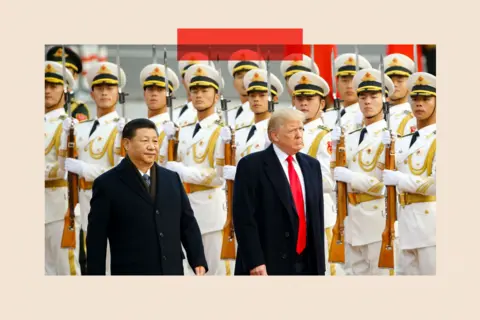
This is the first visit by a US president since Trump's last one in 2017
For months, US-China relations have been a lower priority for Trump. His focus has been on the ongoing war with Iran, military operations in the Western Hemisphere and domestic concerns. But that all changes this week. The future of global trade, rising tensions in Taiwan, and competition in advanced technologies are all at stake.
Economically, the ongoing trade war with the US and the conflict in Iran may be bad news for Xi, but ideologically and politically they're a gift and he will feel he has a strong hand.
This visit could set the groundwork for future cooperation – or conflict – in the years ahead.
China is trying to quietly step in as a peacemaker with the war now in its third month. Beijing has joined Pakistan as a mediator in the US-Israel war against Iran.
Officials in Beijing and Islamabad in March presented a five-point plan with the aim of bringing about a ceasefire and re-opening the Strait of Hormuz. And behind the scenes, Chinese officials have been gently nudging their Iranian counterparts towards the negotiation table.
There's no doubt, despite its steady show of strength, that China is eager for an end to this war.
The country's economy is already battling slower growth and higher unemployment. Increasing oil prices have driven up the cost of items made with petrochemicals, everything from textiles to plastics. For some producers in China, costs have gone up 20%.
 Reuters
A billboard in Tehran shows the Strait of Hormuz as a gag stitched across Trump's mouth
China has enviable oil reserves and the lead it has taken in renewables and electric cars has insulated it from the worst effects of the fuel crisis, but the war is causing more pain to a sluggish Chinese economy that is heavily reliant on exports. However, if China is to step in and help the US, it will still want something in return.
The visit of Iranian Foreign Minister Abbas Araghchi to Beijing last week seemed designed to show the kind of hold and influence China has in the Middle East.
The US was watching closely. "I hope the Chinese tell him what he needs to be told," said US Secretary of State Marco Rubio. "And that is that what you are doing in the Strait is causing you to be globally isolated. You're the bad guy in this."
 VCG via Getty Images
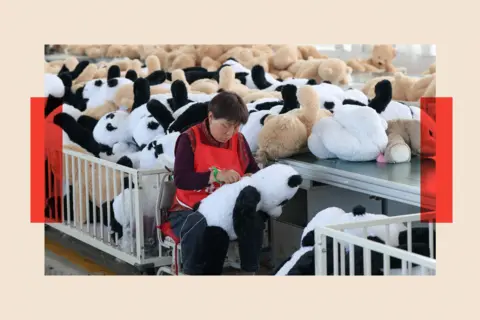
Oil prices affect Chinese exports and textile production significantly
The US has also attempted to convince China not to block a new UN Security Council resolution condemning Iran's attacks on ships attempting to transit Hormuz after it, and Russia vetoed an earlier proposal.
"I think if we're going to bring Iran back to the negotiating table in an enduring way, I think that the United States recognises that China is going to play some role," says Ali Wyne, Senior Research and Advocacy Advisor for US-China relations at International Crisis Group.
Trump, for his part, has appeared unbothered by China's close relationship with Tehran. While the US recently sanctioned a China-based refinery for transporting Iranian oil, the president last week downplayed any Chinese support for Iran during the conflict.
"It is what it is, right?" he told a US journalist. "We do things, too, against them."
The Trump administration has been sending mixed signals when it comes to Taiwan.
Last December, the US announced an $11bn (£8bn) arms deal with Taiwan, infuriating the Chinese government in the process. Trump, however, has downplayed the US willingness to defend Taiwan, which China claims as its own territory.
"He considers it to be a part of China," Trump said of Xi, "and that's up to him, what he's going to be doing."
He has also said Taiwan does not adequately reimburse the US for its security guarantees, adding that it "doesn't give us anything". Last year, he imposed a 15% tariff on Taiwan and accused it of stealing semiconductor manufacturing from the US.
Last week, Rubio said that Taiwan will be a topic of conversation during the visit, although the goal will be ensuring that the issue does not become a source of new tension between the two superpowers.
"We don't need any destabilising events to occur with regards to Taiwan or anywhere in the Indo-Pacific," he said. "And I think that's to the mutual benefit of both the United States and the Chinese."
 Anadolu via Getty Images
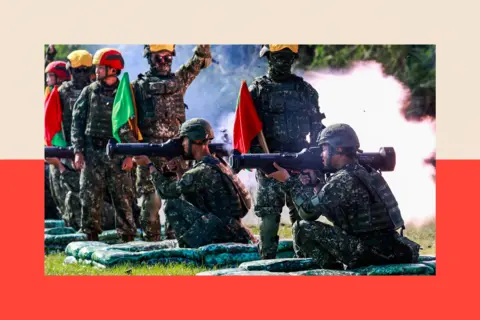
Taiwan relies on the US for military support
For its part, China has signalled that Taiwan is a priority in these talks. The Foreign Minister Wang Yi said last week that he hoped the US would make the "right choices" during a call with Rubio.
Beijing has been ramping up its military pressure by sending warplanes and naval vessels around Taiwan almost daily.
Some analysts believe Chinese officials may be pushing for a change of language of the wording on Taiwan that was carefully drafted back in 1982. Washington's most recently declared policy is that it currently does not support Taiwan independence. Could Beijing push for stronger wording such as "the US opposes Taiwan independence"?
"I just don't think that President Xi is going to go for that," says John Delury, a senior fellow from the Centre on US-China Relations at the Asia Society. "Even if Trump says something kind of left field that looks like some capitulation on Taiwan, because he's not so careful with his use of language, the Chinese know better than to put much stock in that, because he can reverse it with a Truth Social post a week later."
For much of 2025, the US and China appeared to be on the verge of a new trade war, one that could shake the foundations of the global economy.
Trump repeatedly raised and lowered tariffs on America's largest trading partner, at times reaching rates of over 100%.
China responded by curtailing exports of rare earth minerals to the US and its purchase of American agricultural exports, hitting farmers in key states that voted for Trump.
The temperature has cooled considerably since Trump and Xi met face-to-face in South Korea last October. The February Supreme Court decision curtailing the president's unilateral tariff power also helped to tamp down Trump's more mercurial trade instincts.
Trump and Xi will still have plenty to talk about during their Beijing summit, however. The American leader will push to increase Chinese purchase of US agricultural products. China is sure to pressure the US to drop a recently announced trade probe into unfair business practices that could give Trump the ability to reimpose higher tariffs on Chinese goods.
This will be tricky for the American side. "It could be tough for the US to give up investigations of all unfair Chinese trade practices given how widespread and distorting the latter still are," says Michael O'Hanlan, Phil Knight Chair in Defense and Strategy at the Brookings Institute, a Washington DC-based think tank.
The Trump administration is also inviting CEOs from Nvidia, Apple, Exxon, Boeing and other big companies to accompany him on this visit, according to Reuters.
While China is no longer as reliant on the US for trade as it was during Trump's first term as president, Xi will want this meeting to go well as China needs stability in the global economy.
It is now the lead trade partner for more than 120 countries, but Xi will know he cannot appear too confident during Trump's visit.
"So long as the visit proceeds smoothly and Trump concludes he was treated respectfully, then the uneasy calm in the bilateral relationship will endure. If, on the other hand, Trump leaves feeling disrespected or trifled with, then he could have a change of heart," says Ryan Hass, Director of the John L Thornton China Centre at the Brookings Institute.
China is in a race to own the future. It is investing heavily in AI and humanoid robots. These are part of what Xi describes as "new productive forces" which he hopes will propel China's economy forward.
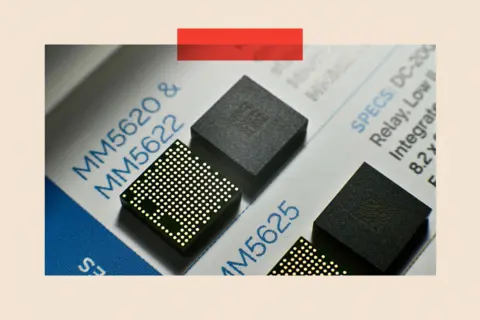
Many US policymakers, however, believe official Chinese policy is to co-opt or outright steal US technology to advance their domestic industries. It has led to restrictions on the export of the latest microprocessors, for instance, despite objections from American manufacturers.
 Reuters
Chip diplomacy will be a critical part of the talks
The successful resolution to the thorny issue of Chinese ownership and operation of the popular social media app TikTok was a rare happy ending for US-China interactions on technology that frequently are beset by accusations and suspicion.
This dynamic is playing itself out in the race to develop AI systems, perhaps the key new technological development of modern times. The issue is complicated by US accusations that Chinese companies like DeepSeek are stealing American AI.
"An opening chapter of an AI cold war is emerging," says Yingyi Ma, from the John L Thornton China Centre at the Brookings Institute. "The White House has accused China of 'industrial scale' theft of American AI models, while Beijing reportedly moved to prevent Meta from acquiring Manus, a Chinese-founded AI start-up now based in Singapore. The deeper contest is not over who copies whose model, but over the talent capable of building the next generation of frontier AI."
China's robots are capable of putting on a show, doing Kung Fu dance moves and racing faster than humans during a marathon in Beijing.
 VCG via Getty Images
Martial arts robots have been used to great effect to showcase Chinese tech
But while Chinese companies appear to be adept at building the bodies of these robots, many are still working on programming the brains of their new creations. To build the best, Chinese companies need high end computer chips, and those come from the US.
This is where Beijing could use its leverage over rare earths, a critical sector that Trump demonstrably covets. It processes around 90% of the world's rare earth minerals which are essential for all modern technology from smartphones to wind farms, to jet engines.
So, there may be a deal to be done. The US can have Chinese rare earths in return for high-end chips. This is China's very own Strait of Hormuz - it can stop the supply at any time.
 AFP via Getty Images
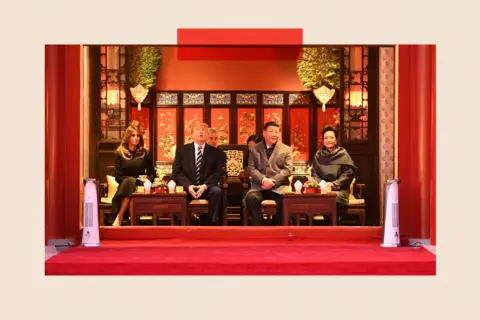
Trump and Xi have a lot of talking points during a short trip
For all the policy ground the two sides have to cover, Trump's visit will be a whirlwind tour, with meetings and events set for Thursday and Friday.
There may not be much time for the two leaders to reach substantive agreements, but even such a brief encounter could set the trajectory for negotiations, and relations, between the two superpowers for years to come.

BBC InDepth is the home on the website and app for the best analysis, with fresh perspectives that challenge assumptions and deep reporting on the biggest issues of the day. Emma Barnett and John Simpson bring their pick of the most thought-provoking deep reads and analysis, every Saturday. Sign up for the newsletter here





 English (US) ·