
 3 weeks ago
25
3 weeks ago
25
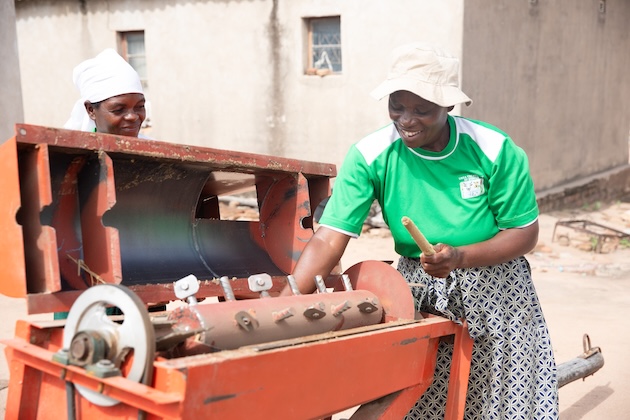 Women farmers using a thresher; they are beneficiaries of a UNDP project to bring agritech to smallholder farmers. Credit: Ignatius Banda/IPS
BULAWAYO, Zimbabwe , June 19 (IPS) - Long burdened by the labour-intensive nature of agriculture, Zimbabwe’s female farmers are finding relief in new agritechnologies that significantly reduce the time they spend in the field.
With assistance from the United Nations Development Programme (UNDP), female farmers are adopting technologies such as earth augers, multi-crop threshers and grinder-choppers to help them navigate climate resilience and boost production at a time when African countries are facing funding cuts in the agriculture sector, further threatening food security.
As global food prices soar because of the ongoing geopolitical tensions that have disrupted global trade and commerce, female farmers find themselves bearing the high costs of food, but new technologies such as those being introduced for Zimbabwe’s farmers are expected to ease these challenges.
Women in Zimbabwe make up the bulk of small-scale farmers, providing a backbone for the country’s food security efforts, but they have been shut out of agricultural finance, limiting their access to farming inputs and equipment.
According to the Food and Agriculture Organization, “approximately 80% of women live in communal areas, where they constitute 61% of farmers and provide 70% of the labour.”
Despite Zimbabwe’s farm mechanisation drive, there are concerns that the collateral demanded by banks has made it impossible for women to fully participate in the country’s agricultural economy.
According to the UNDP, the Green Climate Fund finances the project to support rural female farmers through labour-saving agri-tech under the Climate Resilient Livelihoods Project, which aims to strengthen climate resilience.
“The initiative is supporting 230 Farmer Field Schools with earth augers, multi-crop threshers and grinder-choppers designed to reduce the physical burden of agricultural labour, improve productivity and strengthen resilience to climate change,” the UNDP said in its June media brief.
“The introduction of labour-saving technologies is helping women reclaim valuable time, reduce physical strain and participate more actively in income-generating activities, community leadership and climate-resilient farming practices,” the agency added.
Across Zimbabwe, rural women face the same challenges: field work overload and taking care of their families, creating both physical and mental strain, experts say.
However, with the introduction of earth auger machines, which are hand-operated and drill the earth to prepare for planting, beneficiaries say they are experiencing significant ease in farming labour practices.
“Digging basins manually was exhausting. The auger brought real relief. We now finish plots fast and plant on time,” said Christine Mudzingwa, a farmer and housewife in Buhera, in the country’s east.
“There’s balance now. I can tend my garden and spend time with my family,” she said, painting a picture of how female farmers have struggled to juggle their multi-tasking routines.
Rural farmers have traditionally literally beat grain to produce livestock feed, and the physically taxing practice has led to poor health, with fatigue being an integral part of the occupational hazards women have to endure.
“Preparing feed for livestock used to take us the whole day,” says Precious Hobane, another smallholder and beneficiary in Gwanda, a low rainfall district in the country’s west. “We chopped stover manually, and it was very tiring work. During harvest time, threshing grain was another difficult task for women.”
The planting season has been difficult for female farmers because they know the work ahead will be exhausting, but simple technologies are providing relief, the farmers say.
“Digging planting basins manually was one of the most exhausting jobs,” says Christine Mudzingwa, from the Manicaland province in the country’s eastern highlands. “You would spend the whole day bent over with a hoe in hard soil. By evening, you were completely worn out, but the work would still not be finished.”
The UNDP intervention has been a great help for the 230 women, who say they can now invest their energy in other, more productive farming endeavours.
“Preparing feed used to take a whole day. Now the grinder-chopper does the heavy work. The machines help us care for livestock during droughts, and women are no longer exhausted,” explains Hobane.
The UNDP partnership with the government of Zimbabwe is part of a broader Green Climate Fund initiative expected to promote climate resilience and boost food production as countries in the Global South continue to seek ways to cushion their populations against climate uncertainty.
“Through this Green Climate Fund Readiness support, Zimbabwe is strengthening the systems, partnerships and investment pathways required to translate its Nationally Determined Contributions (NDCs) ambitions into climate-resilient and low-emission development outcomes,” said Constance Pepukai, the UNDP Nature, Energy and Climate Team Leader, at the launch of the initiative.
The government has welcomed the climate-proofing support as Zimbabwe seeks to boost household food security amid a series of droughts and floods that have further complicated how smallholders navigate the climate crisis.
“The project provides an important platform for aligning climate technology, private sector engagement and project pipeline development with Zimbabwe’s national climate priorities,” says Washington Zhakata, acting Secretary for Environment, Climate and Wildlife.
For now, the beneficiaries of the small agritech remain confident that their working hours are being invested wisely and that if the technology is to spread further to the bulk of the country’s female farmers, taking to the fields could be less daunting.
IPS UN Bureau Report
© Inter Press Service (20260619143938) — All Rights Reserved. Original source: Inter Press Service





 English (US) ·