
 1 month ago
28
1 month ago
28
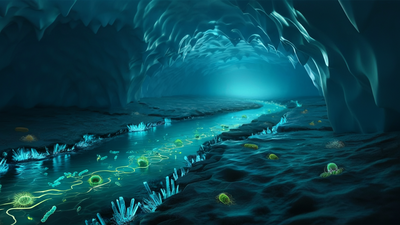
A hidden, glowing river beneath Antarctic ice, teeming with microscopic life and intricate ice formations| Image Credit: TIL Creatives
Ever wondered what lies beneath the frozen continent of Antarctica? Well, it’s an ecosystem that once seemed inconceivable. Scientists have found an estuarine system, with flowing waters, circulation of nutrients, and living microbes in the dark, at depths of up to several hundred meters of ice cover.This finding, which is associated with investigations under the Ross Ice Shelf, has changed the perception of the continent’s interior landscape. The once-sealed and seemingly barren region is now revealed as a complex ecosystem influenced by meltwater, ocean mixing, and biology.According to a study published in Nature Communications, researchers studying the cavity beneath the Ross Ice Shelf found “phylogenetically and functionally diverse microorganisms” living in the dark sub-ice environment.What scientists found beneath the iceTo explore the secreted cavity, the scientists drilled into hundreds of metres of floating ice via a hot-water drill technique. The Ross Ice Shelf report indicates that the cavity lying under the ice was not sterile but harboured active microbial populations affected by inputs of oceanic water and subglacial discharge. What does this imply? That life is sustainable even in areas that lack sunlight, as long as there is movement of water and the presence of nutrients.
Why a river-like estuary can exist under iceIt may seem impossible that there is a continuous flow of an estuary under Antarctica; however, scientists have claimed that it is physically possible. An ice shelf does not always remain frozen all the way down to the sea floor. There can be currents of ocean water beneath them, which melt the ice from underneath, and create gaps for the fresh water to mix with the salty water.A 2022 study on the Nansen Ice Shelf, published in Communications Earth & Environment, examined how ice and ocean processes interact beneath floating Antarctic ice.
The study was not just any random study; it described how warm and cold waters meet under the shelf and contribute to melting and circulation.According to scientists, such processes may lead to the formation of stable river-like structures under the ice, providing the ability for water and other substances to flow through isolated cavities.
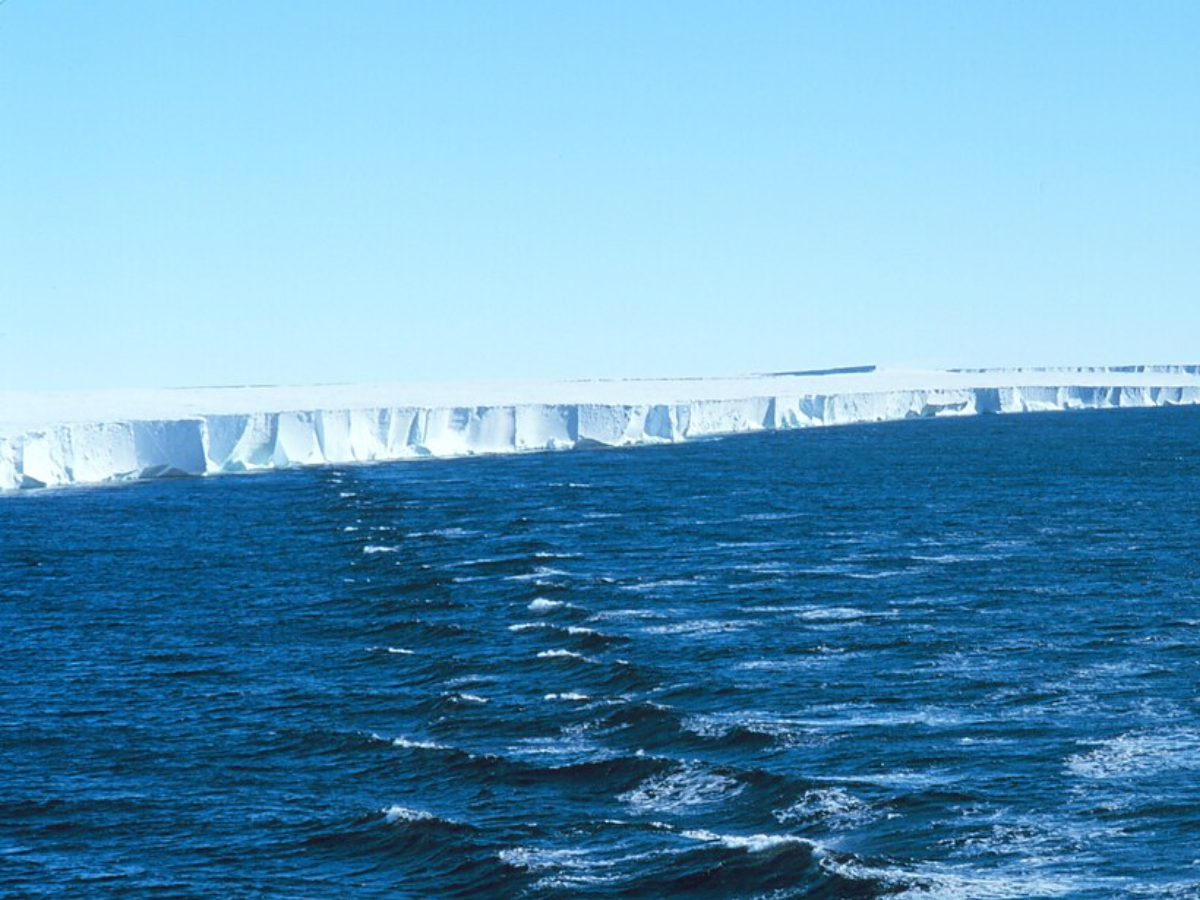
Image of Ross Ice Shelf| Image Credit: Wikimedia Commons
A hidden ecosystem in complete darknessThe key biological data still revolves around microorganisms, not bigger creatures.
Nevertheless, scientists state that the fact of the existence of organized microbial communities in such harsh conditions is surprising enough. According to the study, the microorganisms detected below the ice were not contaminants but organized communities related to ocean influx and subglacial water flow. Thus, the exchange of nutrients and water flow contribute to biological processes occurring within the dark cavity.It should be noted that scientists warn about the lack of data for claiming the existence of a complex food chain, including bigger organisms. Nonetheless, the physical environment seems suitable for sustaining active ecosystems.Why does the discoveryscovery matter?The results are significant not only for biology but also for climate studies. Changes in sea ice coverage near Antarctica have affected coastal environments and made previously difficult-to-access areas more accessible for scientists.
It was highlighted that alterations in sea ice coverage could impact the stability of ice shelves and surrounding environments.It was suggested that hidden networks of water systems in Antarctica may be more influential in affecting ice dynamics than initially thought. Such water channels can affect not only ocean circulation and the stability of floating ice masses but also the transportation of heat and nutrients in the area.From a research perspective, the discovery has opened an opportunity to explore the processes of life adaptation under isolation.









 English (US) ·