
 1 month ago
30
1 month ago
30
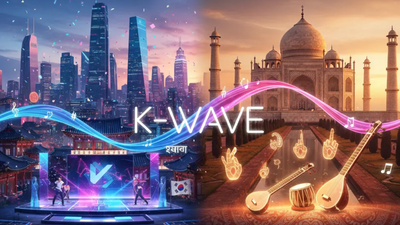
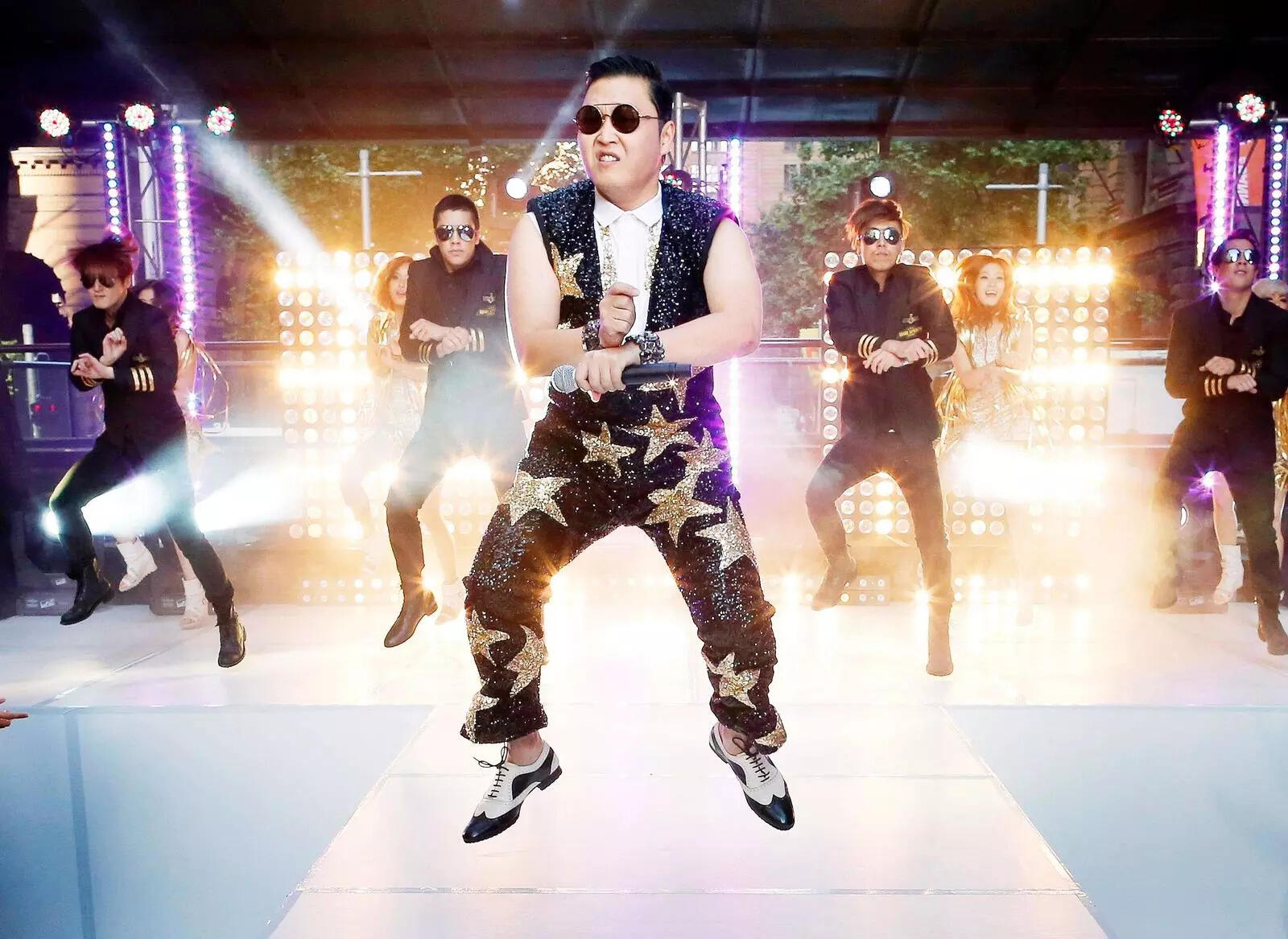
It began, for many Indians, with a song.When Gangnam Style by Psy released in 2012, it seemed ubiquitous — at weddings, college fests, street performances and on television. The horse-riding dance became shorthand for global virality.
What was initially dismissed as a novelty would later be recognised as a cultural inflection point.
Over a decade on, K-culture is surging back with a dark twist. The triple sisters' suicide in Ghaziabad has gripped the nation, fueling nonstop headlines with grim revelations. Their shared obsession? Korean dramas, films, and pop culture. For millions in India, this tragedy marks their stark first brush with South Korea's magnetic soft power.South Korea is no longer a distant East Asian economy known primarily for electronics and automobiles. It is in Indian kitchens in the form of instant ramen and kimchi, in beauty aisles through multi-step skincare routines, in streaming histories dominated by Korean dramas, and in playlists headlined by K-pop groups. Cafes in Delhi, Mumbai and Bengaluru serve tteokbokki and kimchi pancakes alongside pizza and pasta.
Bookstores stock Korean fiction in translation. For a growing segment of India’s urban youth, South Korea is not simply a country; it is an aesthetic, an aspiration and a daily consumption choice. The Korean Wave — or Hallyu — has moved from subculture to mainstream. Its expansion is not accidental. It sits at the intersection of culture, commerce and state policy. For India, the rise of South Korean soft power presents both an example of successful cultural diplomacy and a case study in how global influence now travels — through screens, social media and aspiration.
What is soft power — and why does it matter?
The term “soft power” was coined in the 1980s by American political scientist Joseph Nye Jr. It refers to a country’s ability to shape the preferences of others through attraction rather than coercion. Unlike hard power — military strength or economic sanctions — soft power works through culture, political values and foreign policy credibility.Much of this influence starts far from government offices. Schools, charities, religious institutions, and community programs all help shape how a country is seen abroad.
Music, sports, films, and big industries, like Silicon Valley or Hollywood, amplify the effect. They don’t just entertain or innovate; they send a message about a way of life, about what a country stands for and what it celebrates.That doesn’t mean governments aren’t involved. Many actively cultivate soft power as part of their international diplomatic strategy. The Cold War is a vivid example. The United States and the Soviet Union both leaned heavily on soft power, using cultural festivals, sports, films, and educational exchanges to showcase their societies as models to admire.
It was a battle of attraction, a way to win hearts and minds without firing guns, and it left a lasting mark on global perceptions of each superpower involved.
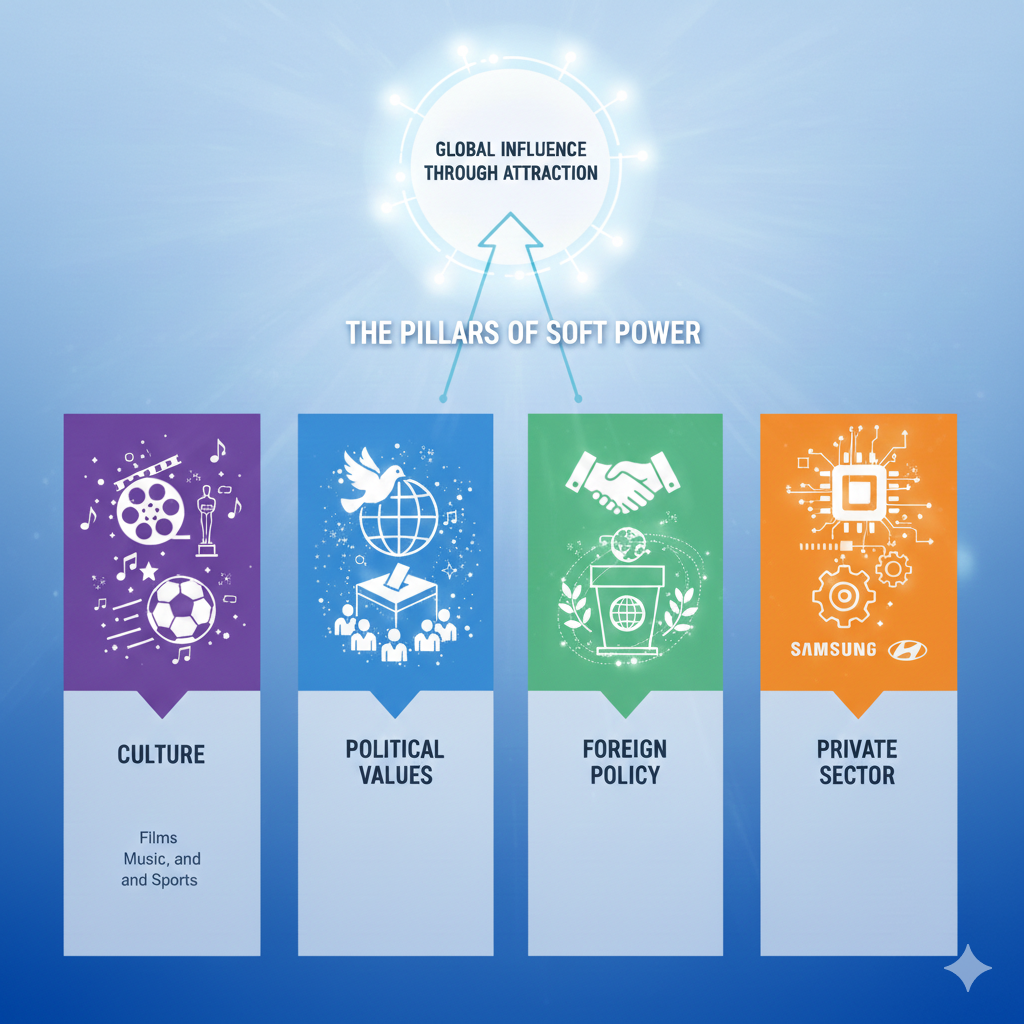
In the South Korean case, soft power evolved from economic strategy to diplomatic instrument. Emerging from the devastation of the Korean War, the country transformed itself within decades into a major economy and democracy. It joined the OECD in 1996 and is now among the world’s largest economies.
Global brands such as Samsung and Hyundai built its industrial reputation.But from the late 1990s onwards, successive governments recognised cultural industries as strategic assets. Laws were enacted to protect domestic film markets. Budgets for cultural exports were increased. Dedicated departments for Hallyu were created within the ministry of culture, sports and tourism. Screen quotas and startup subsidies strengthened local production ecosystems.Research published in the Journal of Indo-Pacific Affairs notes that this policy shift coincided with a move from export-led economic strategy to national branding. Under successive administrations, culture became part of public diplomacy.In 2021, members of BTS addressed the UN General Assembly on Sustainable Development Goals. Blackpink has participated in climate advocacy initiatives linked to global forums.
Cultural icons have been positioned as global messengers.
The results are measurable. According to Guinness World Records, BTS has set multiple global records in music and social media engagement. Spotify data has shown exponential growth in K-pop streaming globally since 2018. The global success of the film Parasite, which won four Academy Awards including Best Picture, and Netflix’s Squid Game, which became one of the platform’s most-watched series, further cemented South Korea’s cultural footprint.Soft power, in this case, has translated into tourism, language learning, product exports and diplomatic visibility.
Cultural hegemony: From Hollywood to Hallyu — and India’s own soft power
The idea of cultural hegemony refers to the dominance of one culture’s narratives and values over others, often subtly, through media and consumption patterns. For decades, Western — particularly American — culture occupied that space globally.India has experienced that influence. English-language music, Hollywood films and Western fashion have shaped urban consumption patterns.
At the same time, India has exported its own culture. Bollywood cinema enjoys audiences across West Asia and Africa. Yoga has global institutional recognition. Indian cuisine and festivals travel with the diaspora.Professor Mayukh Lahiri of the University of Calcutta argues that while Korean culture has emerged as a significant soft power, it has not yet replaced Western dominance in India. “Korean culture has arguably emerged as a soft power, but it hasn't really escalated to the zone of 'dominance'; the expression 'dominance' is particularly applicable in majoritarian aspects and Korean culture hasn't yet overwhelmingly replaced the Western culture,” he says.He points to a sociological distinction. Colonial history led many Indians to view Western culture as “high culture”. Korean pop culture, by contrast, appears more accessible. Citing Gangnam Style, he notes the “leniency and flexibility of grammar” that made participation easier for Indian audiences.A Media, Culture and Fashion Professor at Delhi University cautions against labelling Korean expansion as cultural imperialism in India.
“For any culture to become Imperial, it has to actively take initiative through formal measures to become dominant in new regions and override new cultures,” she says. In India’s diverse society, she argues, K-culture remains largely a matter of selective consumption.As long as it remains “people’s independent preference” and not state-imposed, it is better understood as globalisation and exchange rather than domination.
The Korean takeover: Music, media and lifestyle
The Korean Wave is often categorised into three phases. The first (late 1990s–mid-2000s) centred on television dramas popular in East Asia. The second saw the rise of K-pop groups leveraging social media and YouTube to expand into Europe and the United States. The third, from the mid-2010s onwards, has been driven by OTT platforms and global fandom ecosystems.
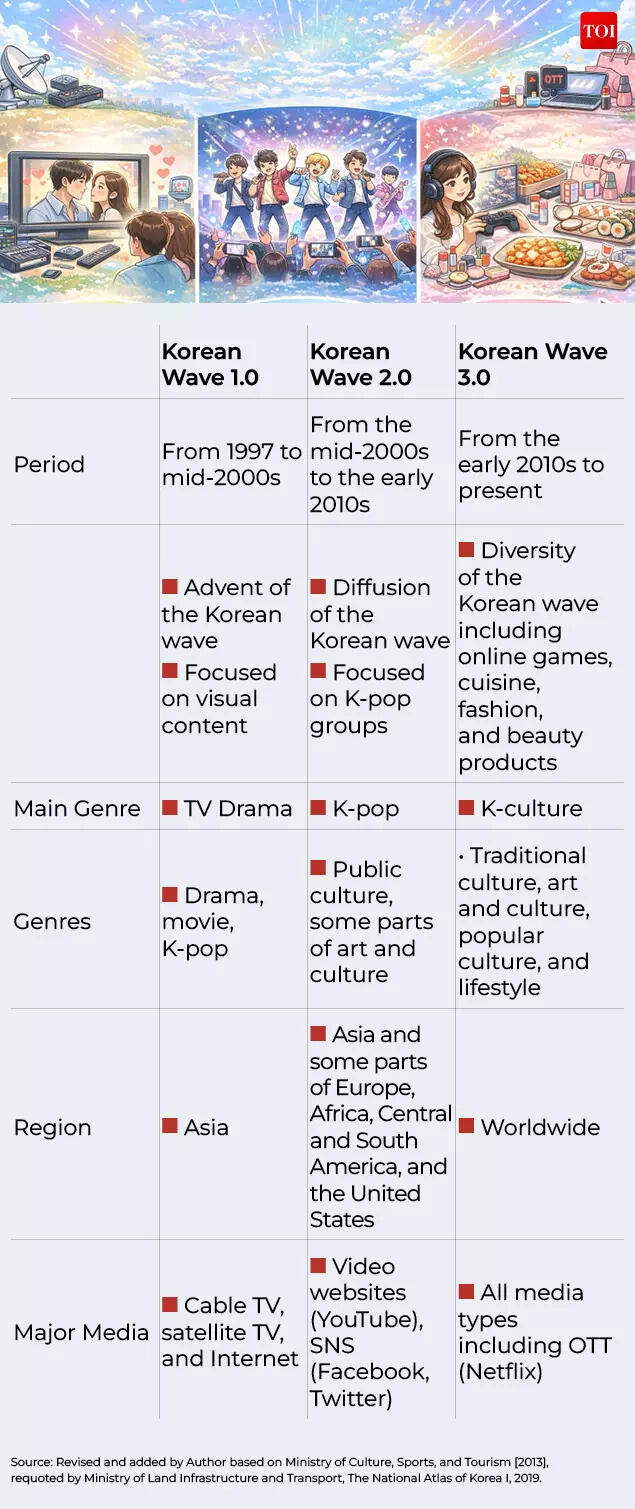
In India, this third phase coincided with affordable data and smartphone penetration.
Streaming platforms reduced language barriers through subtitles and dubbing.Kshitij Mishra, a young journalist, says boredom led him to discover Korean shows. A turning point was Descendants of the Sun. “It completely drew me in and sparked an obsession with K-dramas and Korean culture,” he says. He admires how Korean dramas “never forget their roots, yet they don’t let tradition hold them back from embracing and exploring modernity.” Whereas, Dreamy Nice, a Bangladesh student living in Delhi, traces her introduction to a YouTube video by Lilly Singh reacting to BTS. To her “Korean culture instantly reminds of Ramen,” she says, immediately associating it with Jimin. Her favourites include actress Han Hyo-joo and Buldak ramen. Asked whether fandom turns obsessive, her answer is direct: “Obsession BIGG TIME YES.”Beyond entertainment, the spillover is visible in K-beauty and fashion.
Multi-step skincare routines, glass-skin aesthetics and minimalist fashion are marketed aggressively in Indian metros. Domestic brands increasingly use Korean terminology to signal trend alignment.Food is another vector. Korean restaurants have multiplied in metropolitan cities. Ramen brands are available across e-commerce platforms. What distinguishes Hallyu is its ecosystem effect: Music drives interest in dramas; dramas influence food and fashion; fandom communities sustain engagement.
K-Pop and K-Drama: The cultural engine
At the centre of the Korean Wave are two powerful industries: K-pop and K-drama.K-pop’s rise from regional genre to global phenomenon has been defined by meticulous training systems, synchronized choreography, and sophisticated fan engagement strategies. Groups like Blackpink and BTS have topped international charts, broken streaming records and cultivated vast digital fandoms that mobilise across platforms.
Social media has allowed fans in India to participate in global comeback events, streaming campaigns and virtual concerts in real time.The increasing popularity of the K-Pop industry is reflected in these artists becoming a regular appearance at the late night shows in America, performing and winning at the biggest stages of industry from Oscars to Grammys.
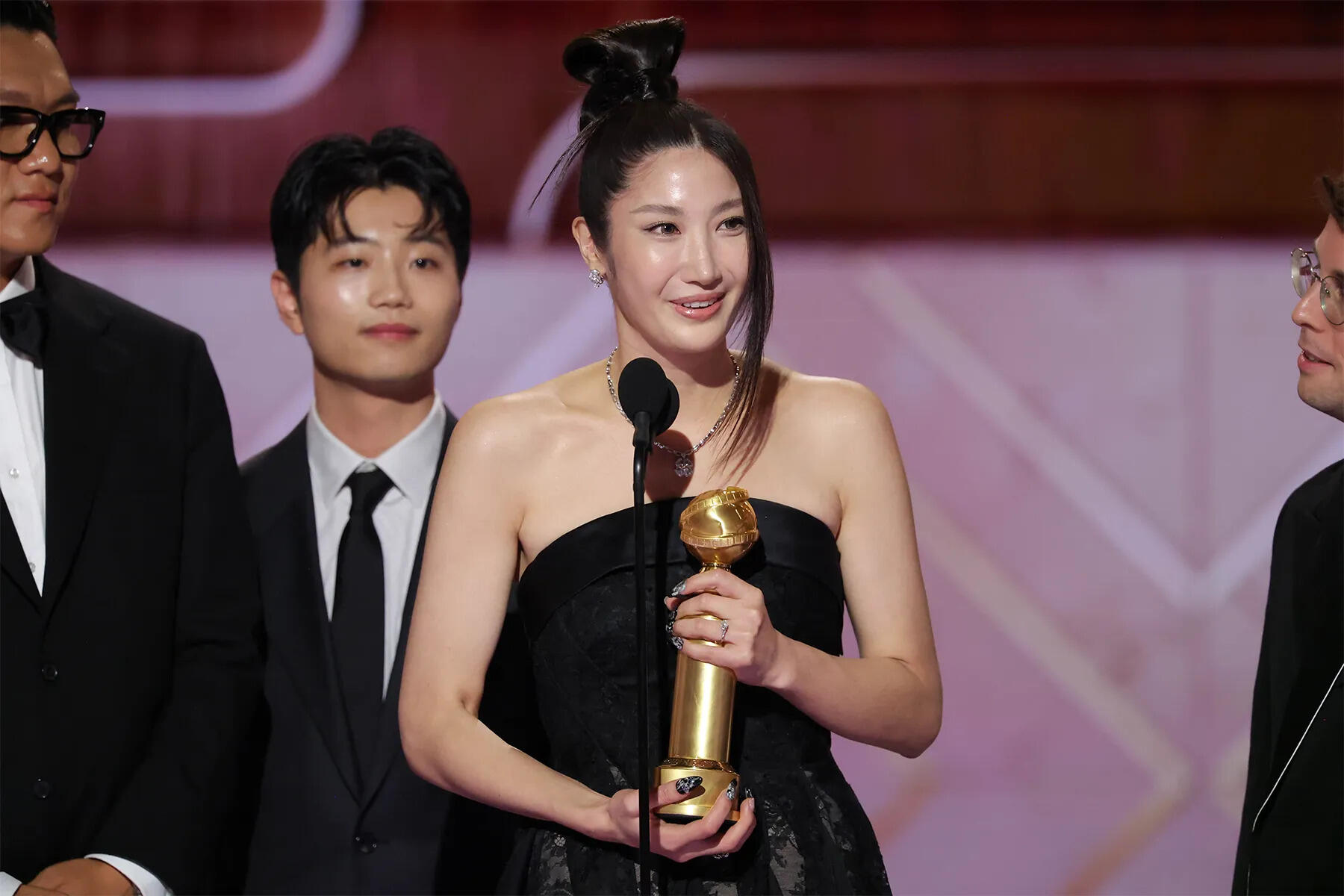
As Kshitij puts it, “Korean cultural influence has already become a global phenomenon.
Even top English musicians and singers collaborate with Korean artists because they recognize their massive impact worldwide.” K-dramas, meanwhile, offer tightly written narratives often limited to 16–20 episodes — a format that contrasts with the long-running serial structure of Indian television. Series such as ‘Crash Landing on You’ and ‘Goblin’ have drawn Indian viewers with their blend of romance, melodrama and social commentary.
Skincare
K-beauty brands now occupy entire sections in major beauty retailers, from Sephora to Nykaa. In the first half of 2025, South Korea even overtook France, the country long seen as the birthplace of modern cosmetics, to become the world’s second-largest exporter of beauty products, after the United States, as cited by the BBC.A cursory search for “Korean skincare” on Instagram, or YouTube will lead to the discovery of a plethora of content.
Influencers with millions of followers dissect ingredient lists, unbox new launches, and film “Get Ready With Me” videos centered on concepts like “glass skin,” sheet masks, and the infamous snail mucin. At the core of K-beauty’s global rise is its relentless pace of innovation: new products appear every few months, often designed to spark the next viral hyper-fixation.
But this global enthusiasm comes with a cost. Experts have raised concerns about the social impact of the standard it imposes, especially on young people.
An incessant exposure to skincare content online can contribute to anxiety, reinforce narrow standards of beauty, and encourage excessive spending. As K-beauty continues to expand, its cultural influence is clear, but so too are the questions it raises about the pressures of a hyper-curated, image-focused world.
K-fashion
K-fashion, or Korean fashion, has gained global attention largely due to the rising popularity of K-pop and K-dramas, a trend that is particularly visible in India today.
It blends contemporary, urban styles with subtle elements of traditional or conservative fashion, creating a look that is both modern and approachable. Central to K-fashion is a “less is more” philosophy, favoring clean lines, understated silhouettes, and carefully curated accessories.Virochini Shandil, a MBA student, says her singular biggest traction has been the Korean fashion industry, “The dress sense is so fascinating and also the cultural blend in it, it’s just so intriguing.”
The trend encompasses a wide range of styles, from baggy pants and oversized tops to tailored trench coats and minimalist tote bags, offering versatility while maintaining a distinct aesthetic. What sets K-fashion apart is its balance: the pieces are understated yet deliberate, simple yet immediately recognizable. This approach to clothing reflects a broader cultural emphasis on aesthetics and personal expression.
Films
Over the past two decades, Korean cinema has steadily moved from festival circuits to mainstream global screens. Films such as Oldboy, The Handmaiden, Train to Busan, Minari, and the Oscar-winning Parasite have shown an industry unafraid of genre-bending, moral ambiguity, and political commentary. These films are deeply rooted stories that travel because their emotions and conflicts are recognisable everywhere.Virochini says, “the Korean entertainment industry in itself is attractive, they make very few movies, but the ones they come up with are literally awesome.”
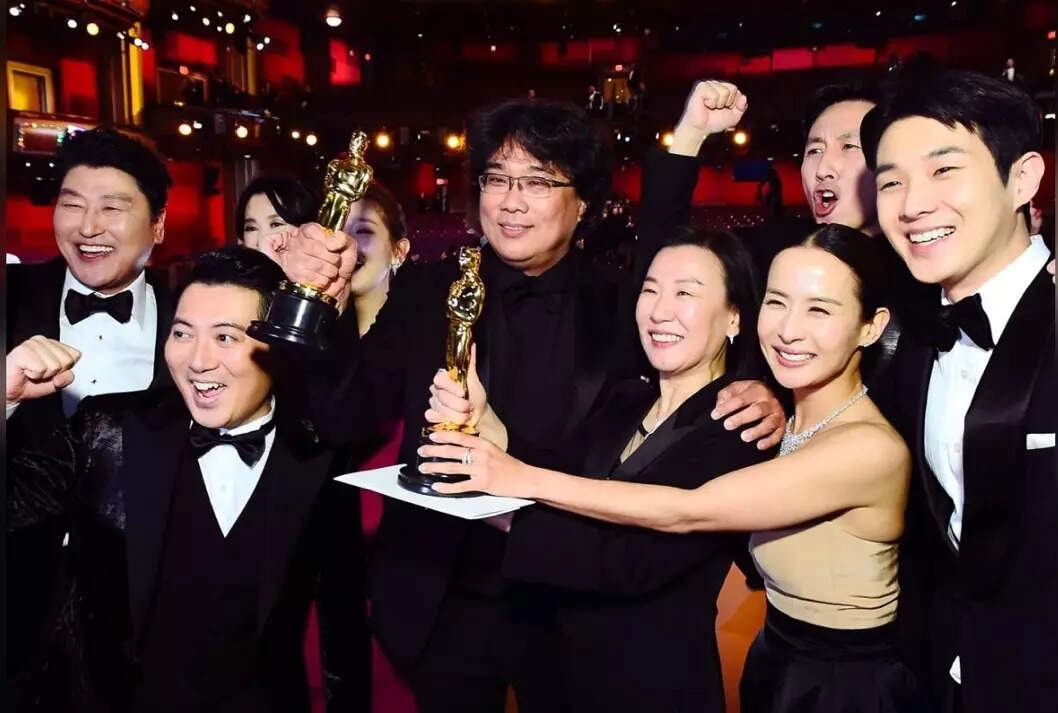
With directors who experiment fearlessly and writers who resist set resolutions, Korean films have carved out a space that feels both distinctly local and global at the same time. The result is a cinema that does not just entertain but provokes, and lingers, one that has firmly placed South Korea among the world’s most influential film cultures today.
Mukbangs and Dalgona coffee
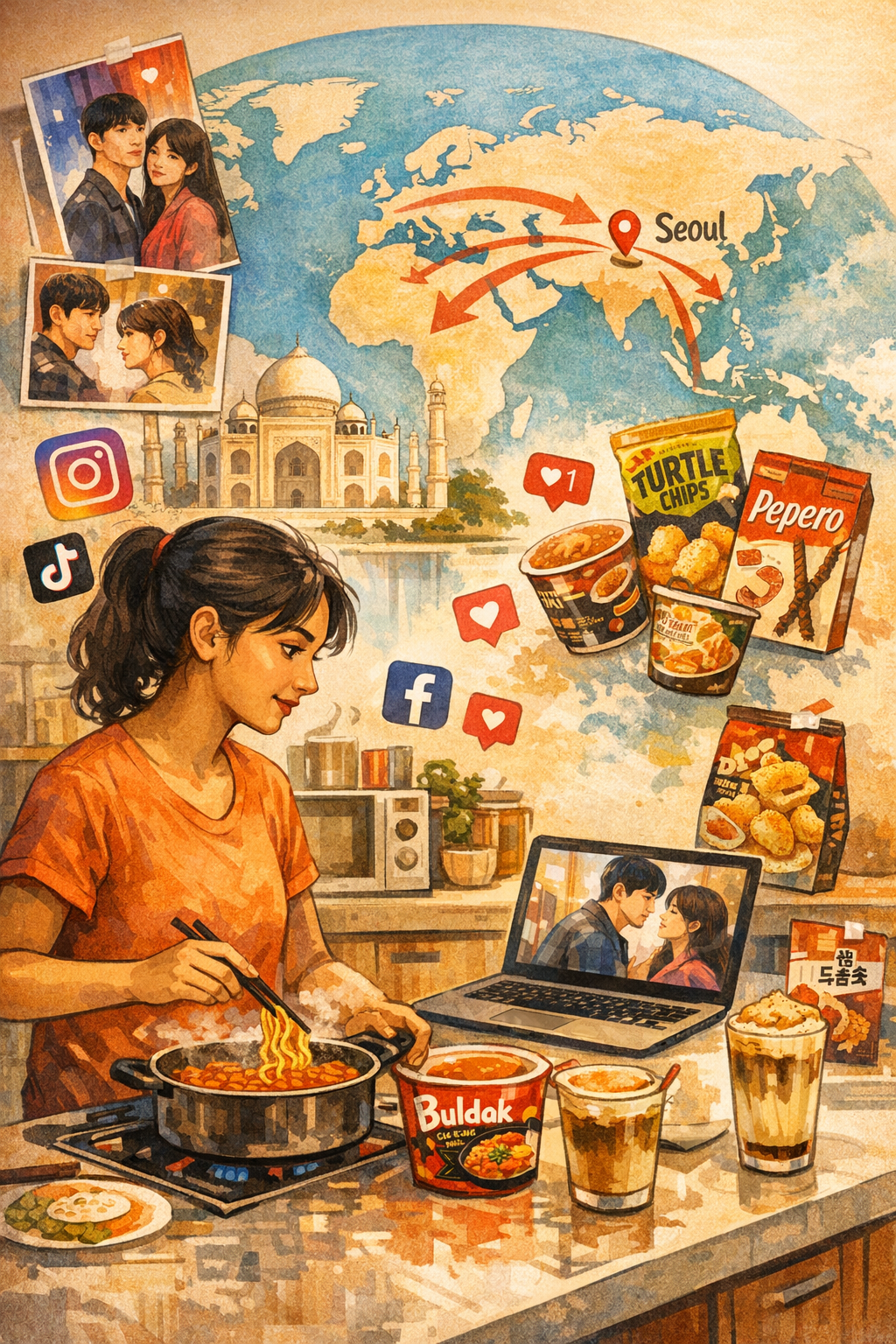
A decade ago, Korean food was still a curiosity outside East Asia. Today, it is a familiar sight in Indian supermarkets and social media feeds. The rise of K-pop, K-dramas and films pulled global audiences into Korean culture, and food became one of the easiest ways to participate in it. The pandemic years pushed this further. With people stuck at home, dalgona coffee and ramyeon recipes went viral, turning casual viewers into home cooks.
Brands like Samyang’s Buldak Ramyeon rode this wave with bold flavours and savvy social media marketing, becoming staples in dorm rooms and kitchens worldwide.Mukbang videos and Korean dramas helped popularise snacks like Pepero and Turtle Chips, while companies quickly adapted flavours to global trends, from matcha to fusion variants. Korean food’s global success is not just hype—it is a carefully marketed, fast-adapting industry that has found a loyal audience far beyond Seoul.
Adaptation or displacement?
Does this popularity threaten local industries?The DU Professor believes Indian industries adapt rather than retreat. “Indians are very adaptable and would hardly lose out to Korean culture because Indians have time and again jumped into the mainstream and reshaped itself with time,” she says. Many Indian brands, she notes, sell domestic products under Korean-sounding labels.Professor Lahiri observes that mediated global cultures have long overshadowed folk traditions.
Korean influence may intensify that infusion, but it is part of a larger globalisation process rather than a singular takeover.For policymakers, the key is balance — encouraging domestic creative ecosystems while remaining open to global exchange.
The geopolitical layer: Can culture offset constraints?
South Korea’s soft power has enhanced its global image, but it cannot replace hard power realities. Surrounded by China, Japan, Russia and allied with the United States, Seoul operates in a complex geopolitical environment.
North Korea’s nuclear programme remains a central security concern.Analysts such as Chung Min Lee have argued that soft power cannot resolve geopolitical tensions but can expand diplomatic space. South Korea’s leadership in digital technology, development cooperation and human rights advocacy could complement its cultural influence.
The dark side: Pressure behind perfection
The global polish of K-pop and K-drama often conceals an industry built on intense competition, rigid hierarchies and relentless scrutiny.
Entry barriers are high. Only a fraction of trainees debut successfully. Performance standards are exacting.Behind the synchronised choreography and cinematic storytelling lies a system that has drawn increasing criticism — both within South Korea and abroad.Observers have repeatedly raised concerns about mental health pressures within the entertainment industry. Strict contracts, public scrutiny and online harassment add strain.
High-profile celebrity suicides in recent years have prompted debate within South Korea about industry reform and support systems. Virochini argues, “amid the all starry and glorious facade, one thing that immediately comes to mind thinking of Korea is ‘no -free will’. In the North there is dictatorship so you can’t expect anything, but in the South the way they have made the system twisted, with contracts, obligations, fandom, stardom that an artist or media face just can’t even have a private life.
They can’t do anything on their own.”Indian fans are aware of this contradiction. Mishra acknowledges that “craze and love can sometimes turn into obsession… it can become a delusion, affecting their critical thinking and sense of reality.” Saksham Baru, a young working professional, points out a more concerning trend, the rising racism in South Korea. He says, “I have come across so many incidents where the Koreans haven’t really been nice to us.
So i wonder if they don’t like it why are we obsessing over them, or so and about it. The only thing that leads me to is disgust.” The aspirational lifestyle promoted through K-pop and K-dramas — flawless skin, coordinated fashion, disciplined bodies — can create pressure among young audiences. Professor Lahiri warns of “peer pressure” and risks of “compulsive buying/consumption.”At the same time, critics caution against moral panic. As Professor from DU notes, overconsumption is a risk with any global cultural stream.
Fearmongering, she argues, could inadvertently elevate Korean culture into the very imperial force critics fear.The beauty, body image and social impact is also huge. The aesthetic standards projected through K-pop and K-drama — pale skin, slim figures, symmetrical features — have had ripple effects across Asia and beyond. South Korea has one of the world’s highest rates of cosmetic procedures per capita, a statistic often linked to competitive beauty norms.As K-beauty and K-fashion spread globally, these standards travel with them. In India, where colourism already shapes beauty hierarchies, the promotion of “glass skin” and flawless complexions can reinforce narrow ideals. Young fans may internalise unattainable expectations, blurring the line between admiration and self-criticism.
From trend to template
South Korea’s cultural ascent illustrates how middle powers can leverage creativity, technology and policy coordination to amplify influence.
It demonstrates the convergence of economic growth, democratic consolidation and digital innovation.For Indian audiences, the Korean Wave is less about displacement and more about diversification. Bollywood and cricket continue to dominate domestic conversation. But Seoul now shares space in the cultural imagination for many. Soft power travels through bandwidth. A dance challenge can move from Seoul to Jaipur in hours.
A drama released on an OTT platform can trend in Mumbai overnight. Influence no longer depends on geography.The Korean wave’s future in India will likely depend on continued digital access, evolving tastes and the ability of both countries to engage beyond entertainment — in technology, education and policy collaboration. Soft power has limits. It cannot erase geopolitical fault lines. But it can build familiarity, open markets and create narratives of partnership.From Gangnam Style to Squid Game, from ramen shelves to UN podiums, South Korea’s rise as a cultural power reflects a broader shift in global influence — one where attraction, not coercion, increasingly shapes the conversation.








 English (US) ·