
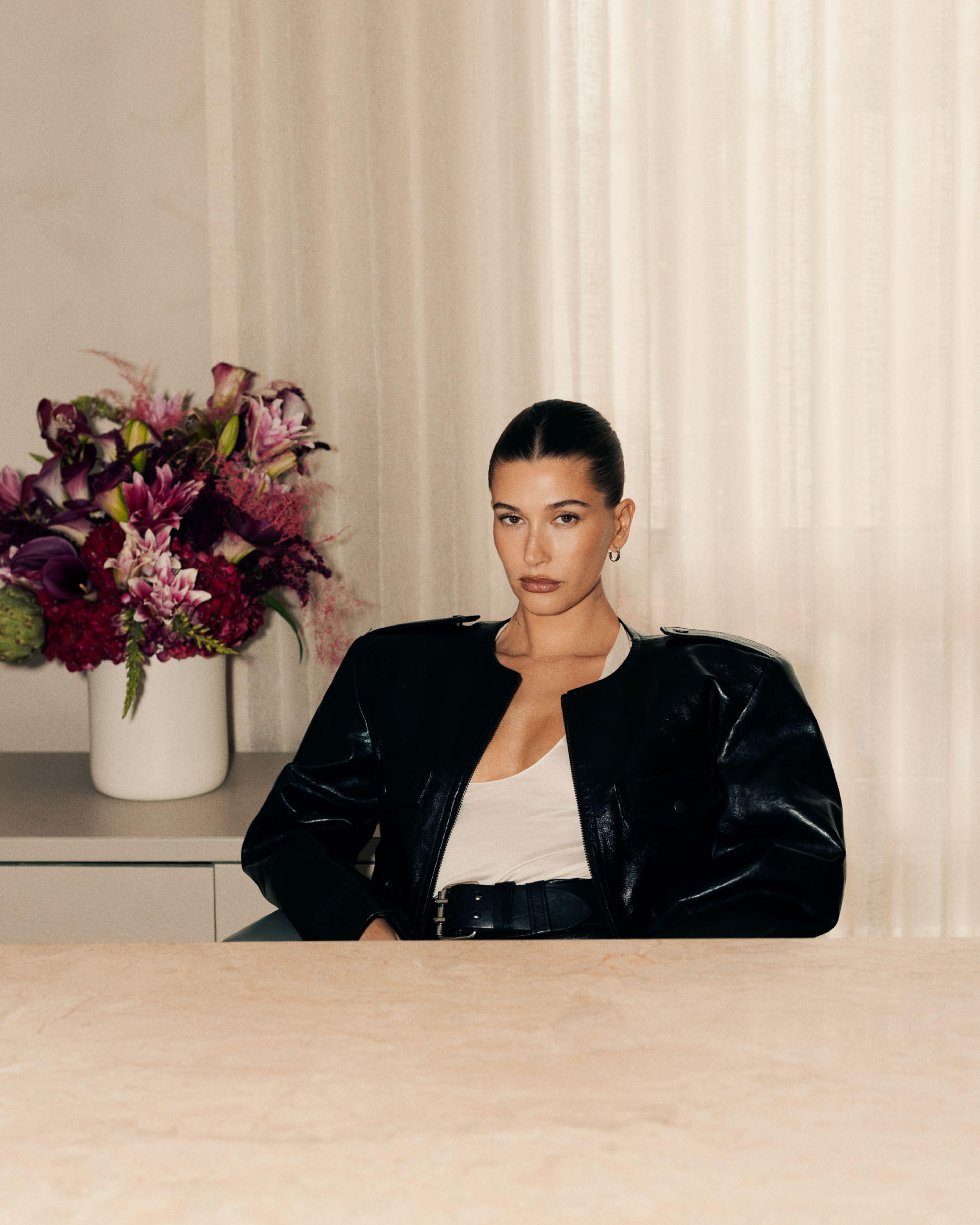
Hailey Bieber, founder and chief creative officer of Rhode, photographed on March 30, 2026.
At OBB Studios in Hollywood, there is a parking spot inside the office—like literally right next to the reception area. It makes loading in production gear easy, and, on days like today, provides superfamous visitors a seamless, paparazzi-proof way to enter the building. Which is why Hailey Bieber’s bright white, electric G-Wagon is parked just feet away from the office bullpen, where 20-something staffers of the full-service production company are plucking away at their computers.
Behind the reception desk, a glass-topped display case exhibits products from Bieber’s beauty brand, Rhode, like objects in a museum. Hanging on the walls are stills from the film and TV projects produced by OBB—a docuseries about Shaq mentoring entrepreneurs, Sabrina Carpenter’s holiday special—interspersed with marketing images for the brand, shot onsite. Bieber posing with a giant tube of moisturizer. Bieber bare-legged and kneeling with a lip balm in her hand. Bieber’s face artfully dotted with globs of lotion. Her arrival is business as usual—this studio is a home away from home.
A production company and a start-up selling skin care may not seem like the most obvious pairing, but that connection is a major factor in how Rhode became one of the most coveted beauty brands in America. In May 2025, when Rhode was a three-year-old, direct-to-consumer brand with just 10 products, it was acquired by E.l.f. Beauty in a transaction valued at up to $1 billion. In the months since, Rhode has established a retail presence, boasting the biggest debuts ever in the history of Sephora North America, Sephora U.K., and Mecca in Australia and New Zealand. It’s expected to reach $260 million to $265 million in net sales for the fiscal year 2026.
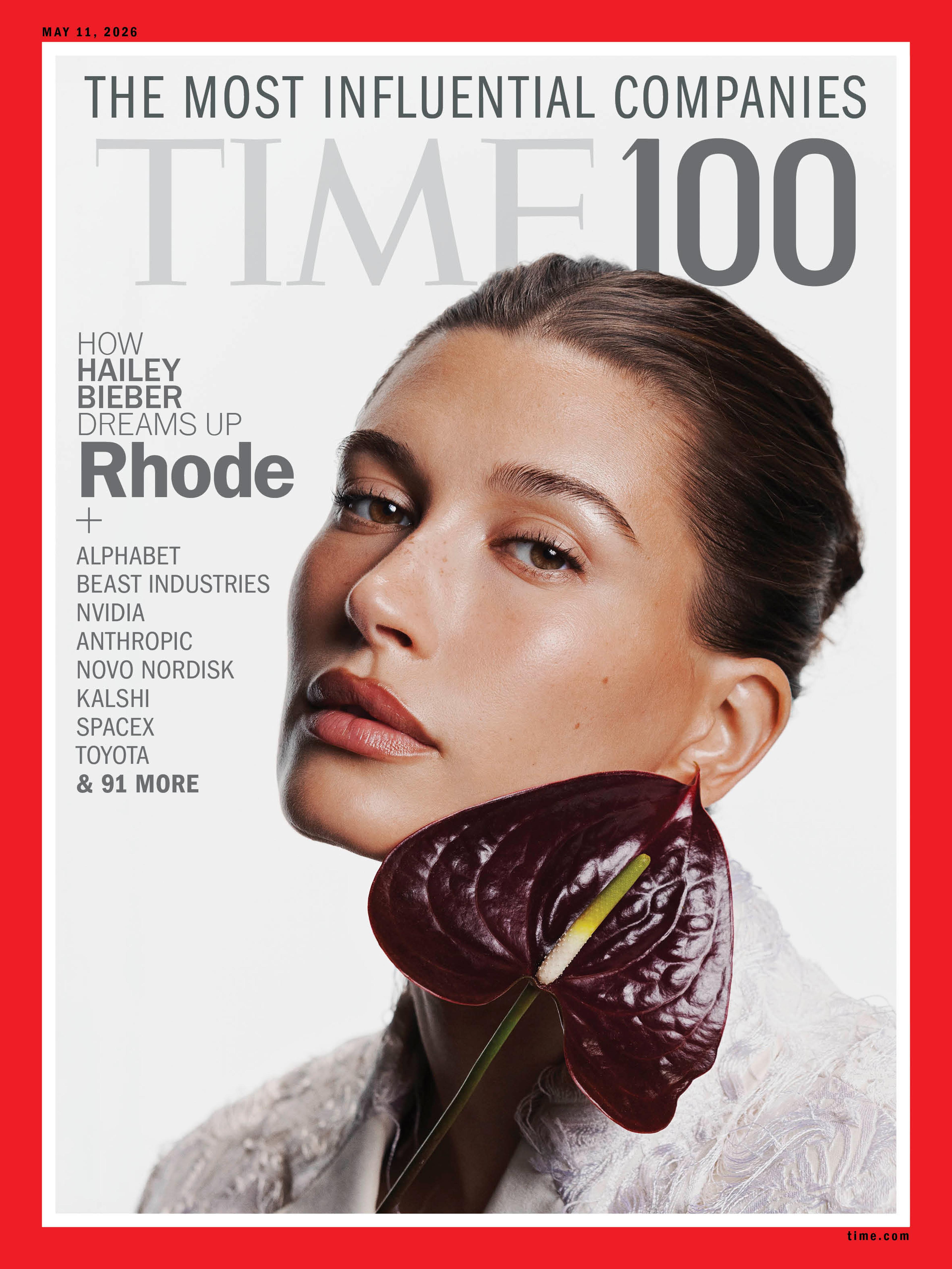
Kanya Iwana for TIME
Rhode is a celebrity brand, yes—Bieber is the progeny of the Baldwins (daughter of Stephen, niece of Alec), the wife of a generation-defining pop star, a model, and a powerful influencer. She has more than 76 million followers on Instagram and TikTok; women everywhere copy her hairstyles, her nails, her outfits. But a celebrity founder is not enough for a beauty brand to thrive. Everyone from Drew Barrymore to Addison Rae has struggled to find or maintain their footing in a saturated market driven by consumers who know better than to buy a product just because someone famous tells them to. Bieber, 29, has succeeded because she’s taken her authentic obsession with skin care, grown an audience around it, and created products that tap into their aesthetic desires—the same desires she and Rhode continually stoke with the aspirational image of her life and the brand.
In Bieber’s own words, she’s “building a world” with Rhode. “We focus on innovation, we focus on formulation, we focus on packaging, we focus on color story, we focus on imagery, we focus on storytelling. We focus on inviting you into this whole entire world that really fits into your lifestyle,” she says. “And I think that goes so far beyond skin care.”
Bieber’s path to founding a company was not traditional. She moved from a suburb into New York City at 17 years old for her modeling career, forgoing a high school diploma, and established herself as a model and influencer. Then, in 2018, her engagement and marriage to Justin Bieber shot her to a new level of global recognition.
Despite her New York roots, Bieber is in many ways the ultimate L.A. girl—she’s wellness obsessed, a devotee of saunas and cold plunges, lymphatic drainage massages, and meditation. She famously created a namesake “skin glaze” smoothie at the upscale grocery store Erewhon with hyaluronic acid and sea-moss gel. When she says “glazed donut skin” or “strawberry girl makeup” are in, the beauty world takes note. And after years of helping other companies succeed through endorsement deals, seeing the value of her association with a product, she wanted to build something of her own.
But six years ago, when Bieber decided to launch a brand, the first person she called was neither a dermatologist nor a beauty-business leader. It was Michael D. Ratner, the CEO of OBB Media and a producer who’d shadowed her and her husband for over a year to make the 2020 docuseries Justin Bieber: Seasons. Ratner says he didn’t even know the words cosmetic chemist and esthetician when he first signed on as a co-founder. It was less important to Bieber that a partner have direct experience in the industry, and more important that they be someone she trusted who’d built a company before, he says. “She also smartly identified that storytelling was going to be at the heart of any business that she would create.”
Together, they tackled two distinct but equally critical projects: figuring out how to make skin-care products, and building up Bieber’s voice as a subject-matter expert on social media. Ratner’s proposal was to program her YouTube channel “like a network”—creating multiple franchises so she could own her place in culture in a new way. Inspired by Bieber’s comment to Ratner that the best conversations at the Met Gala happen in the bathroom, they launched a YouTube series, Who’s in My Bathroom?, where Bieber invited guests like her friend Kendall Jenner and fellow entrepreneur Gwyneth Paltrow into her actual (palatial) bathroom to discuss beauty and wellness. They talked about products they liked, didn’t like, what was missing from their routines—and all the while picked up insights from Bieber’s growing audience about what consumers wanted. “So much of that was also elevating other businesses and brands that ultimately, I guess, you could deem a competitor,” Ratner says. “But it was fine, because we just wanted to be a part of that community.” In the early stages, Ratner also introduced Bieber to fashion marketer Lauren Rothberg, his girlfriend, who came on as a co-founder. (They are now married.)
While creating content for Bieber’s social media was a business play unto itself, the parallel paths are what helped ensure Rhode’s instant success. “We built this whole ecosystem of hours and hours of content, hundreds and hundreds of millions of views, about things she just cared about,” Ratner says. “And then, by the time products came along nearly two years later—we started that in 2020, then Rhode didn’t launch till June 2022—people were dying for it.”
The previous tenant in Rhode’s Beverly Hills office space was The Rock. Bieber did away with the stark, black finishes, replacing everything with soft fabrics in sand and cream tones, and hanging a brand sign on a mirror in the entryway—perfect for snapping selfies with Rhode’s viral lip-balm-holding phone case. Even the furniture in this place got a feature in Vogue—Bieber is that much of a source of fascination.
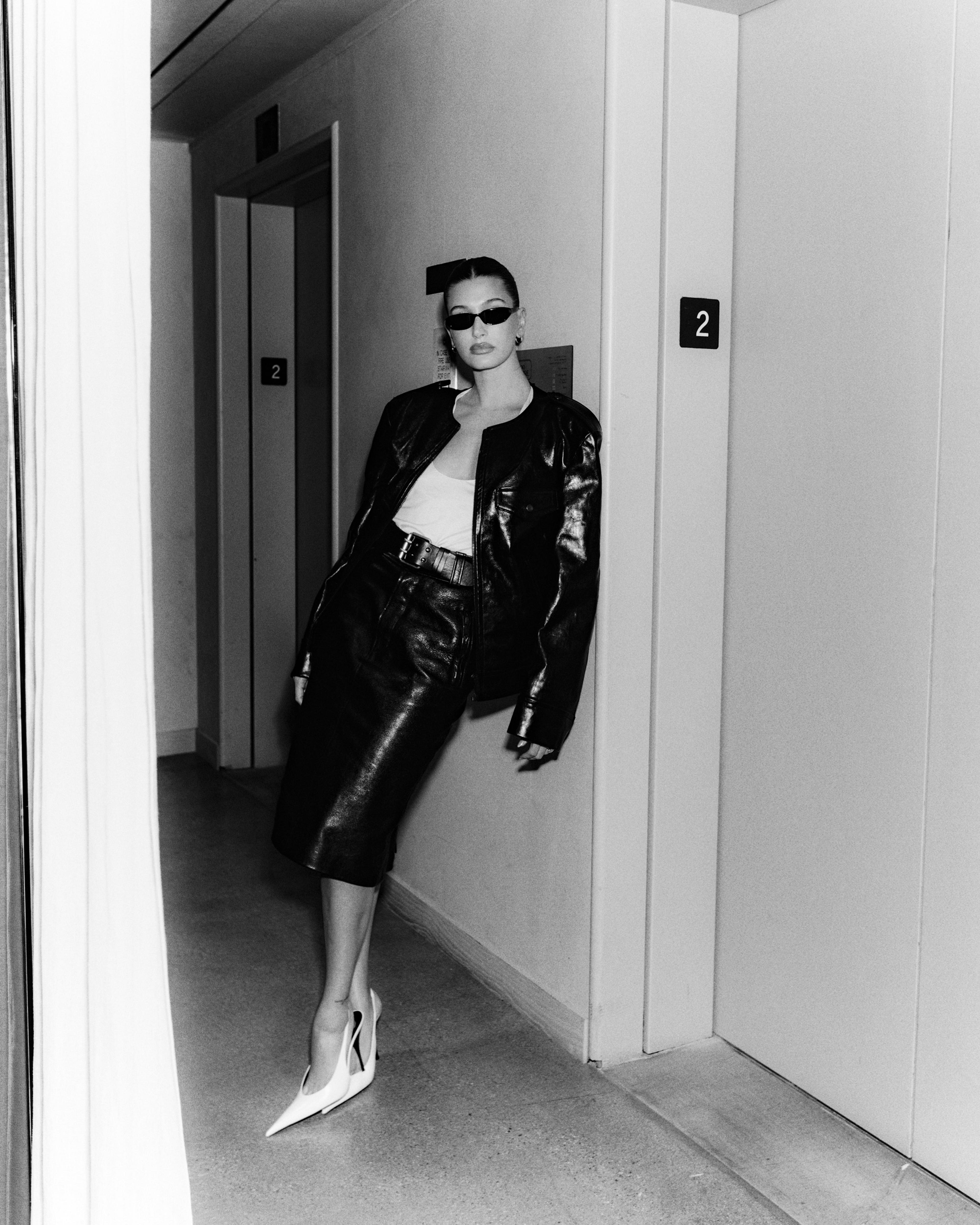
Kanya Iwana for TIME
“It was pretty dude-ish in here,” she says, sitting at an elongated marble table, the centerpiece of the conference room.
Skin care is a true obsession of Bieber’s—she can talk your ear off about ingredients and the latest scientific advancements (these days, she’s really into exosomes). But with Rhode, she wanted to keep things simple, developing the brand’s mantra of “one of everything really good.”
Rhode debuted in June 2022 with three items, all under $30: the Peptide Lip Treatment (a thick balm), Peptide Glazing Fluid (a gel serum), and Barrier Restore Cream (a moisturizer). All sold out within a day.
In a minidoc released on her YouTube that July, Bieber shared footage of early meetings with advisers from the world of dermatology and cosmetic chemistry, from product-testing sessions where she gave her feedback, and business conversations where she settled on the right packaging and pricing, showing how involved she was from conception to launch. They reformulated some test products upwards of 15 times.
Still, Bieber knows that no skin-care product will work for everyone. “When I see people have an experience where it doesn't agree with their skin—they break out from it, it's not working for them—I get so disappointed,” Bieber says, “because if I could, I would formulate things that across the board worked for a hundred percent of people.” An early snafu involved an issue with the lip treatments. When they arrived at customers’ homes, some had developed a grainy texture, leading to online backlash and complaints. “I was so disappointed. I was so mad at myself, thinking, ‘How could we have done this different and where did it go wrong?’” Bieber recalls. The Rhode team investigated the issue, finding that one of the ingredients crystalized with temperature fluctuations, and released an updated formula. Bieber made a video explaining what happened and how they resolved it.
From the start, she knew there would be skepticism with the introduction of yet another celebrity brand. “I understood that there was definitely a lot of side-eyeing of ‘Oh, here we go again,’” she says. “I never want to be that person who creates a brand to be like, ‘This is what I use and it's the only thing that makes my skin look like this.’” She makes a point to share some of the treatments she relies on: microneedling with PRP (platelet-rich plasma), PRF (platelet-rich fibrin) injections, and laser treatments.
“I am super, super conscious of skin care, health, and wellness being all really one cohesive channel,” she says. “There's no skin care that's a one fix-it-all."
Rhode has masterfully leveraged Bieber’s image for its campaigns, creating memorable launches. For the Glazing Milk, a hydrating essence, she lounged in a milky bath in the desert. For a lemon-themed set of summer products, she mounted a yellow jet ski in the Bahamas. And for the just-released Spotwear—a pimple patch, Rhode’s first acne product—the brand partnered for the first time with Justin, offering a limited drop of five shapes designed by “the Biebers,” and teased the product with cozy photos of the couple that felt like an intimate peek inside their life together. Then they took Rhode to Coachella, setting up an invitation-only activation to spark social buzz on the same day Justin headlined the festival.
Rhode’s highly online team has also tapped of-the-moment celebrities like pop star Tate McRae and actor Harris Dickinson to help define the brand’s vibe. Sarah Pidgeon stars in a spring campaign that came out right as her portrayal of Carolyn Bessette Kennedy on the series Love Story made her the style icon du jour.
Lauren Ratner uses the term “surround sound” to describe Rhode’s approach to marketing—they build a “360 world” that’s impossible to escape online, she says. “The world is fun, it's sexy, and it's something that you just want to be a part of.”
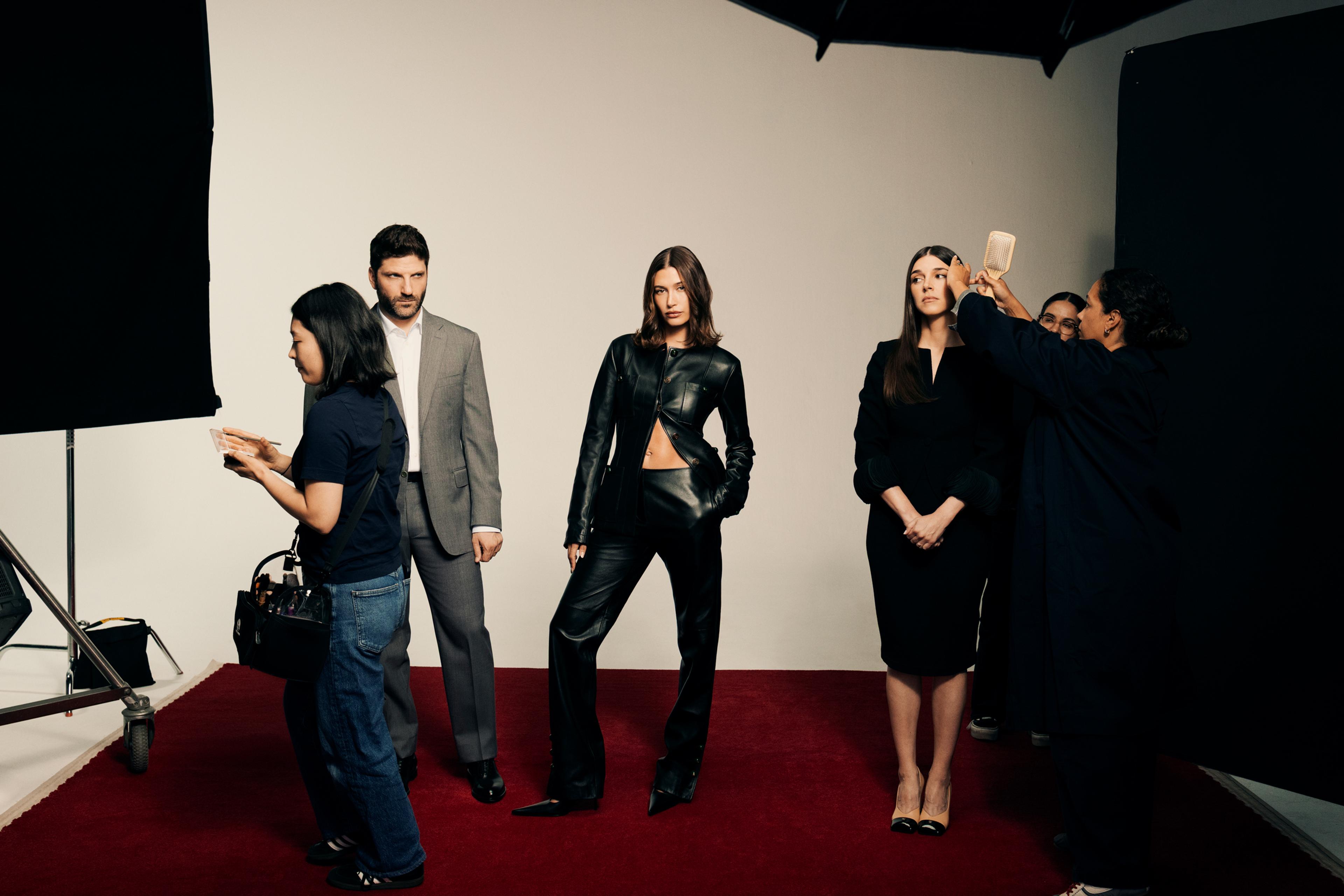
Hailey Bieber photographed alongside Rhode co-founders Michael D. Ratner and Lauren Ratner on set of TIME's cover shoot. Kanya Iwana for TIME
But for all the advantages Bieber has as a founder, her place in culture can also be challenging to navigate. There are corners of the internet dedicated solely to criticizing everything she does—from how her hair looks in a photo to the way she talks about her marriage or parenting her son, Jack, to what she wears in a Rhode campaign.
“I just think being in this position in general, there's a lot of judgment,” she says. “It does feel hard sometimes, having every single thing be looked at and picked apart.” Experience has taught her that there’s no stopping people from inventing narratives. “They create a story for you, and it can feel really uncomfortable and bizarre sometimes, because I'm like, it's just not even real,” she says. To her, there’s only one solution: “I need to live my life and continue to move forward regardless.”
This past year was a major test—Bieber experienced her first full year of motherhood while also navigating the sale and in-store retail launch of her company. “There’s a lot of change happening at once,” she says. “It really showed me—as a woman, as a businesswoman, as an entrepreneur, as a mom, as a wife, as a friend—really what my capacity was, because I felt really stretched in a lot of ways.”
Selling Rhode was not a given—Bieber was aware she had options. And E.l.f.’s namesake brand, a mass drugstore line with hundreds of products, most of which cost $10 or less, wasn’t an obvious match. But the companies aligned in their “disruptive” approach to marketing, says E.l.f. CEO Tarang Amin, and the value proposition for each side was clear. E.l.f., which also owns Alicia Keys’ Keys Soulcare, Naturium, and Well People, gets access to Bieber’s reputation and insights, as well as Rhode’s Sephora presence, customer base, and growth. Rhode gets to tap into E.l.f.’s operational and distribution capabilities to scale and achieve Bieber’s goal of expanding into retail around the world. Plus, for Bieber, the price was right. She had said in internal meetings that she would not sell for less than $1 billion. The transaction was ultimately $800 million in cash and E.l.f. Beauty stock for Rhode’s equity holders, and an additional $200 million contingent on Rhode’s performance in the first three years of the partnership.
“E.l.f. is a very elastic brand. There are very few brands I know that you can launch in Sephora Mexico and Dollar General in the same quarter,” Amin says. He views Rhode the same way. “Rhode really taps into her entire lifestyle, so it’s not landlocked. It's not limited to ‘This is just skin care,’ or ‘This is just hybrid makeup,’ or ‘This is accessories.' It can go wherever Hailey wants it to go.”
The next stop is Sephora E.U. While customers in many E.U. countries can order Rhode from the website, the brand has yet to launch in retail locations in the territory. Bieber told TIME exclusively that Rhode will debut in all E.U. countries where the store operates in “early fall” of this year. Rhode CEO Nick Vlahos says 20% of Rhode’s business is international sales from DTC, but 74% of the brand’s social followers are from outside the U.S. Which means anticipation is high for the E.U. launch, especially on the heels of record-breaking debuts in other territories. “I think we're going to see similar types of results, just based on the pent-up demand that exists within those markets,” Vlahos says.
Bieber’s aim is to make Rhode a truly global brand—she wants to bring Rhode to South America, specifically mentioning Brazil, where her mother is from. And she wants to expand the line, offering more products geared toward specific skin concerns and creating solutions for her own skin as she ages. She’d also like to start another business someday, but she doesn’t have a particular vision in mind yet. “I’m an entrepreneur at the end of the day,” she says. “I want to expand in business and I want to be able to do more things—but I’m definitely not in a rush.” And she’s not about to get distracted by the next shiny thing. “You hear a lot of stories that founders—they sell their business and they get pushed out or they leave or they just get a payday and they decide to move on.” But she’s clear that she has a lot more she still wants to do with Rhode—the company hasn’t yet hit its fourth anniversary, after all.
And in life, Bieber herself is on the precipice of a new decade, turning 30 in November. She remembers being 19 and thinking that 30 sounded old and “embarrassing”—too far away to relate to. Now, she’s proud of the person she’s grown into. “I say to my friends all the time: couldn't pay me to go back to being 20 for a day. There's nothing there for me,” Bieber says. “Can't wait to turn 30 and continue to see what's in store.”
Stylist: Dani Michelle; Hair: Irinel DeLeon; Makeup: Nina Park; Nail artists: Zola Ganzorigt, Mandy Enkh; Location: OBB Studios









 English (US) ·