
 3 weeks ago
18
3 weeks ago
18
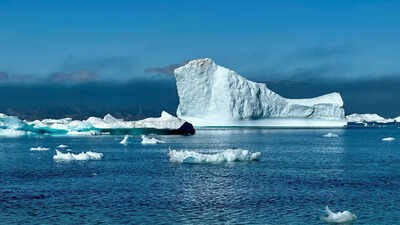
Greenland, the largest island in the world, is commonly mistaken for its deceptive title. Greenland boasts an area in excess of 836,000 square miles, and to its credit, 80% of the island is covered in ice.
Greenland’s climate is so harsh that the ice in certain areas can be approximately two miles thick. According to USA Today, contrary to expectations related to its name, Greenland is primarily composed of ice, frozen fjords, ice caps, and occasional ice-free areas. Because Greenland is so cold in climate and inaccessible geographically, it is recognised as the coldest habitable area in the world. The title Greenland provides an intriguing case study in history, culture, and current climate shifts.
Greenland and the Vikings, who made it famous
The story of Greenland's name goes back to around 1000 AD, when Viking explorer Erik the Red settled on the island after being exiled from Iceland. Per the Icelandic Sagas, Erik called the land "Greenland" on purpose, as a way to make it sound more attractive in hopes that settlers would relocate to the icy island. Much of Greenland was covered in ice, but Erik's naming was strategically important in attracting the Norse to its coastal areas.
Thus, this "branding" sets out the realist approach of the Vikings to colonisation in one of the harshest climates on earth.
Greenland Explodes, Protesters Storm US Embassy As Trump Vows Takeover By June 1 | ‘Hands Off!’
The Inuit name for Greenland is Kalaallit Nunaat, which translates to “Land of the Kalaallit.” For many centuries, the Kalaallit have been Inuit people living off the western coast, surviving by applying their knowledge of ice, marine life, and local geography. While names were a form of marketing for the Vikings, the Inuit would subsistence hunt and fish, with limited farming in the few ice-free areas.
Their understanding of the land allowed them to sustainably live in one of the most inhospitable places on the planet.
Greenland’s frozen land and the rare times it turned green
Despite being predominantly icy, Greenland did have some periods of relative “greening” – for example, during the Medieval Warm Period (900 to 1300 AD). During this phase of glacial retreat, a slight warming trend permitted some regional areas to accumulate enough plant life to provide small pasturelands and agricultural lands that could support Viking settlement and agricultural activities.
Nevertheless, fully 80% of Greenland was still under ice during this period and never fully greened and forested.Currently, Greenland’s ice is melting away at an increasing pace due to global warming. Recent research studies carried out in 2024 show that ice and glaciers covering 11,000 sq. miles of area, which is slightly larger than Massachusetts, an American state, have melted away in the past 30 years. As ice melts away, chunks of land covered with shrubs, marshes, and rock surfaces are being exposed for the first time in Greenland in almost 1,000 years.
Such trends, according to researchers, are not only physical manifestations but also signals for sea level rise, ocean currents, and changes in polar regions.
Iceland–Greenland naming paradox
Greenland's name is all the more ironic in comparison with Iceland. Iceland, much smaller and relatively temperate, received its name for icy landscapes around 850 AD from the Viking explorer Flóki Vilgerðarson. Greenland, on the other hand, is much colder, more fully ice-covered, and sparsely populated.
Such a paradox rubs in the impact of perception, marketing, and historical context on naming conventions.
Whereas Iceland is greener than Greenland, in fact, Greenland is "green" only in name, a manipulated use of language by early settlers to attract migration.
Greenland’s size and map misconceptions
On many maps, Greenland is depicted as far larger than it is because the Mercator projection distorts the size of land near the poles. Actually, Greenland's area is about three times the size of Texas, but not as big as one might think from its typical depiction in atlases.
An accurate understanding of the true size of Greenland is important for climate scientists and policy makers as they monitor the rate of loss of ice cover, sea-level rise, and regional climatic impacts.
Specific knowledge about Greenland's geography guarantees qualified planning regarding environmental and climate-related challenges.The retreat of the Greenland ice sheet is of huge consequence to the planet. Melting ice contributes to rising sea levels, posing dangers to the coastlines of communities worldwide. The reduction of this ice impacts ocean currents and regional climate patterns, in turn influencing weather far beyond the Arctic. Greenland's ice is, in essence, a sensitive indicator of the change in climate that already exists, providing scientists with further necessary information to track environmental transformations and forecast future changes in global ecosystems.






 English (US) ·