
A confident far-right Alternative for Germany (AfD) gathered Saturday to found its new youth organisation as thousands of protesters converged on the western city of Giessen, some of them clashing with police.
Demonstrators began descending on the central town from the early morning, with police also out in force. The meeting had been due to start at 10am local time but only got underway hours later, accompanied by audible whistles, drums and chants from the protesters outside.
Demonstrators blocked or tried to block roads in and around the city of some 93,000, delaying many delegates' arrival. Police said they used pepper spray after stones were thrown at officers at one location. In another case, police said they used water cannons to clear a blockade by some 2,000 protesters after they ignored calls to leave.
AfD's leaders condemned the protests as the meeting opened at the city's convention centre. “What is being done out there – dear left-wingers, dear extremists, you need to look at yourselves – is something that is deeply undemocratic,” party co-leader Alice Weidel said.
The new youth organisation's predecessor, the Young Alternative – a largely autonomous group with relatively loose links to the party – was dissolved at the end of March after AfD decided to formally cut ties with it.
AfD wants to have closer oversight over the new group, expected to be called Generation Germany. The party finished second in Germany's national election in February with over 20% of the vote and is now the country's biggest opposition party. AfD, with which mainstream parties refuse to work, has continued to rise in polls as Chancellor Friedrich Merz's coalition government has failed to impress voters.
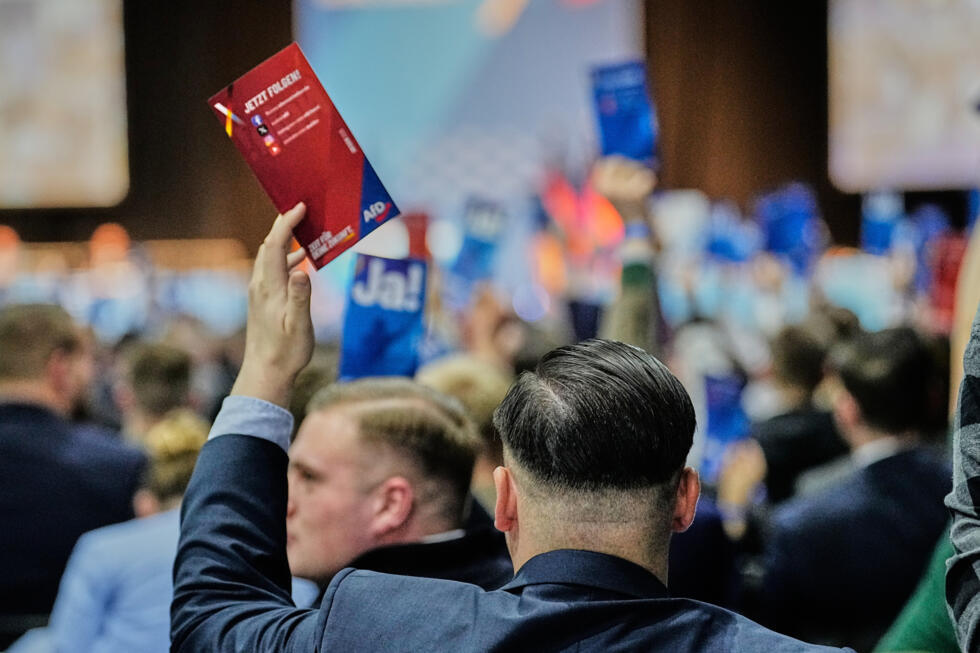 File phot of a delegate casting his vote during the re-founding of the AfD youth organization in Giessen, Germany, taken November 29, 2025. © Martin Meissner, AP
Germany's domestic intelligence agency had concluded that the Young Alternative was a proven right-wing extremist group. It later classified AfD itself as such a group, but suspended the designation after AfD launched a legal challenge.
Read moreGermany arrests teenagers accused of forming far-right 'terrorist' group, planning attacks
In a ruling last year rejecting a call for an injunction against the Young Alternative designation, a Cologne court argued that preserving an ethnically defined German people and the exclusion if possible of the “ethnically foreign” was a central political idea of the group.
It also pointed to agitation against migrants and asylum-seekers, and links with extremist groups such as the Identitarian Movement. In June this year, a higher court ended the appeal process, noting that the Young Alternative had been dissolved.
A typical move for German parties
AfD's other co-leader, Tino Chrupalla, said the party must learn from past mistakes.
“Some benefited from the young, from their ability to mobilize, but didn't have the well-being and future of this youth sufficiently in sight,” he said. “We should have taken more care of the young new hopes in our party; it will be different in the future.” He added that the young activists must “put themselves at the party's service.”
It's typical for German parties to have youth wings, which are generally more politically radical than the parties themselves. It remains to be seen whether the new AfD youth organisation will be more moderate than its predecessor, with at least some continuity expected.
Watch moreTracking neo-Nazis at Germany's far-right rallies
Kevin Dorow, a delegate from Germany's northern Schleswig-Holstein state, said he was previously active in the local branch of the Young Alternative.
“The new formation means above all continuing what the Young Alternative started - being a training ground, attracting young people ... and above all bringing them into politics for the good of the party," in which they could take on offices at some point, he said. He said he hadn't seen any “drift in a radical direction” in the Young Alternative.
AfD portrays itself as an anti-establishment force at a time of low trust in politicians. It first entered the national parliament in 2017 on the back of discontent with the arrival of large numbers of migrants in the mid-2010s, and curbing migration remains its signature theme. But it has shown a talent for capitalizing on discontent about other issues too in recent years. That was reflected in the confident tone of AfD's leaders Saturday.
Watch moreSidelining AfD in German parliament a sign of 'weakness' of traditional parties, analyst says
Five of Germany's 16 states hold regional elections next year. Two of those are in the ex-communist east, where the party is strongest.
“We will get the majority of mandates; we will provide our first governor,” Weidel said.
(FRANCE 24 with AP and AFP)







 English (US) ·