
 3 weeks ago
26
3 weeks ago
26
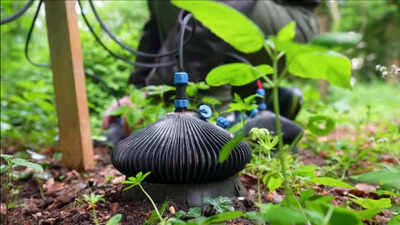
Somewhere under a patch of ordinary garden soil, billions of bacteria are quietly going about their business eating organic matter, releasing electrons, and in doing so, producing a faint but constant electrical charge.
For most of human history, that energy has simply disappeared into the ground unnoticed. A British startup called Bactery, spun out of the University of Bath, is trying to change that. The company has developed a device it calls a "Bactery" a soil microbial fuel cell that captures the electrons naturally released by bacteria in the ground and converts them into usable electricity. The technology, founded on the PhD research of chemical engineer Dr Jakub Dziegielowski, is designed to be buried and forgotten and then quietly generate power for the next 25 to 30 years without any maintenance at all.
How soil microbial fuel cells harness bacterial electricity from the ground
The science behind Bactery's device is not new in principle, but getting it to work reliably in real outdoor environments has been the hard part. Soil microbial fuel cells operate by exploiting a group of microorganisms called electrigens, or exoelectrogenic bacteria that, as a natural byproduct of consuming organic compounds in the soil, release electrons outside their cells. Genera like Geobacter and Shewanella are among the best-known examples, and they are found naturally in soils all over the world.
Bactery's device captures these freely available electrons using electrodes an anode buried in the soil to absorb the electrons, and a cathode exposed to air at the surface. The soil itself acts simultaneously as the fuel source, the electrolyte, and the medium carrying microbial activity, which means no membrane, no pumps, and no complicated chemical inputs are required. As a comprehensive review of microbial fuel cell mechanisms published in the International Journal of Energy Research explains, bacteria within these systems metabolise organic substrates through standard biochemical pathways and produce electrons that flow through an external circuit the same basic principle that underlies all electrical generation, just with microbes doing the work instead of combustion or photovoltaic cells.The University of Bath team, including Professor Mirella Di Lorenzo, who co-founded Bactery alongside Dziegielowski and Dr Ben Metcalfe, successfully field-tested an early version of this approach in 2019 at a primary school in Icapui, Brazil, where stacked soil fuel cells produced enough electricity to disinfect three litres of water per day.
Bactery's device design: bury it, forget it, collect power for decades
The practical design of Bactery's unit is part of what makes it interesting.
The device is roughly the size of a small box around six by six inches and installation requires nothing more sophisticated than digging a hole, placing the unit in it with the same soil that came out, and covering it back up. Within a few days, a natural biofilm of electroactive bacteria forms inside the reactor, and energy generation begins on its own.According to the University of Bath's official announcement, the device has an anticipated lifespan of over 25 years and an expected cost of around £25 per unit with zero maintenance expenses what the company describes as "install and forget" functionality.
There are no moving parts, no fuel that needs replacing, and no weather dependence. Unlike solar panels, which stop producing when the sun goes down, or wind turbines that need wind, a soil fuel cell runs as long as the microbial ecosystem beneath it remains active which, given that soil bacteria have been doing this for billions of years, is not really a concern.Current outdoor prototypes generate around 0.2 watts per square metre, which is modest but already sufficient for the agricultural applications Bactery is initially targeting.
In lab settings, Dziegielowski says their systems are already performing at six times that level, and the company has set a target of reaching 4 watts per cubic metre as a practical benchmark for broader household use.
Powering smart agriculture with clean soil energy first
Bactery's immediate commercial target is not domestic homes it's farms. Precision agriculture is increasingly dependent on soil sensors, moisture monitors, and Internet of Things (IoT) devices that transmit real-time data back to farmers.
The problem is powering all of that equipment across large rural areas where cabling is impractical, disposable batteries create ongoing waste and cost, and solar panels are weather-dependent and require installation infrastructure.Research published in Frontiers in Computer Science specifically identifies soil microbial fuel cells as a promising clean energy source for exactly these kinds of outdoor sensor networks, noting their suitability for environments where traditional power sources aren't practical.
Bactery's device is already capable of meeting the power demands of low-draw agricultural sensors without any issues, according to Dziegielowski, and the company sees the farm sector as its first major deployment ground before scaling toward residential applications.The technology also appears to have a positive rather than neutral effect on the soil it sits in. Bactery has reported no depletion of soil quality in its testing, and analyses suggest the microbial activity encouraged by the device may actually benefit the surrounding ecosystem.
The soil, as the company puts it, is a complex self-sustaining environment not easily destabilised by the presence of graphite electrodes drawing off a small fraction of naturally produced electrons.
Could your garden eventually power your home?
The longer-term vision that Dziegielowski has sketched out is more ambitious. Speaking to Reuters, he described a scenario where multiple Bactery devices, scaled up and linked together, are installed fully underground across an average-sized residential garden.
The combined output, he said, could offset a meaningful portion of a household's electricity bills and because the system runs year-round regardless of season or weather, it would complement solar in a way that addresses solar's most obvious weakness.A 2024 study from Northwestern University, published in the Proceedings of the ACM on Interactive, Mobile, Wearable and Ubiquitous Technologies, demonstrated a soil-powered fuel cell that could run underground sensors entirely without batteries or solar panels, working in both dry and wet conditions and outlasting comparable technologies.
The research, described by ScienceDaily as a potential replacement for conventional batteries in low-power applications, adds independent academic weight to the direction Bactery is heading.The honest caveat is that the power density of soil microbial fuel cells remains low compared to solar or wind at scale, and getting from 0.2 watts per square metre to something that meaningfully contributes to household energy is still a genuine engineering challenge. But the fundamentals are sound the bacteria are already there, already producing electrons, and have been doing so without interruption since long before humans started worrying about electricity bills.
Bactery is simply the first company to make a serious commercial attempt at collecting what the ground has always been giving away for free.









 English (US) ·