
Renewed clashes between Syrian security forces and Kurdish fighters in the Aleppo region are a reminder of the volatile communal and sectarian tensions that continue to roil the country more than a year after the fall of the Assad dynasty.
The latest violence follows weeks of deadly clashes last summer pitting Bedouin tribesmen against Druze militias in the country’s south, and after the massacre of Alawite civilians in their western heartland in March and April of last year.
Each bout of violence underscores the daunting challenge facing Syria’s new rulers as they grapple with the complex, fragile ethnoreligious mosaic of a country ravaged by more than a decade of civil war and riven with bitter divides.
While the focus is on Syria’s vulnerable minorities, the country’s Sunni majority – itself divided along tribal lines and past opposition or allegiance to the Assads – holds the key to stabilising the country and staving off further sectarian strife.
With that aim in mind, the Syrian presidency set up an “Office of Tribes and Clans” in September headed by Jihad Issa al-Sheikh, also known by his nom de guerre Abu Ahmed Zakour, a longtime fellow traveller of Syria's rebel-turned-president Ahmed al-Sharaa.
FRANCE 24’s Wassim Nasr was able to meet with al-Sheikh and other members of the office at its three regional branches in Aleppo, Hama and Idlib, gaining exclusive insight into a body that aims to play a key role in the Syrian reconciliation process.
In Aleppo, old grudges and shifting alliances
Strategically placed alongside Aleppo's Bureau of political affairs, the local branch of the Office of Tribes and Clans has moved into the former premises of the Baath party that ruled Syria for decades under the Assads.
Its task is to maintain the non-aggression pact between Syria’s former rebels and the Sunni militias that had previously backed the Assad regime, before switching sides during the lightening offensive led by Sharaa’s Hayat Tahrir al-Sham (HTS) in November 2024.
It was their change of allegiance that led to the fall of Aleppo, Syria’s economic capital, in just three days, hastening the end of Assad rule.
Read moreSyria after Assad: Journey through a war-ravaged nation in transition
The largest of these militias, the al-Baqir Brigade, had previously received funding from the Iranian Revolutionary Guards and was entrusted with conscripts from the Syrian regular army. This effectively gave them the power of life and death over local inhabitants.
“The rebels in Aleppo came from the same (Sunni) neighbourhoods (as the militiamen),” said a witness from the early days of the Syrian revolution in 2011, who traced existing rancours to a notorious incident involving a family accused of siding with the Assads.
“The discord began when the head of the Meraai family and one of his sons were executed and their mutilated bodies displayed in public for several days,” added the witness, describing their killing as a response to the shooting of anti-Assad demonstrators.
A lynchpin of the al-Baqir Brigade, the Meraai family was widely seen as a tool of the Assad regime to suppress opponents – not necessarily acting on direct orders from Damascus, but rather to preserve its financial interests and the favours granted by the regime.
Sitting on a plastic chair amid the ruins, a Meraai family member who was imprisoned at the time had a different take on the incident. He said the executions “were unjustified because we simply don’t know who fired at demonstrators from the rooftops”.
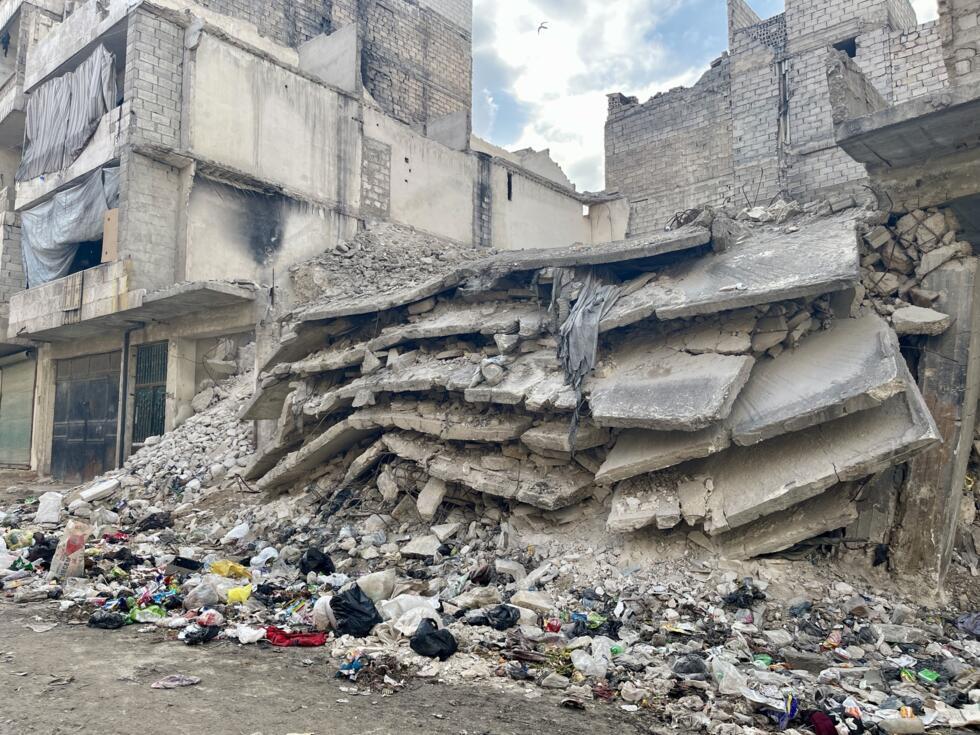 A destroyed building in the al-Salihin neighbourhood of Aleppo. © Wassim Nasr, FRANCE 24
Fifteen years on from that fateful incident, his brothers Khaled and Hamza would play a key role in the liberation of Aleppo by Sharaa’s rebel coalition. After more than two years of negotiations and a visit to Sharaa’s bastion in Idlib, Khaled al-Meraai was persuaded by his fellow Bagara clansman Jihad Issa al-Sheikh that the time had come to abandon the Assads.
Seeing the tide turning, Khaled al-Meraai agreed to secretly harbour an HTS commando unit that would attack a strategic command centre of the Syrian army in Aleppo. Months before the battle, scouts had infiltrated the city to prepare the ground, including Jihad Issa al-Sheikh's own brother, Abu Omar.
But this crucial role in the liberation of Aleppo has not erased, at least in the eyes of the early rebels, the Sunni family’s earlier participation in the Assad regime’s repressive apparatus. As the former inmate put it, “our relatives will flee the city, fearing revenge, if they don't see me sitting in my chair here every day”.
While the Meraais still own valuable properties, including a stud farm for purebred Arabian horses, they have been forced to return some of the assets that were confiscated from former rebels. The new Syrian authorities are protecting the family, but without publicly acknowledging the deal that helped bring about the capture of Aleppo – even though Hamza al-Meraai was recently photographed with an interior ministry spokesperson in Damascus.
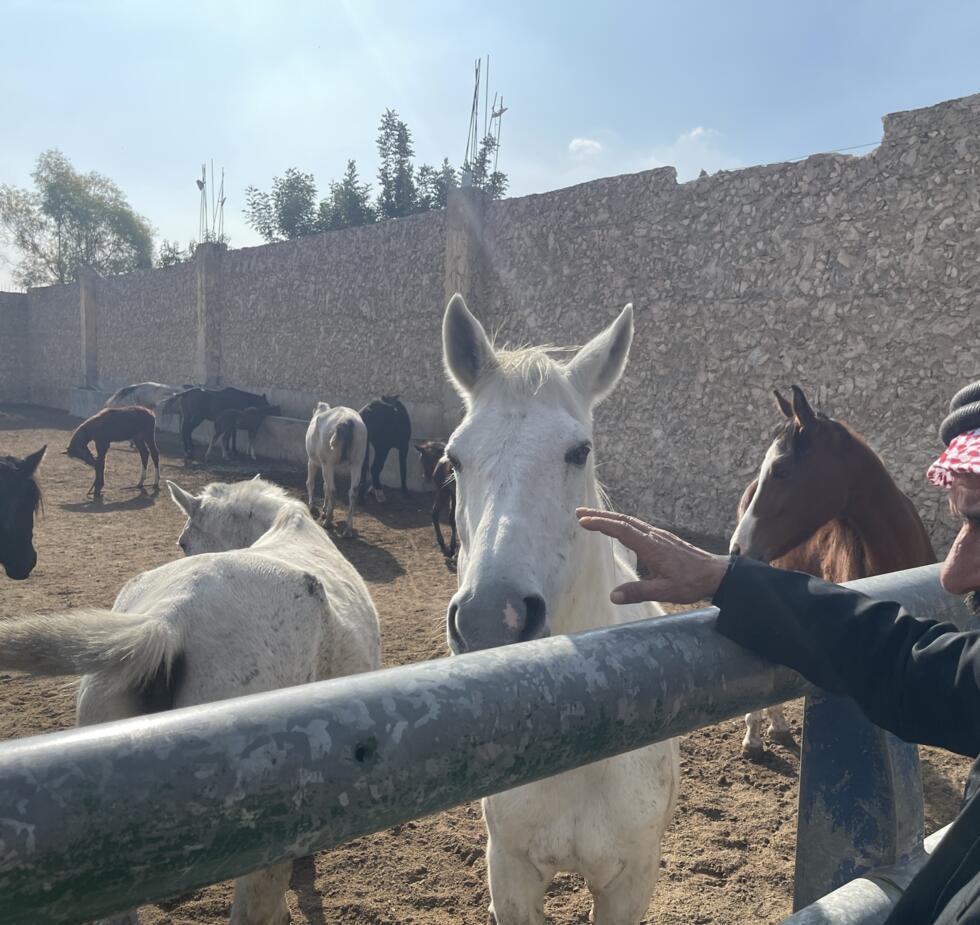 The Meraai family's stud farm in Aleppo. © Wassim Nasr, FRANCE 24
In addition to Sunni reconciliation, the sprawling multi-faith city faces formidable security challenges. On New Year's Day, a member of the internal security forces was killed while preventing a suicide bomber from attacking a Christian celebration. His funeral was attended by senior officials including the interior minister as well as representatives of Aleppo’s Christian churches.
A few kilometres north of the city, residents of the Shiite villages of Nubl and Zahra live under heavy protection from the Syrian army. As soon as Aleppo was captured in late 2024, the villages sent representatives to the city to obtain security guarantees. Once again, Jihad Issa al-Sheikh, the presidential adviser, acted as mediator. Since then, “there has been only one murder”, said a local representative in Nubl. “In the early days, the local (HTS) commander slept here on the floor to ensure that there would be no abuses.”
But the situation remains precarious for the Shiite villagers, who are mindful that nearby Sunni villages are still in ruins. “Our [Sunni] neighbours see that we are protected, while they are unable to rebuild their villages and are still living in tents,” said the Nubl resident. “One can imagine and understand what they are going through.”
Clan leaders gather in Damascus
On December 9, the Damascus home of Sheikh Abdel Menaam al-Nassif hosted a high-level meeting of clan representatives from across Syria, presenting the Office of Clans and Tribes with an ideal platform to send a message.
Addressing the assembly of senior clansmen, Jihad Issa al-Sheikh said the office was “not designed to command you or replace you, but rather to serve as a direct line to President Sharaa”. He then issued an advice to clans tarnished by collaboration with the deposed regime.
“Those clans that were on Assad’s side should keep a low profile and put forward figures who have not been compromised. We need everyone,” he added. “We must turn the page on old quarrels once and for all by supporting the state and not being a source of destabilisation.”
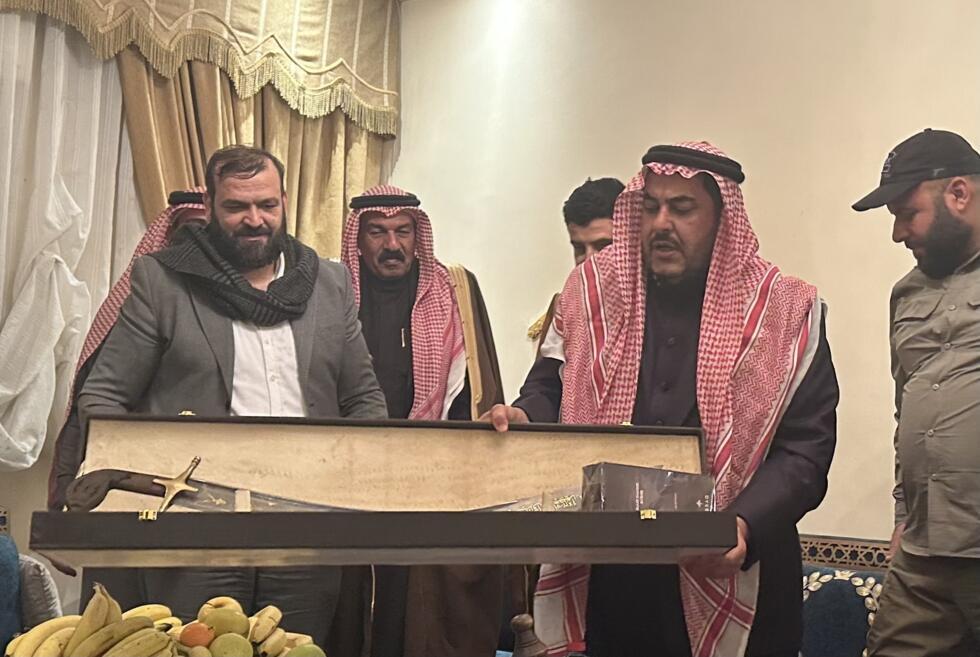 Jihad Issa al-Sheikh (left), a key Sharaa aide and head of the Office of Tribes and Clans, attends a meeting in Damascus in December 2026. © Wassim Nasr, FRANCE 24
Referring to recent sectarian classes, the top Sharaa aide said it was “unacceptable for clans to take up arms at the slightest incident or to join the ranks of our enemies for one reason or another”. He added: “We must rise to the challenges we have faced since the liberation of the country.”
General Hamza al-Hmidi, the head of operations for the Syrian armed forces, then spoke of the deadly summer clashes in Sweida, which saw Bedouin tribesmen converge on the southern province to fight local Druze militias, and led Israel to intervene militarily with strikes on security forces deployed to quell the bloodshed.
“We were faced with militiamen firing at us at the front and with killers and looters in our wake. These actions, which do not reflect our values, gave (the Israelis) a pretext to bomb us, forcing us to leave the city in the hands of (Druze) militiamen,” lamented the young general.
Read moreExclusive: On the ground in Sweida, a Syrian city torn by Druze-Bedouin clashes
The meeting touched on the sensitive subject of cronyism and political appointments, with clan leaders urged to present qualified candidates for administration jobs and the future National Assembly – and to refrain from promoting themselves or their relatives. The message was that the Baath party ways of coopting tribal and clan leaders through clientelism would no longer be accepted.
The meeting, attended by two representatives of Syria’s new political bureau, led to animated debate. The idea of a "Council of Elders" composed of clan leaders was put forward – a means to preserve their status and influence while separating their role from that of political institutions.
It’s a delicate balance for Syria’s new rulers, for whom gaining the support of clans necessarily means making concessions, including material ones, particularly in areas that are still outside Damascus’s control.
Preventing vendettas in Hama and Homs
The office’s Hama branch had its baptism of fire in the wake of two particularly grisly murders in nearby Homs, which kicked off attacks on Alawite neighbourhoods. Its primary mission was clear: to ease tensions in Syria’s third most populous city.
In the days following the murders, representatives of various clans acted quickly to prevent an escalation, under the coordination of Sharaa’s adviser al-Sheikh. The investigation revealed that the murders of a married couple, initially presented as sectarian, were in fact an internal family affair. A joint letter from community leaders helped to tamp down reprisals and narrowly avert bloodshed.
Sheikh Abu Jaafar Khaldoun, head of the Hama office, stressed the importance of inter-community dialogue. “We need to start from scratch and rebuild neighbourly relations,” he said. “This involves simple gestures, such as attending funerals.”
Khaldoun said interactions with the Alawite, Ismaili and Christian communities helped to defuse tensions after rebel forces took over Hama and then Homs.
‘We wasted no time after liberation, for fear of reprisals between communities, and even within each community,” he explained. “The first few months were tense, and some people took advantage of the situation to settle old scores.”
In Idlib, a laboratory for reconciliation
A rebel bastion and launchpad for the lighting offensive that toppled Assad, northwestern Idlib province has also served as a model for the type of conflict resolution advocated by Syria's new leaders.
Starting in 2017, Sharaa’s HTS began to work with local clans with a pragmatic goal: to resolve conflicts between rival factions in areas outside the regime's control, drawing on clan ties shared both by residents and the province’s large number of internally displaced people. After a series of military setbacks in 2019, the clans were gradually integrated as a supporting force for HTS and the "Syrian Salvation Government" that administered the rebel holdout.
This dual experience, both military and mediatory, is the foundation of the new Office of Clans and Tribes, whose leaders are largely drawn from the ranks of Idlib’s displaced population.
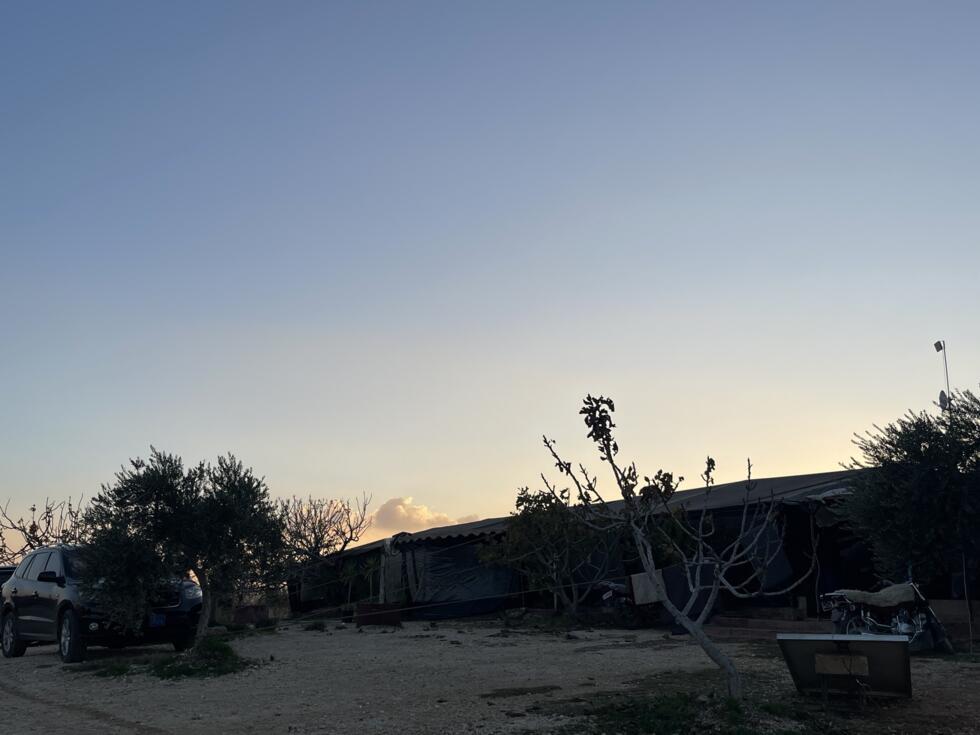 A tent used by the head of the office's Idlib branch in the northwestern province. © Wassim Nasr, FRANCE 24
A key role of the office’s local branch is to maintain a link between the new Syrian authorities and displaced people from eastern Syria. The latter include both the clans based in areas controlled by the Kurdish-led Syrian Democratic Forces (SDF) and displaced people from Raqqa, Hassaka or Deir ez-Zor – populations often buffeted by war, forced displacement and shifting alliances.
Efforts to tilt the tribal balance have weighed heavily in recent military realignments. Most recently in Aleppo and months before in nearby Manbij, shifts in clan alliances have facilitated the recapture of entire neighbourhoods previously held by Kurdish forces, illustrating the decisive role played by Jihad Issa al-Sheikh and his office in reshaping the balance of power on the ground.
For the new regime, the stakes are primarily political and security-related. The eastern provinces provide most of the SDF's recruits while at the same time constituting a potential breeding ground for jihadist groups. To alienate them once more would be to repeat the mistakes that in the past pushed certain clans into the arms of the Assad regime, Kurdish forces or the Islamic State (IS) group.
Read moreTaking stock of Sharaa’s rule in Syria, one year after the fall of Assad
Reassuring the Sunni majority and healing the deep divides left by years of war is a matter of survival for the new Syrian authorities. Lasting stability can only come from internal dynamics, driven by Syrians themselves. In this context, the Office of Tribes and Clans holds a key place at the intersection of community tensions and the most sensitive security issues. The stated objective is not to marginalise the clans, but to integrate them as actors of stabilisation.
The authorities are claiming a number of results since the office’s creation, including de-escalation in Homs, the management of protests in coastal areas home to many Alawites, and a gradual decline in assassinations targeting former members of the Assad regime. Despite the recent deadly clashes in Aleppo, the ability to prevent a major escalation in fighting over sensitive neighbourhoods previously held by Kurdish factions is also presented as concrete illustration of this new approach.
This article was translated from the original in French.






 English (US) ·