
France has banned Israel’s far-right national security minister, Itamar Ben-Gvir, from entering the country, joining a growing number of European countries to denounce Israel’s alleged abuse of the activists from the Global Sumud Flotilla, many of whom returned in recent days to their home countries after being detained last week by Israel while attempting to deliver aid to Gaza.
Last week, Ben-Gvir posted on social media a video of himself taunting flotilla activists that were detained by Israeli forces as they headed for Gaza in an attempt to break Israel’s naval blockade. The videos include a clip of Ben-Gvir waving an Israeli flag over the detainees who appear hunched over on the ground with their hands bound and a clip of him smiling and chanting “Am Yisrael Chai”—Hebrew for “The nation of Israel lives”—at a detainee. Other clips showed detainees being pushed down to the ground, and detainees with their foreheads pressed against the floor, surrounded by armed guards as the Israeli national anthem plays.
The videos sparked public outcry, with several European countries calling for the European Union to sanction Ben-Gvir, and some, including France, taking their own steps to ban him from entry.
The day's top headlines, curated by TIME editors.
“As of today, Itamar Ben-Gvir is banned from entering French territory. This decision follows his unspeakable actions toward French and European citizens who were passengers on the Global Sumud Flotilla,” French Foreign Minister Jean-Noël Barrot posted on X on Saturday. “We cannot tolerate that French nationals can be threatened, intimidated or brutalized in this way—all the more so by a public official.”
Israeli Prime Minister Benjamin Netanyahu condemned Ben-Gvir’s actions on Wednesday, calling Ben-Gvir’s actions “not in line with Israel’s values and norms.” Israeli Foreign Affairs Minister Gideon Sa’ar also criticized Ben-Gvir, saying in a post last week, “you are not the face of Israel.”
The ministers did not comment on the broader allegations of abuse of the 428 detainees by Israeli forces. The Israel Prison Service told media outlets that the allegations of abuse are false. TIME has reached out to Netanyahu’s office and the Israel Prison Service for comment.
Flotilla detainees alleged Israeli abuse
Israeli forces intercepted the 50-boat flotilla in international waters around 250 miles off the coast of Israel beginning on May 18. Those on board the flotilla included activists, journalists, and at least one Italian lawmaker, who set sail from the Turkish district of Marmaris on May 14. Flotilla activists have said that their aim is to challenge Israel’s naval blockade of Gaza in order to deliver much-needed humanitarian aid to Palestinians.
The detainees described experiencing abuse and torture by Israeli forces to the Associated Press. These descriptions included being physically beaten, dragged by the hair, attacked with dogs, tased, and verbally humiliated. Other detainees alleged sexual assault, including “humiliating strip searches, sexual taunting, groping and pulling of genitals, and multiple accounts of rape.” The Israel Prison Service broadly denied allegations of abuse.
Italian lawmaker Danilo Della Valle said the flotilla activists that returned to Italy reported incidents of “public exposure in handcuffs and chains, physical and psychological violence, degrading treatment and violations of human dignity.” Italian prosecutors are reportedly investigating possible crimes of kidnapping, torture, and sexual assault against the activists.
A German Foreign Ministry spokesperson told Reuters that consular officials reported that activists returning to Germany had injuries and that the ministry expects a “full explanation.” Five French activists had also been hospitalized in Turkey, some with broken ribs or fractured vertebrae, Reuters reported.
The detainees, hailing from more than 40 countries, have all been deported, according to Israel’s foreign ministry.
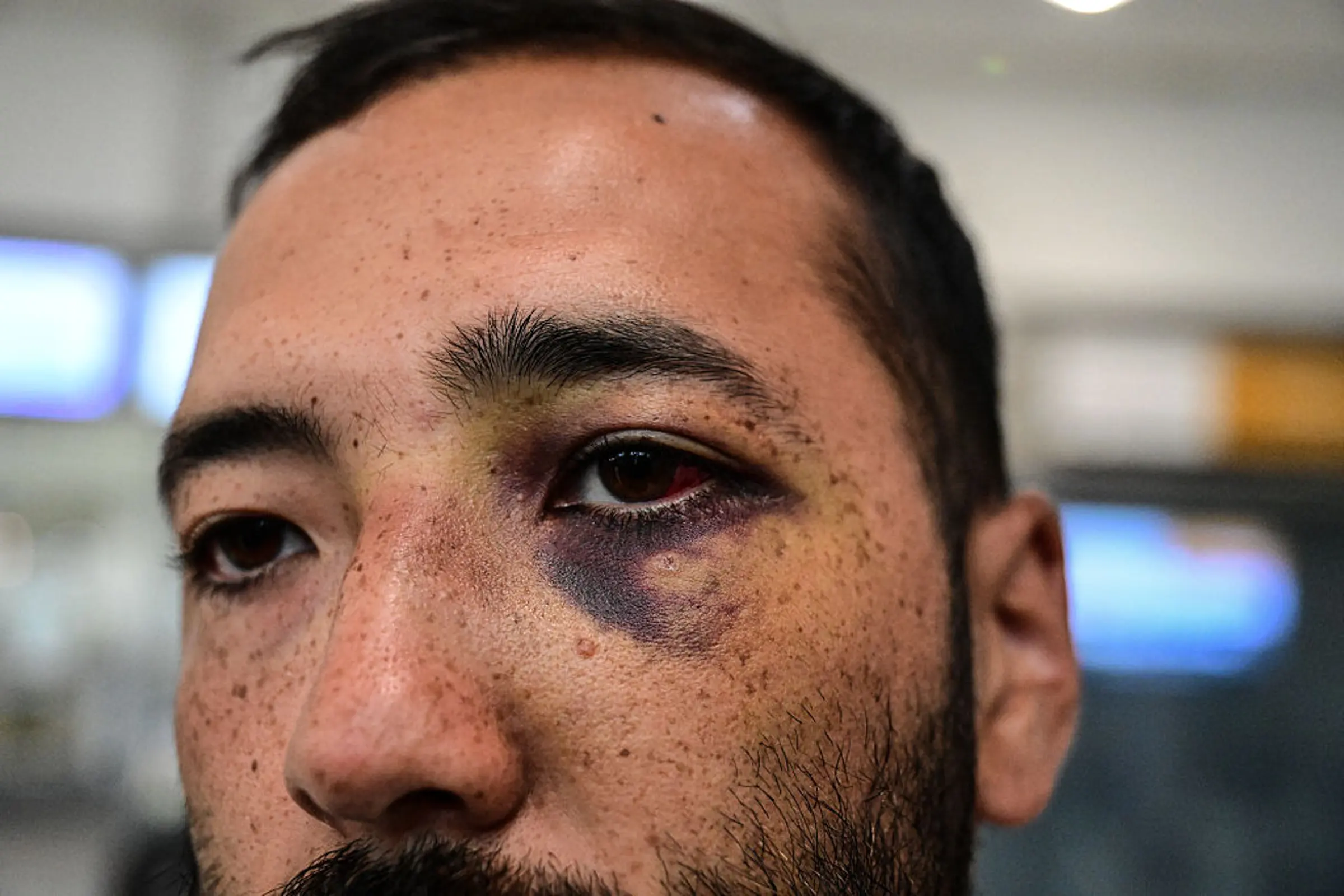
A man named Suza, one of the Americans who had participated in the Global Sumud Flotilla to Gaza, shows a bruise on his eye he said he received while in Israeli captivity after returning to John F. Kennedy Airport in New York City on May 24, 2026. Stephanie Keith—Getty Images
E.U. to consider sanctions
A growing number of countries have condemned Israel’s alleged mistreatment of the flotilla activists.
France joined Poland, which announced a five-year entry ban on Ben-Gvir on Thursday.
“In the democratic world we do not abuse and gloat over people in custody,” Polish Foreign Minister and Deputy Prime Minister Radosław Sikorski posted on X. “You may not treat Polish citizens who have committed no crime in this way.” In an interview, Sikorski added that Ben-Gvir is “a chauvinist and attention-seeker, so he’s a threat to public order in Poland.”
The U.K., Canada, Australia, New Zealand, and Norway had already imposed a travel ban on Ben-Gvir last year, as well as Israeli Finance Minister Bezalel Smotrich last year, accusing the ministers of inciting violence against Palestinians in the occupied West Bank.
Italy also formally asked the E.U. to weigh sanctions against Ben-Gvir, with France, Ireland, Spain, and several other European nations backing the request.
Della Valle said on Thursday that he and dozens of other members of the E.U. parliament had called for penalties for Ben-Gvir and others responsible for the abuse. “The images released by Israeli Minister Ben-Gvir are terrifying: men and women surrounded by armed soldiers, forced to listen to the Israeli anthem after being stopped in international waters. Scenes we never wanted to see in 2026,” Della Valle posted.
Several countries, including Italy, France, the Netherlands, Poland, and Canada have also summoned their Israeli ambassadors over the alleged mistreatment. Others have expressed formal diplomatic protests, Della Valle said.
The detentions, as well as Israel’s earlier interceptions of Gaza-bound flotillas in international waters, have raised questions around what actions are legally permissible to enforce a blockade.
The detentions of the flotilla activists come after the E.U. levied targeted sanctions on Israeli settlers and settler organizations that had committed violence against Palestinians in the West Bank. Those sanctions, which had been blocked for months by Hungary under Viktor Orbán, moved forward after Hungary’s new pro-E.U. government took office earlier this year.
Several European countries, including France, Belgium, and the U.K., as well as Canada and Australia, have also recognized Palestinian statehood in recent months, challenging Israel’s opposition to Palestinian sovereignty and a two-state solution. Five countries—Spain, the Netherlands, Ireland, Iceland, and Slovenia—also withdrew from or boycotted Eurovision this year over the inclusion of Israel, which placed second.
Now, some E.U. members are calling for further action from the bloc. In a letter to the European Council from Irish Prime Minister Micheál Martin that was obtained by the AFP, Martin called on the E.U. to ban “products from Israeli settlements and the suspension of parts if not all of the E.U.’s Association Agreement with Israel.” Del Valle also called for a suspension of the June 2000 agreement, which created a framework for cooperation, including a clause requiring respect for human rights.
The possibility of sanctions will be discussed at the next E.U. Foreign Affairs Council meeting on June 15.








 English (US) ·