
 1 month ago
70
1 month ago
70
 Rather than adapting to persistent low fertility, population ageing, and slower labor-force growth, many governments continue to pursue policies aimed at reversing these trends and restoring demographic conditions more characteristic of the mid-20th century. Credit: Shutterstock
PORTLAND, USA, July 3 (IPS) - Demographic realities are well documented, and governments have long been aware of the profound demographic changes now underway. Nevertheless, many policymakers continue to discount or ignore these demographic trends.
This reluctance often reflects the tension between short-term political priorities and long-term demographic realities. As a result, governments are frequently unwilling to acknowledge the full scale of the major demographic transformations reshaping their societies.
In some cases, demographic denialism serves to protect entrenched political or economic interests. More often, however, it reflects an unwillingness to confront politically difficult policy choices, such as raising taxes, expanding immigration, increasing retirement ages, or committing additional resources to pensions, healthcare, and other social welfare programs.
Because demographic change typically unfolds gradually, politicians often prioritize policies that deliver immediate political or economic benefits over reforms designed to address long-term challenges such as population decline and demographic ageing. Electoral incentives and short-term political considerations often outweigh the need to adapt to evolving demographic realities.
Governments may also downplay demographic trends because doing so enables them to pursue short-term political priorities and ideological objectives while postponing the more difficult fiscal and policy adjustments required by demographic change.
Moreover, some policymakers continue to pursue measures intended to restore the demographic patterns of the recent past, despite the limited likelihood that such efforts will succeed.
The demographic conditions of the 20th century were historically exceptional. Population growth, fertility rates, age structures, declining mortality, and gains in life expectancy all reached unprecedented levels, particularly during the second half of the century. These conditions were the product of a unique combination of historical, economic, technological, and public health factors and are unlikely to be repeated. Rather than attempting to recreate the demographic environment of the past, governments should focus on adapting institutions, policies, and public finances to contemporary demographic realities.
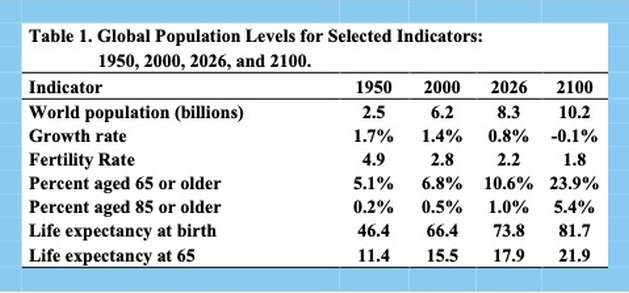
The world’s population nearly quadrupled during the 20th century, rising from 1.6 billion in 1900, to 2.5 billion in 1950, and then to 6.2 billion by 2000.
Today, the global population is approximately 8.3 billion, more than five times its size in 1900. Although the world’s population is expected to continue growing, the rate of growth has slowed dramatically. According to current projections, the global population is expected to peak at approximately 10.3 in the mid-2080s before declining slightly to around 10.2 billion by the end of the century (Table 1).
 Source: United Nations.
The world’s population growth rate, which was 1.7% in 1950, rose to a peak of about 2.3% in the early 1960s. By the end of the 20th century, it had declined to about 1.4%. In 2026, the global growth rate is estimated at approximately 0.8% and is projected to continue decreasing, reaching about -0.1% by the end of the century.
Moreover, many countries are already experiencing population decline, with deaths exceeding births. In 63 countries, home to about 28% of the world’s population, population size has already peaked. Over the next thirty years, the populations of an additional 48 countries and areas are also expected to reach their peak before entering a period of decline.
Fertility levels have also fallen dramatically from the relatively high levels of the mid-20th century. The global fertility rate, which averaged more than five births per woman in the late 1950s, had declined to about half that level by the beginning of the 21st century. By 2026, the world’s fertility rate is estimated at approximately 2.2 births per woman. Furthermore, more than half of all countries now have fertility rates below the replacement level of approximately 2.1 births per woman.
Population ageing is another defining demographic trend. In 1950, only about 5% of the world’s population was aged 65 or older. By 2026, that proportion had more than doubled to nearly 11%. The proportion of the population aged 85 and older has increased even more rapidly, rising from just 0.2% in 1950 to about 1% in 2026.
As populations age, people are also living longer than ever before. Global life expectancy at birth has increased substantially, from about 46 years in 1950 to approximately 74 years in 2026.
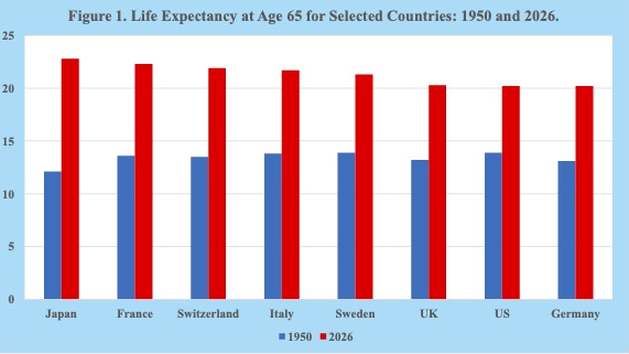
Life expectancy at age 65 has also risen substantially. Globally, it increased from about 11 additional years in 1950 to approximately 18 additional years by the mid-2020s. In many countries, however, the gains have been greater, with life expectancy at age 65 exceeding 20 years. In Japan and France, for example, a 65-year-old can expect to live approximately 23 additional years (Figure 1).
 Source: United Nations.
Rather than adapting to persistent low fertility, population ageing, and slower labor-force growth, many governments continue to pursue policies aimed at reversing these trends and restoring demographic conditions more characteristic of the mid-20th century.
In many low-fertility countries, governments have devoted substantial public resources to pro-natalist measures such as cash transfers, tax incentives, subsidized childcare, and housing assistance. While these policies may ease short-term financial constraints for families, they have generally produced only modest and often temporary increases in fertility rates.
At the same time, despite rising old-age dependency ratios and persistent labor shortages, immigration policy remains politically contentious, and, in some countries, highly restrictive. This has occurred alongside growing fiscal strain on pay-as-you-go pension systems and increasing demand for healthcare and long-term care services.
Although life expectancy continues to increase, especially at older ages, reforms such as gradually raising retirement ages, broadening the tax base, restructuring pension systems, and adapting healthcare financing have often advanced slowly because of political resistance. As a result, fiscal adjustments frequently lag behind demographic change, contributing to mounting budgetary pressures and, in some cases, greater intergenerational tension.
In some countries, political leaders have responded to inconvenient demographic trends by weakening the independence of statistical agencies, reducing funding for demographic research and data collection, firing statisticians, sidelining professional expertise, or publicly questioning well-established demographic evidence. Such actions can make it more difficult for policymakers and the public to assess demographic change accurately, evaluate policy options, and develop effective long-term responses.
Similarly, rather than modernizing public safety nets, diversifying revenue sources, or implementing gradual reforms to retirement and pension systems, many governments postpone difficult policy decisions to minimize electoral backlash. Prolonged delays, however, can undermine the long-term financial sustainability of public programs and increase the likelihood that pension and social insurance trust funds will become insolvent or require abrupt corrective measures.
Another form of political avoidance is the maintenance of restrictive immigration policies despite persistent labor shortages. In many countries, immigration has historically helped offset population decline driven primarily by sustained below-replacement fertility. Without sufficient immigration, population decline and demographic ageing are likely to accelerate in these societies.
The major demographic shifts of the 21st century – including population decline, demographic ageing, sustained below replacement fertility, increasing longevity, migration, refugee movements, and asylum pressures – are well documented and widely recognized. Nevertheless, many governments continue to prioritize efforts to reverse these trends while devoting comparatively less attention to adapting institutions and public policies to long-term demographic realities.
Rather than focusing primarily on restoring the demographic conditions of the recent past, policymakers may benefit from placing greater emphasis on adapting economic, fiscal, and social institutions to the demographic realities of the present and the decades ahead. Such an approach recognizes demographic change not as a temporary departure from historical norms, but as a defining structural feature of the 21st century that requires sustained institutional adaptation rather than attempts at demographic restoration.
Joseph Chamie is a consulting demographer, a former director of the United Nations Population Division, and author of numerous publications on population issues.
© Inter Press Service (20260703112930) — All Rights Reserved. Original source: Inter Press Service










 English (US) ·