
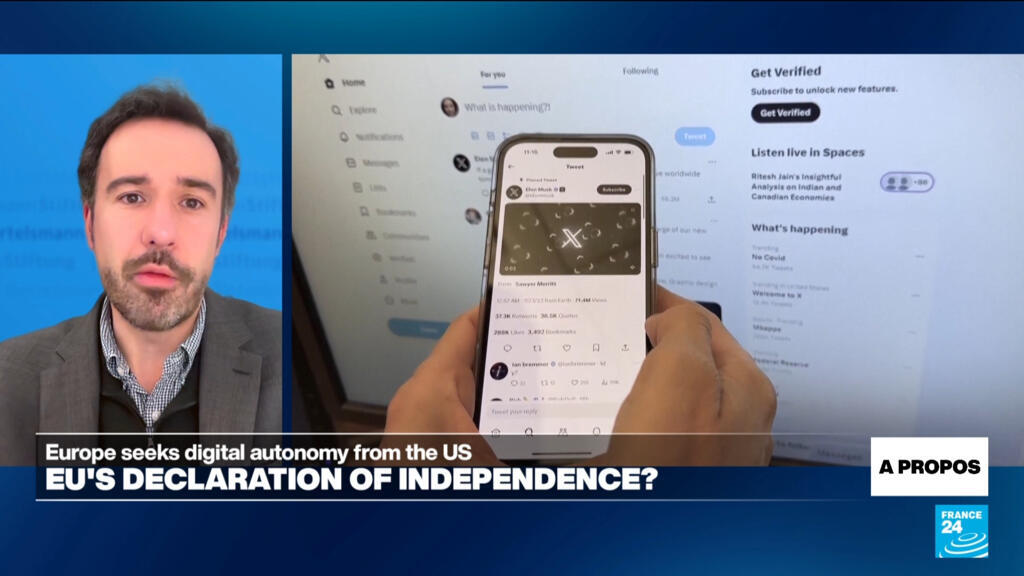
Digital sovereignty in Europe is not just an issue for states and companies. “We've had almost 8,000 participants who've signed up for the campaign in less than a month. That's more than we were expecting,” said Bergliot Christensen, who took part in the launch in early January of the Danish initiative Digital Stemme (“Digital Voice”), which aims to help individuals regain control of their digital lives from the Big Tech giants.
“We launched our initiative on January 1, right around the time that US President Donald Trump started accelerating his rhetoric about invading Greenland,” Christensen said.
To display this content from YouTube, you must enable advertisement tracking and audience measurement.
One of your browser extensions seems to be blocking the video player from loading. To watch this content, you may need to disable it on this site.
 A PROPOS © FRANCE 24
10:56
“And I think that just made everything click in a new way where we don't just need to talk about how these things are an issue, we need to start acting – and we need to do it now.”
Read moreEurope’s digital reliance on US Big Tech: Does the EU have a plan?
David versus Goliath
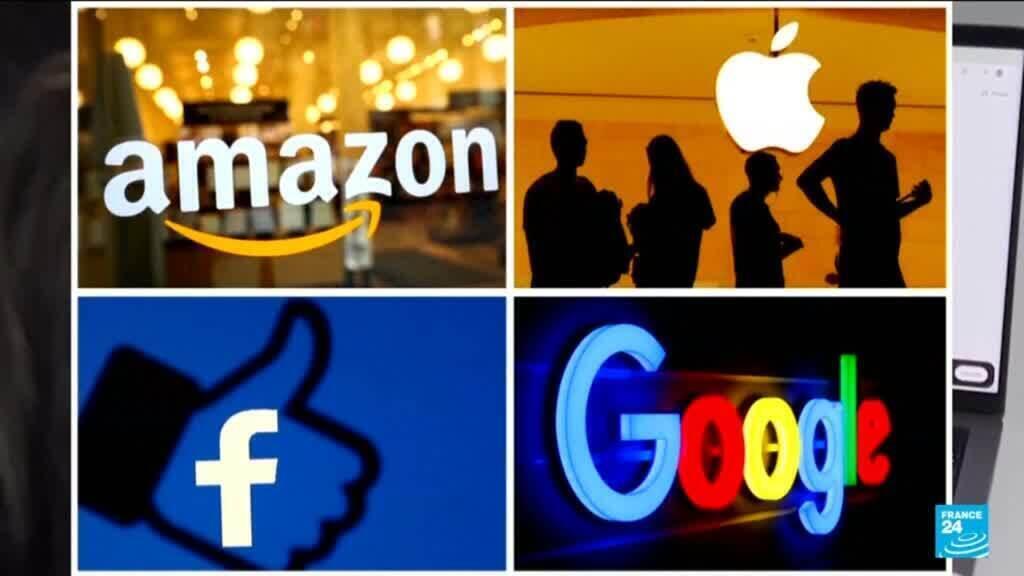
Tech giants have become so embedded in modern life that it is easy to forget how much power and influence they have over normal people just living their lives.
Christensen said there has long been “a feeling that something isn't right with the way that we all assembled online communities that don't always have our best interests in mind”.
“Then, shortly after Trump’s election, that photo of him posing with all the major tech bosses, looking smug, came to reinforce that impression,” she said.
While Danes have found themselves on the front lines of the pressure campaign from Donald Trump, they are not the only ones developing a technological aversion to anything “Made in USA”.
In Germany, the Chaos Computer Club – Europe’s oldest and largest hacktivist group – launched “Digital Independence Day,” or DI-Day, on January 6.
The initiative consists of monthly meetings across Germany, held on the first Sunday of each month, aimed at helping beginners “de-Google” their habits.
“We want to offer concrete, free and gradual help to get rid of American services. The idea is to turn a process that can seem tedious and technical into something rather fun and collaborative,” said Jochim Selzer, one of the Chaos Computer Club’s spokespersons on “digital self-defence”.
The aim is not to do everything at once. “For example, we first try out LibreOffice. Then, at the following event, we try switching from X to Mastodon. On the third meeting, we add Signal to our phones,” Selzer said.
In France, the French Data Network, a group promoting free software, backed the DI-Day initiative.
These Danish and German efforts may look like militant acts – and in part, they are.
Read moreAs Europe aims for 'digital sovereignty', biomedical agentic AI could be the next big field
But Trump’s threats to use technological leverage to pressure Europe do not concern only state sovereignty and the competitiveness of European companies.
“It's also an issue for individuals. Personally, I'm worried about my children and my grandchildren,” said Harald Wehnes, spokesperson for the Digital Sovereignty working group of the German Informatics Society.
Washington’s ‘digital colonies’?
A computer scientist at the University of Würzburg, Wehnes published an open letter denouncing what he calls “American technological imperialism”, which he says aims to turn Europe and its inhabitants into a “digital colony” of Washington and Big Tech – powerful multinationals such as Google, Meta and Amazon.
“Digital platforms [Facebook, Instagram, X] control the flow of information,” said Martin Hullin, director of the European Network for Technological Resilience and Sovereignty at the Bertelsmann Foundation, a German thinktank.
“Algorithms can polarise and disinformation can also undermine social cohesion,” he added.
To display this content from YouTube, you must enable advertisement tracking and audience measurement.
One of your browser extensions seems to be blocking the video player from loading. To watch this content, you may need to disable it on this site.
 © France 24
01:44
There are precedents. “The Cambridge Analytica scandal in 2018 showed how data available on social networks can be exploited to influence user behaviour,” warned Frans Imbert-Vier, chief executive of the Swiss technology consulting firm UBCOM and an advocate of technological independence.
The collection of personal data on Facebook allowed Cambridge Analytica, a data analysis firm, to tailor political advertisements in an effort to influence US voters in 2016.
And those who oppose such practices may face consequences from the tech giants, who have little interest in relinquishing their position.
“Two German activists that are fighting hate online have been doing so very well for the past years that they ended up being banned from traveling to the US,” Hullin said.
The ban was imposed on the grounds that they were acting against freedom of expression.
German authorities denounced the decision as an attempt to impose a vision of free speech on Europeans that serves the purposes of Trump and billionaire X owner Elon Musk.
Risk of becoming the ‘social black sheep’
Christensen fears that digital dependence on these platforms has already backfired on Europeans amid the stand-off between Europe and Washington.
“I can’t prove it, but during a rally some people found that their posts about this event were not getting as much traction and reach on Facebook as they used to. And that naturally led to the question, is Facebook suppressing information about this demonstration in Denmark?”
“We shouldn't tolerate having our discussions controlled by external forces located in a country with which we are in conflict,” she added.
Individuals targeted by the US administration could find themselves cut off from key aspects of digital life, with tangible consequences.
“What happens if you no longer have access to certain online payment methods or shopping sites where you used to buy your groceries?” Hullin asked.
Without Apple Pay, PayPal or access to Amazon, digital life can quickly become much more complicated.
Wanted: Alternatives to US Big Tech
While the Trump administration once championed “alternative facts”, America's Big Tech firms are no fans of alternatives to their tools and platforms. Competitors are required to fend off accusations of monopoly, but they remain largely invisible, crushed by “the massive marketing budgets that tech giants have been showering on the public for decades”, says Martin Hullin, head of the European Network for Technological Resilience and Sovereignty at the Bertelsmann Foundation, a German think tank.
Yet there is a world beyond Gmail, Word, X, Chrome and Apple. Europe, in particular, is home to “many small companies with very interesting ideas and products that are sometimes of better quality than their American equivalents”, argues Frans Imbert-Vier, CEO of technology consulting firm UBCOM and a key advocate of European technological independence.
The hard part is often finding them. Who, for example, has ever heard of Olvid, a French alternative to WhatsApp and text messaging?
France’s Emmanuel Macron has sought to set an example with his “start-up nation” slogan. His government has developed a whole batch of homegrown digital tools to escape American control, aiming to replace Teams with “Visio”, Google Drive with “Files”, and WeTransfer with “FranceTransfer”.
With strained EU-US relations leading to renewed interest in technological sovereignty, some experts in the field have posted catalogues of alternative solutions online.
For each American software programme, Austrian IT developer Constantin Graf has compiled an almost exhaustive list of European alternatives. The ambitious German project Digital Independence Day is less exhaustive but more educational. Its website offers step-by-step instructions on how to switch, for instance, from PayPal to Wero, a European mobile payment system.
Read moreAs EU stalls, France goes it alone with special tax on tech giants
Activists from the Chaos Computer Club and the organisers of Denmark’s Digital Stemme initiative acknowledge that detoxing from GAFAM is hard. “Individuals are embedded in an American digital ecosystem where they can connect with family, colleagues and friends. If they leave it, they become the social black sheep,” Imbert-Vier said.
Many non-American alternatives also struggle to attract users.
“It's no fun being on the most perfect social network if nobody else is there,” Christensen said.
That is why most advocates of digital autonomy stress the urgency of acting now – while frustration with the US remains strong enough in Europe to trigger a sizeable shift toward European digital options.
But there is reason to be circumspect.
“There was similar interest in [digital sovereignty] issues in 2013 after Edward Snowden’s revelations about NSA surveillance. But it didn't last long,” Selzer said.
Read the three parts of our investigation into European digital sovereignty:
– Have Trump’s threats spurred a European awakening?
– Can Europe’s businesses survive without US Big Tech?
– Are European citizens trapped by US Big Tech?
This article was translated from the original in French.





 English (US) ·