
When a German business lobby asked IT executives how they would fare without access to US technology, their reply offered a sobering reality check for champions of European autonomy.
More than 95% said they wouldn’t survive two years if the United States cut off access to its digital technologies and services, according to the survey carried out last year by Bitkom, Germany’s largest digital industry association.
Compared with earlier surveys, Bitkom’s findings pointed to growing pessimism about the resilience of German businesses at a time of heightened tensions between the Trump administration and Europe.
Read moreDigital sovereignty (1/3): Have Trump’s threats spurred a European awakening?
There is widespread fear that Europe’s businesses could end up as collateral damage in the event of a deeper transatlantic fallout, says Bertrand Trastour, global sales director for Stormshield, an Airbus subsidiary specialising in sovereign cybersecurity solutions.
“It's clearly on people’s minds,” Trastour acknowledges. “I’m using an American smartphone as we speak. What would we do without it? We don't have any viable alternatives in Europe for certain types of equipment.”
Smartphones, chips, software
According to the Bitkom survey, an abrupt shortage of high-tech gear from the likes of Apple or Google is a key concern voiced by German business, for whom coping without US-made smartphones, laptops or tablets is inconceivable.
It's not just the American hardware that Europe’s businesses depend on. “One wonders what would happen if US software publishers were to suspend the licences they provide for European companies,” Trastour says.
Without access to customer relationship management (CRM) tools provided by California-based Salesforce, for instance, many factories in Europe would be forced to drastically scale back their operations, resulting in layoffs.
Washington could also choose to place export controls on certain advanced technologies, mirroring steps already taken to curb the rise of China’s AI industry.
To display this content from YouTube, you must enable advertisement tracking and audience measurement.
One of your browser extensions seems to be blocking the video player from loading. To watch this content, you may need to disable it on this site.
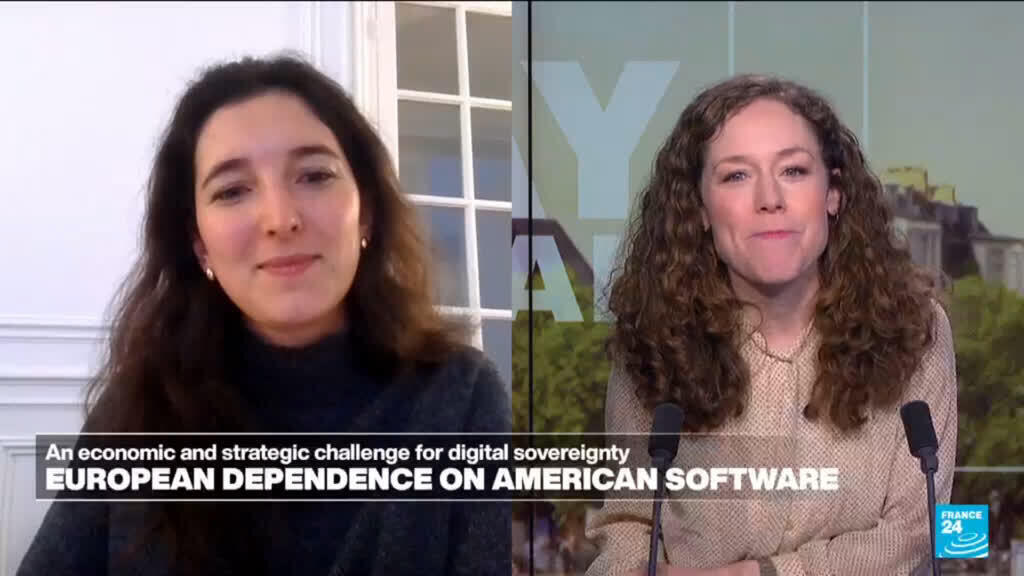 © France 24
09:17
Limiting chip exports to Europe would significantly curtail research and development on the continent, warns Christophe Grosbost, chief strategy officer at the Innovation Makers Alliance.
“We are very dependent on GPUs, the graphics chips sold mainly by Nvidia, which are used to run the data centres where information is stored to train AI models,” Grosbost explains.
The costs of ‘decoupling’
But European companies are not entirely helpless, says Trastour, whose company provides cybersecurity solutions that are strictly “French- or European-made".
“The goal is to build technological autonomy,” Trastour explains. “We cannot completely wean off US tech, but by using European functional building blocks [software that performs specific functions] we can come up with a technological mix that offers a degree of resilience.”
Experts point to an abundance of European tools and services, many of which remain little-known.
Jitsi, a collaborative communication tool developed by Bulgaria's Emil Ivov, is touted as an alternative to Microsoft Teams. European cloud providers like France's OVH and Switzerland's Infomaniak have emerged as viable competitors to larger North American firms.
The French government announced in late January that its 2.5 million civil servants will stop using Zoom, Microsoft Teams and others by 2027 in favour of Visio, a homegrown videoconferencing system.
Wanted: Alternatives to US Big Tech
While the Trump administration once championed “alternative facts”, America's Big Tech firms are no fans of alternatives to their tools and platforms. Competitors are required to fend off accusations of monopoly, but they remain largely invisible, crushed by “the massive marketing budgets that tech giants have been showering on the public for decades”, says Martin Hullin, head of the European Network for Technological Resilience and Sovereignty at the Bertelsmann Foundation, a German think tank.
Yet there is a world beyond Gmail, Word, X, Chrome and Apple. Europe, in particular, is home to “many small companies with very interesting ideas and products that are sometimes of better quality than their American equivalents”, argues Frans Imbert-Vier, CEO of technology consulting firm UBCOM and a key advocate of European technological independence.
The hard part is often finding them. Who, for example, has ever heard of Olvid, a French alternative to WhatsApp and text messaging?
France’s Emmanuel Macron has sought to set an example with his “start-up nation” slogan. His government has developed a whole batch of homegrown digital tools to escape American control, aiming to replace Teams with “Visio”, Google Drive with “Files”, and WeTransfer with “FranceTransfer”.
With strained EU-US relations leading to renewed interest in technological sovereignty, some experts in the field have posted catalogues of alternative solutions online.
For each American software programme, Austrian IT developer Constantin Graf has compiled an almost exhaustive list of European alternatives. The ambitious German project Digital Independence Day is less exhaustive but more educational. Its website offers step-by-step instructions on how to switch, for instance, from PayPal to Wero, a European mobile payment system.
But ditching US tools and systems in favour of European alternatives is far from straightforward, particularly for large companies that operate internationally, warns Francesca Musiani, head of the Internet and Society Centre at France’s National Centre for Scientific Research (CNRS).
“Large international firms tend to build their entire productivity frameworks on a stack of highly integrated American 'bricks’ such as the cloud, collaborative tools (like Teams), CRM and AI,” she explains. Removing one “brick” risks destabilising the entire system.
Unlike government agencies, Musiani adds, private companies “cannot always invoke sovereignty or national security to justify choosing alternative solutions that are sometimes more expensive or less efficient in the short term”.
Read moreEurope’s digital reliance on US Big Tech: Does the EU have a plan?
Moreover, the bigger players “tend to be risk-averse and inclined to maintain the status quo” rather than migrate thousands of employees and retrain them on new systems, notes Johan Linaker, a specialist in digital sovereignty and innovation at the Research Institutes of Sweden (RISE). This conservative culture “can be counterproductive” if a rapid shift towards European solutions is required.
Smaller, nimbler companies may be quicker to jump on the technological autonomy bandwagon but would still face a bumpy ride.
“It won't happen overnight and it will require investment in training, research and acquisition,” says Frans Imbert-Vier, CEO of technology consulting firm UBCOM and an advocate of European technological independence.
Pointing to such “invisible costs” of decoupling from American technology, Musiani warns that the process “can lead to errors, frustrations and productivity losses”, in turn resulting in a “loss of competitiveness” – particularly in the face of competition from the US.
Short-term thinking
Helping to facilitate this transition is where European authorities need to step in, says Imbert-Vier.
“In 2024, the European Union purchased €111 billion worth of American technology,” notes the UBCOM CEO, for whom part of this expenditure could have been “directed towards supporting European innovation” instead.
To display this content from YouTube, you must enable advertisement tracking and audience measurement.
One of your browser extensions seems to be blocking the video player from loading. To watch this content, you may need to disable it on this site.
 BIOLOGICAL AI © FRANCE 24
08:58
Martin Hullin, director of the European Network for Technological Resilience and Sovereignty at Germany's Bertelsmann Foundation, warns that sticking with a single service provider – i.e., the United States – is “very short-term thinking” that poses a long-term risk to efficiency.
He argues that companies need the courage to take decisions that might be costly in the short term but will ultimately make them more resilient.
Research published last year by Hullin and other economists concluded that Europe needs to invest around €300 billion over 10 years to establish economic sovereignty in technology.
But a failure to do so could prove even costlier in the long run, experts warn.
While decoupling “carries an economic cost, being too dependent on a monopoly across the Atlantic probably carries a greater one”, argues Trastour.
“It’s a strategic decision and it has to be made now.”
This article was translated from the original in French.





 English (US) ·