
Congressional Democrats introduced legislation on Tuesday that they said would eliminate the statute of limitations that has shielded sex traffickers such as the late financier Jeffrey Epstein.
Senate Democratic Leader Chuck Schumer and Representative Teresa Leger Fernandez announced the proposal alongside Epstein victims and Virginia Giuffre's family. The proposal – Virginia's Law – is named after Giuffre, one of Epstein's most prominent accusers, who died by suicide last year.
The bill's fate in the Senate and House of Representatives, which are both controlled by Republicans, is unclear.
However, a bipartisan effort was successful last year to compel the Department of Justice to release all unclassified files in its Epstein investigation.
Epstein files: US Justice Dept has been 'destroyed from within', former prosecutor says
To display this content from YouTube, you must enable advertisement tracking and audience measurement.
One of your browser extensions seems to be blocking the video player from loading. To watch this content, you may need to disable it on this site.
 SPOTLIGHT © FRANCE 24
11:15
"Virginia's dream was to inspire and empower survivors to come forward in a world that too often turns away from abuse and pushes it into the shadows. She wanted to bring light," said Sky Roberts, Giuffre's brother.
A teary-eyed Roberts, speaking at a press conference in the US Capitol, was asked about a photograph that has been made public showing former UK prince Andrew Mountbatten-Windsor with his arm around Giuffre.
Watch more‘Entitled’: UK monarchy and national security at risk over Andrew’s Epstein links
"I think he should show up in front of our Congress," Roberts responded, adding, "He has a lot of questions he needs to answer."
The Democrats' new bill would end the statute of limitations for adult victims or their survivors bringing civil suits, which would include many of Epstein's alleged victims. It broadens victims' legal recourse in additional ways, including covering applicable sex crimes occurring beyond US soil if a US court has jurisdiction.
Though Epstein died in 2019, transparency and accountability for victims of his abuse have led to oversight investigations and passage of the Epstein files law.
DOJ said it has released nearly 3.5 million pages of documents, though some files are heavily redacted. Members of Congress began reviewing unredacted files on Monday. Schumer has been calling for all the unreleased files, which he said number in the millions, to also be made public.
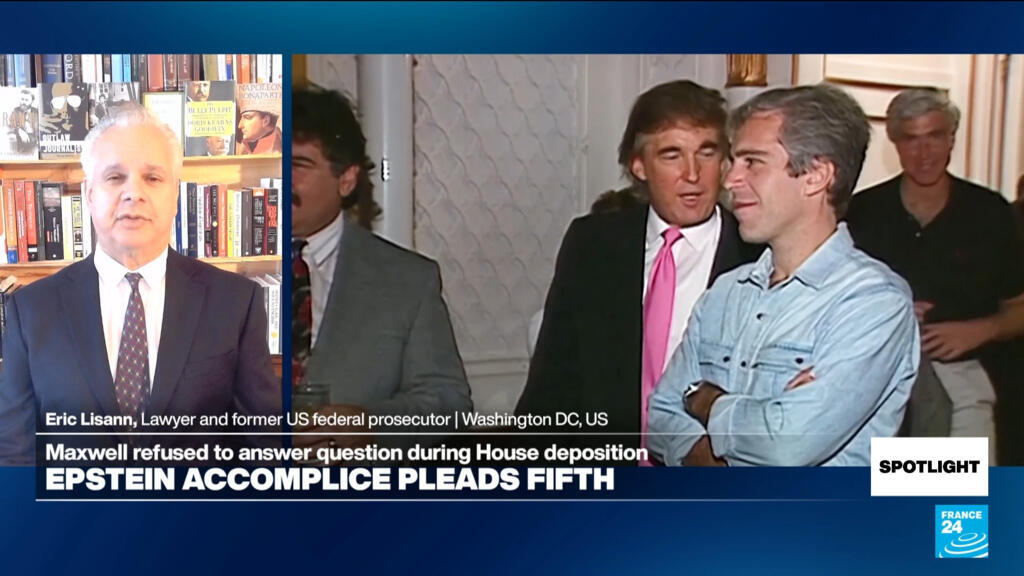
The House Oversight Committee interviewed Epstein associate Ghislaine Maxwell virtually on Monday in a private deposition.
Ghislaine Maxwell refuses to answer questions from congressional Epstein committee
To display this content from YouTube, you must enable advertisement tracking and audience measurement.
One of your browser extensions seems to be blocking the video player from loading. To watch this content, you may need to disable it on this site.
 © France 24
02:02
Maxwell, who was found guilty in 2021 for her role in helping Epstein sexually abuse teenage girls, refused to answer questions. She is serving a 20-year prison sentence.
Former President Bill Clinton and former Secretary of State Hillary Clinton are set to testify separately behind closed doors in the committee's Epstein investigation later this month.
(FRANCE 24 with Reuters)










 English (US) ·