
France dropped on Tuesday to an all-time low in Transparency International’s annual corruption perceptions index, with the organisation warning of “democratic danger” if politicians fail to act.
The Corruption Perceptions Index is compiled by experts and businesspeople who rank 182 countries on their perceived corruption levels in the public sector based on data from institutions including the World Bank and the World Economic Forum.
Countries score between zero, for those seen as highly corrupt, and 100, for those seen as very clean. In the 2025 edition released on Tuesday, Denmark ranked top with 89 points and South Sudan lowest with a score of 9.
France was given a score of 66 points, one point lower than 2024, and slipped down in the overall rankings to 27th place – its worst performance since the index, which was created in 1995, implemented its current methodology in 2012.
France’s poor score comes on the back of three high-profile corruption cases that dominated headlines last year.
A Senate report released in May found that the French government covered up consumer fraud by food giant Nestle, allowing the company to use prohibited treatments to produce "natural" mineral waters, including Perrier.
Ex-president Nicolas Sarkozy was imprisoned for 20 days in October after being found guilty of illegally seeking funding for his successful presidential campaign from former Libyan leader Muammar Gaddafi.
And, in an ongoing scandal, far-right leader Marine Le Pen and others from her National Rally party were found guilty in March of embezzling European Parliament funds.
Le Pen appeared in a Paris court this week to appeal the verdict which, if upheld, will ban her for running in the 2027 presidential elections.
Read moreWhat to know about French far-right leader Marine Le Pen's graft appeal
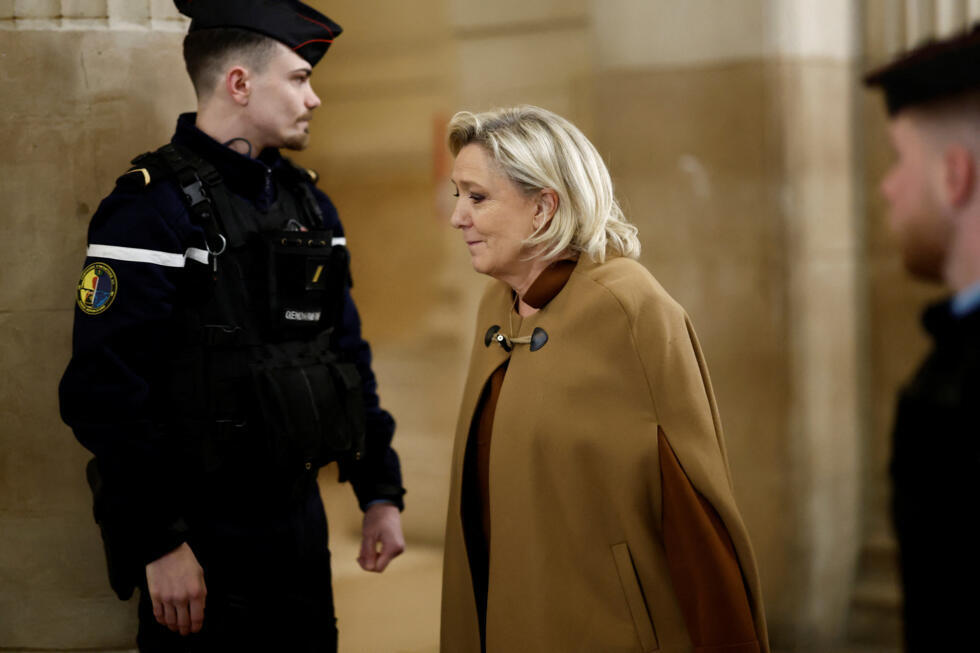 French far-right leader Marine Le Pen arrives for a hearing at the Paris courthouse on the Ile de la Cité on February 3, 2026. © Benoit Tessier, Reuters
'No political leadership'
These notable cases have “contributed to the deterioration in the perception of corruption”, said Florent Clouet, chief executive of Transparency International France.
But beyond the headline-grabbing scandals, the organisation has identified several key factors in France allowing an increase in the perception of corruption.
“The most significant problem, in our view, is the lack of political will – there is absolutely no political leadership in the fight against corruption,” Clouet said.
A recent plan to strengthen anti-corruption measures has not been championed by any MPs or presented at the weekly Council of Ministers chaired by President Emmanuel Macron, and accusations of corruption at the heart of government seem increasingly common.
Paris mayoral hopeful and current Culture Minister Rachida Dati is the latest in a series of serving ministers to face corruption charges.
France's culture minister Rachida Dati to be tried on corruption charges
To display this content from YouTube, you must enable advertisement tracking and audience measurement.
One of your browser extensions seems to be blocking the video player from loading. To watch this content, you may need to disable it on this site.
 La ministra de Cultura de Francia, Rachida Dati, durante la sesión en la Asamblea Nacional este 30 de junio de 2025. AFP - LUDOVIC MARIN
01:29
The lack of political support for anti-corruption measures is compounded by under-resourced investigation and prosecution bodies.
The National Financial Prosecutor's Office (Le parquet national financier) is overrun, with “each pair of magistrates ... dealing with 80 cases, when the original plan was for them to handle eight cases”, Clouet said.
There is also a chronic lack of personnel at leading financial investigation agencies the central anti-corruption office (l’Office central de lutte contre la corruption et les infractions financières et fiscales) and the High Authority for Transparency in Public Life.
“As a result, we find ourselves in a situation where, basically, they are unable to properly carry out the missions for which they were created,” Clouet said.
The president of the High Authority for Transparency in Public life in April called on the government to increase its budget, saying that of 13,000 declarations made by public officials in 2024, it only had capacity to verify 5,000.
While these organisations were set up to monitor high-ranking officials and public servants, an additional issue is the lack of oversight at lower levels of government.
“There is great difficulty detecting and combating what is known as 'low-intensity corruption', involving relatively small amounts of money that slip under the radar of prevention and detection mechanisms,” Clouet added.
A ‘worrying trend’
Rather than being an outlier, Transparency International found the issues in France are part of a “worrying trend” of “backsliding scores in traditionally well-performing democracies” including Canada, New Zealand, Sweden and the UK.
Globally, more than two thirds of all countries surveyed received a score lower than 50 and “the vast majority of countries are failing to keep corruption under control", the report found.
Over the past decade, progress has “stalled” in Western Europe and “been deteriorating” in the US, which dropped to a new low of 64, it added.
Indeed, US President Donald Trump’s dismantling of decades-old measures to fight corruption seem to have inspired other countries to loosen their own laws.
“In the current geopolitical climate, Europe should be raising, not lowering, its anti-corruption ambitions. Corruption is not inevitable,” said Flora Cresswell, regional adviser for Western Europe at Transparency International.
But “that's not what's happening. Europe tends to follow the United States’ lead,” Clouet said.
The degradation in the public's perception of corruption comes with serious consequences, he warned, causing disenchanted citizens "to abstain from politics" as well as driving "social anger, which can fuel illiberal political forces. In all cases, it's democracy that really loses out.”
A survey released on Monday by the Cevipof research institute found that just 22 percent of people in France say they have confidence in politics – a four percent drop on the previous year.





 English (US) ·