
Cuban President Miguel Díaz-Canel said Thursday that his country will "be ready" for a possible attack from the United States as President Trump's rhetoric against Cuba continues to escalate.
Earlier this week, Mr. Trump said his administration could focus on Cuba after the war in Iran ends.
With Cuba's crisis deepening as a result of a U.S. energy blockade, Díaz-Canel said that he does not want U.S. military aggression to come to Cuba. He said that the country will be prepared to fight back if it happens.
"The moment is extremely challenging and calls upon us once again, as on April 16, 1961, to be ready to confront serious threats, including military aggression. We do not want it, but it is our duty to prepare to avoid it and, if it becomes inevitable, to defeat it," Díaz-Canel said.
He spoke as tensions remain high between the two countries, at a rally commemorating the 65th anniversary of a historic speech by the late leader, Fidel Castro during a crisis with the United States.
Threats against Cuba continue
Mr. Trump said earlier this week, "We may stop by Cuba after we finish with this," he said. He described the island as a "failing nation" and asserted that it's "been a terribly run country for a long time."
The president previously has threatened to intervene in Cuba. At a news conference about the U.S. military's capture of Venezuelan President Nicolás Maduro in January, Mr. Trump warned that Cuba should be "concerned." His rhetoric escalated following the assassination of Iranian Supreme Leader Ali Khamenei in U.S. strikes on Iran.
He told reporters in March at the White House that he believed he would have "the honor of taking Cuba" in some form or another.
Mr. Trump has also threatened tariffs on any country that sells or provides oil to Cuba.
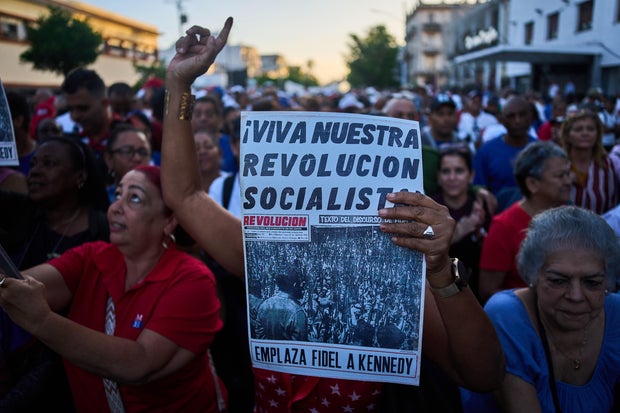 People attend a celebration marking the 65th anniversary of the proclamation declaring the Cuban Revolution socialist, in Havana, Cuba, Thursday, April 16, 2026.
Ramon Espinosa / AP
People attend a celebration marking the 65th anniversary of the proclamation declaring the Cuban Revolution socialist, in Havana, Cuba, Thursday, April 16, 2026.
Ramon Espinosa / AP
Both Mr. Trump and U.S. Secretary of State Marco Rubio — whose parents emigrated from Cuba in the 1950s before the revolution — described the island's government as ineffective and abusive.
Díaz-Canel accused them of trying to construct a "narrative" that has no justification.
"Cuba is not a failed state. Cuba is a besieged state. Cuba is a state facing multidimensional aggression: economic warfare, an intensified blockade and an energy blockade," said Díaz-Canel, the main speaker at Thursday's rally.
"Cuba is a threatened state that does not surrender. And despite everything. And thanks to socialism. Cuba is a state that resists, creates, and make no mistake, a state that will prevail," Díaz-Canel added.
A possible humanitarian crisis
Both Cuba and the U.S. have acknowledged talks to resolve the tension, but no details have been disclosed.
The Cuban president recalled the achievements made possible by the revolution and its social welfare system, which allows for free education that has trained thousands of professionals, many of whom have now been forced to emigrate due to the crisis.
The oil embargo imposed by Trump worsened the already harsh conditions brought on by an economic crisis that has lasted for five years and was triggered by the COVID-19 pandemic and a tightening of U.S. sanctions aimed at pressuring for a change in the island's political model.
Experts have warned of a humanitarian crisis.
Measures to prevent the island from acquiring oil from its Venezuelan, Mexican and Russian suppliers are exacerbating the already poor living conditions of the population, including prolonged blackouts and fuel shortages.
The rally commemorated the 65th anniversary of a historic speech by the late leader, Fidel Castro, during a crisis with the United States. That moment marked the ideological course the Caribbean nation would take and its opposition to Washington's continental hegemony.
Caitlin Yilek contributed to this report.
In:
What is Trump's primary focus with Cuba?
What is Trump's primary focus with Cuba?
(03:02)







 English (US) ·