
 4 weeks ago
34
4 weeks ago
34
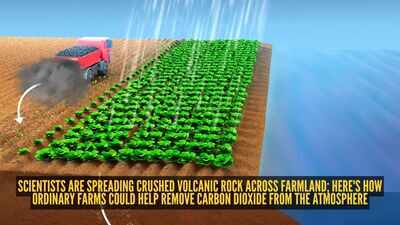
Rock weathering for carbon dioxide removal (Illustration)/ Image Credit: Canva
As countries race to cut greenhouse gas emissions, scientists are exploring innovative ways to remove carbon dioxide (CO₂) that is already in the atmosphere. One approach attracting growing attention involves something surprisingly simple: spreading finely crushed volcanic rock over farmland.
The method, known as enhanced rock weathering (ERW), speeds up a natural geological process that has helped regulate Earth's climate for millions of years. Researchers believe this technique could not only capture atmospheric carbon but also improve soil health and crop productivity making farms a valuable ally in tackling climate change.
How crushed volcanic rock removes carbon dioxide
Volcanic rocks like basalt tend to react naturally with rainwater over thousands of years.
Rainwater picks up carbon dioxide in the atmosphere and soil to create a weak carbonic acid. Upon exposure to rocks rich in silicates, the chemicals interact to break down the mineral content and convert carbon to bicarbonate ions. These ions are then washed to the oceans by rivers, where carbon may be trapped for thousands of years either in sediments or carbonate rocks.Enhanced rock weathering accelerates this natural process by crushing basalt into a fine powder before spreading it across agricultural land.
The smaller particles have a much larger surface area, allowing them to react with rainwater far more quickly than solid rock. Since farmers already spread lime and fertilisers over fields, researchers suggest basalt could be applied using existing agricultural equipment.Besides capturing carbon, basalt gradually releases nutrients such as calcium, magnesium, potassium and silica into the soil. These minerals can improve soil fertility, reduce acidity and, in some cases, support healthier crop growth.
Scientists are therefore investigating whether the technique can provide both climate and agricultural benefits at the same time.

Image Credit: Canva
A promising solution for climate and agriculture
A study published in Science of the Total Environment highlights enhanced rock weathering (ERW) as a promising carbon dioxide removal strategy that can work alongside agriculture. According to the researchers, spreading finely crushed silicate rocks such as basalt on farmland accelerates a natural weathering process that captures atmospheric carbon dioxide and stores it in a stable form.
The study also notes that basalt can gradually release nutrients like calcium, magnesium and silicon into the soil, helping reduce soil acidity and, in suitable conditions, improving soil health and crop productivity.The study also notes that field experiments in acidic tropical soils have shown that part of the basalt weathering can be driven by naturally occurring soil acids rather than carbonic acid formed from atmospheric carbon dioxide.
The researchers say this highlights the need for careful field measurements to accurately determine how much carbon dioxide is actually removed under different farming conditions.These findings suggest that farms could play a role in helping mitigate climate change without disrupting food production. According to the researchers, enhanced weathering is compatible with current agricultural practices since farmers can use existing machinery to spread pulverised basalt on their fields.
Yet, at the same time, the scientists underscore the importance of field monitoring and measurements of carbon sequestration for assessing this approach's efficiency.
Can farms become climate solutions?
Although the technology shows considerable promise, scientists caution that it is not a silver bullet. Mining, crushing and transporting large amounts of volcanic rock require energy, meaning the overall climate benefit depends on using low-carbon energy sources.
Researchers also need reliable methods to verify exactly how much carbon is stored over time - particularly if farmers are to receive carbon credits in the future.In spite of all this, it is clear that enhanced rock weathering is unique in the sense that it is based on pre-existing agricultural techniques rather than on a completely new infrastructure. If ongoing research confirms its effectiveness and environmental benefits, ordinary farms could become an important part of future carbon-removal strategies while continuing food production.










 English (US) ·