
 2 hours ago
2
2 hours ago
2
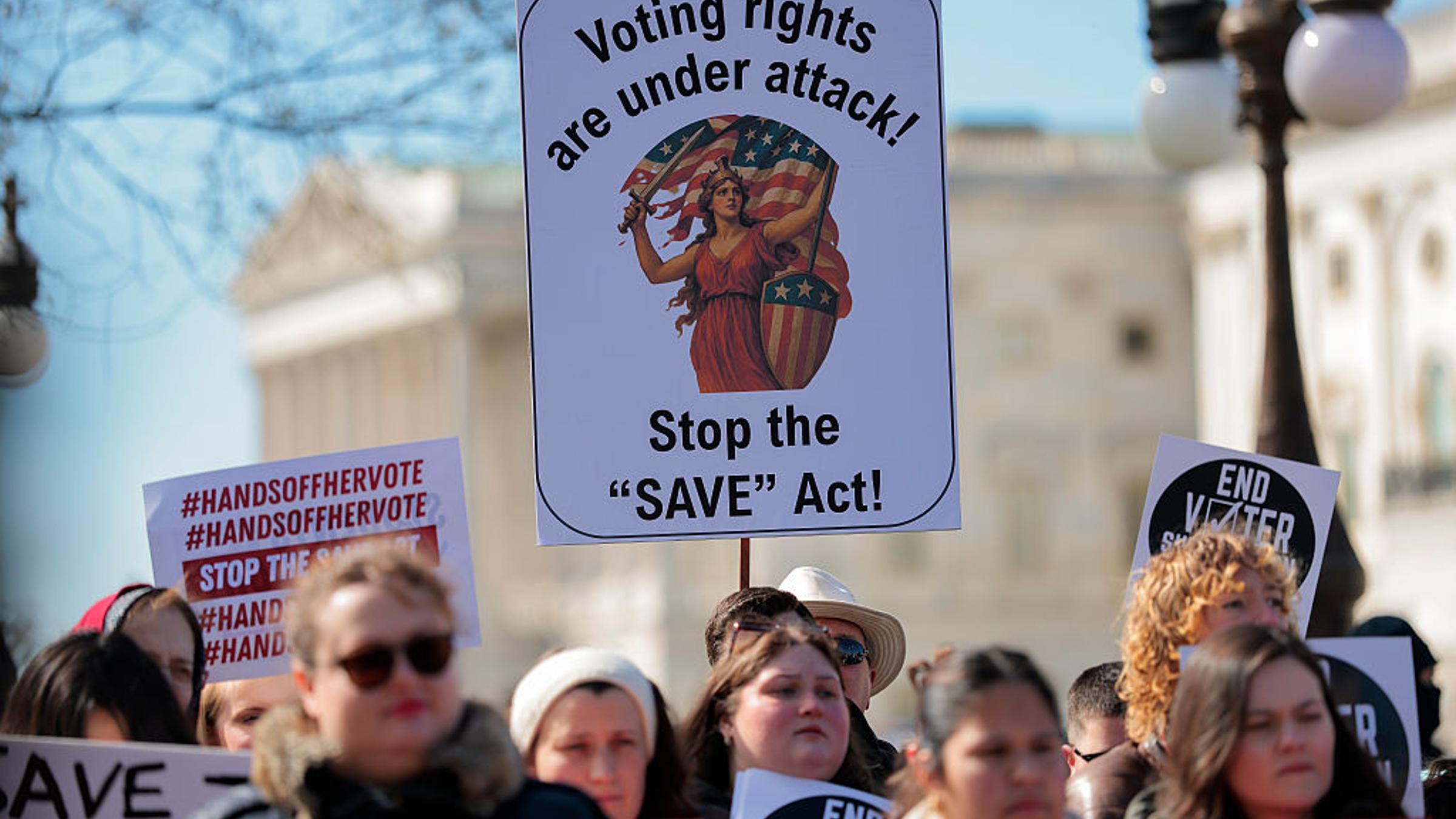
A sweeping federal bill to impose stricter voter-identification requirements that President Donald Trump has aggressively pushed Congress to pass appears all but doomed in the Senate, where it is currently the center of a marathon debate. But a number of states are moving forward with imposing their own restrictions.
The Republican governors of Florida, Mississippi, South Dakota, and Utah have all recently signed their states’ own versions of the SAVE America Act, a bill that would require voters to provide proof of citizenship and photo ID to vote in all 50 states that Trump has made his top legislative priority. In several other states, measures to add additional language into their constitutions explicitly prohibiting non-citizens from voting are on the ballot in the November midterms. And in still more, efforts to get amendments of that kind on the ballot are underway and state legislators are weighing bills to introduce proof of citizenship requirements or otherwise restrict voting access.
Trump and Republican lawmakers have claimed that such measures are critical to counter widespread voter fraud and ensure election security. But research shows that non-citizen voting and fraud are already extremely rare in U.S. elections. And mandating that Americans provide proof of citizenship in order to register or vote could present a challenging hurdle for many citizens: The Brennan Center for Justice found in a 2023 survey that more than 21 million citizens of voting age, or about 9 percent, don’t have ready access to such documents.
Here are some of the states where new voting restrictions have been signed into law, or will be put before voters this year.
Signed into law: Florida, Mississippi, South Dakota, and Utah
Florida’s Republican Gov. Ron DeSantis signed a bill on Wednesday that will impose stricter voter ID requirements and requires Floridians to show proof of citizenship to register.
“Today I signed the election integrity bill, also known as the Florida SAVE Act. This legislation strengthens the security, transparency, and reliability of Florida’s election system,” DeSantis said in a statement. “In Florida, we will always stand up for election integrity.”
The new law will also require that the citizenship of every already-registered voter be verified by checking Florida voter rolls against federal and state records. Voters who are flagged as potential non-citizens will then be notified and have to provide proof of citizenship in order to remain registered.
The law’s major provisions will not take effect until after the 2026 midterms.
The measure was quickly challenged by a coalition of voting rights organizations, who filed a lawsuit after DeSantis signed the bill seeking to block it from going into effect. The groups argue the new rules will make it “harder for eligible U.S. citizens to vote—and for some, impossible,” and that they violate both the First and Fourteenth Amendments.
Mississippi Gov. Tate Reeves, a Republican, also signed a piece of voting legislation on Wednesday. The bill, dubbed the Shield Act, will require that voters’ citizenship be verified through databases from the state Department of Public Safety and the U.S. Citizenship and Immigration Services’ Systematic Alien Verification for Entitlements (SAVE) program. If the individual cannot be found in those systems, they will be required to provide proof of citizenship to register.
The law also requires the state to conduct annual audits of its voter rolls.
“While states like California and New York flood their voter rolls with illegal aliens, Mississippi will do the opposite and defend Americans’ right to determine the outcome of elections,” Reeves posted on X on Wednesday. “This shouldn’t be a controversial issue, but it is. And it’s because Democrats are desperately trying to appease their growing radical base and outsource the management of our country to those who shouldn’t be here.”
The bill will take effect on July 1.
Republican South Dakota Gov. Larry Rhoden signed his state’s own law requiring people to provide proof of citizenship in order to register days earlier, on March 26.
“In South Dakota, we do things right, especially when running our state elections,” said Rhoden in a statement after signing the law, called the South Dakota SAVE Act. “This bill ensures only citizens vote in state elections, keeping our elections safe and secure.”
An emergency clause in the South Dakota bill will make the new requirements take effect immediately, ahead of the state’s June 2 primary.
The law will only impact new registrants. South Dakotans already registered or looking to change their registration information will not be required to show proof of citizenship.
Just one day prior, on March 25, Utah Gov. Spencer Cox, also a Republican, signed a similar bill requiring new registrants to provide proof of citizenship in order to join the voter rolls. The law also mandates that a review of voter registration records be conducted by July 1 this year. Already registered voters whose citizenship cannot be verified in that review will be notified by election officials and have to provide proof of citizenship to stay on the rolls.
The law takes effect on May 6, before the state’s June 23 primary.
Under both the South Dakota and Utah laws, voters in the states who do not provide proof of citizenship may still be eligible to vote in federal elections, though they will be barred from casting ballots in state or local contests.
Utah’s state election office stated earlier this year that after months of reviewing its voter rolls, the state had not confirmed any instances of non-citizens voting.
On the ballot in November: Alaska, Arkansas, Kansas, South Dakota (again), and West Virginia
Measures will be on the ballot in several states on November 3 that would amend the states’ constitutions or laws to include language barring non-citizens from voting.
In Arkansas, an amendment to the state constitution would specify that "only a citizen of the United States meeting the qualifications of an elector" can vote in elections in the state and that "a person who does not meet the qualifications of an elector under this section shall not be permitted to vote in any state or local election held in this state."
Arkansas’ constitution currently states that people may vote if they are at least 18 years of age, a resident of the state, a citizen, and legally registered.
In Kansas, an amendment would change the state constitution to hold that “no person shall be deemed a qualified elector” unless they are a U.S. citizen, are at least 18 years old, and live in the area where they’re seeking to vote.
The state constitution currently states that “every citizen of the United States who has attained the age of eighteen years and who resides in the voting area in which he or she seeks to vote shall be deemed a qualified elector.”
An amendment on the West Virginia ballot would slightly tweak the wording of the state’s constitution from saying that "citizens of the state shall be entitled to vote" to "only citizens of the state who are citizens of the United States are entitled to vote."
In addition to South Dakota’s recently signed bill, a proposed amendment will be on the November ballot that would add text to the state constitution stating that an “individual who is not a citizen of the United States is disqualified from voting in any election or upon any question submitted to the voters of this state."
The South Dakota constitution currently says that “every United States citizen eighteen years of age or older who has met all residency and registration requirements shall be entitled to vote in all elections and upon all questions submitted to the voters of the state unless disqualified by law for mental incompetence or the conviction of a felony.”
In Alaska, a measure that would amend a state statute to state that only citizens can qualify as voters in the state has also qualified for the November ballot.
The ballot initiative would amend an existing voter qualification law in Alaska that states that "a person may vote at any election who is a citizen of the United States” to read "only a person who is a citizen of the United States … may vote at any election."
In Michigan, a similar measure has been proposed, but has not yet officially made it onto the November ballot.
Americans for Citizen Voting, the organization leading the push for the ballot initiative, said it had collected well over the number of signatures required to put the proposed constitutional amendment before voters, but the Michigan Bureau of Elections has yet to verify the signatures.
In Arizona, a measure has been proposed that would amend the state constitution to include language stating that “only citizens of the United States shall be eligible to register and vote once for each available office or ballot measure, in any primary, general or municipal election in Arizona” and to require voters to provide “acceptable” government-issued identification to cast a ballot, among other things. Both chambers of the state legislature have voted to refer the measure to be added to the November ballot, but is not yet officially on it.






 English (US) ·