
 5 hours ago
2
5 hours ago
2

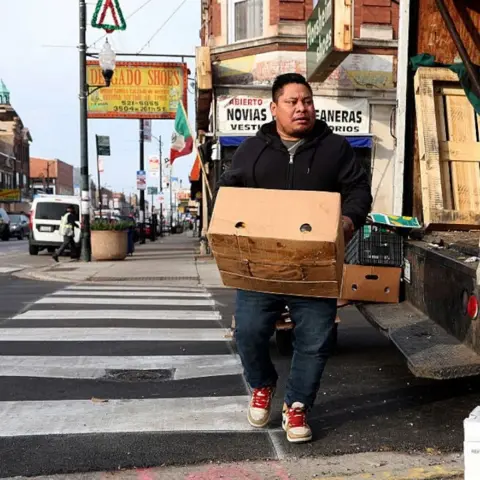 Getty Images
A local shop worker walks by 26th Street in Little Village
For weeks, all eyes have been on Minneapolis where the anger at the killing of two US citizens by federal immigration agents has turned the Midwestern city into a sea of unrest.
President Donald Trump has pledged to "de-escalate" the situation and the new man in charge on the ground, Tom Homan, said on Thursday there will eventually be a "drawdown" in numbers.
A few hundred miles away, Chicago has already seen a surge of immigration agents, and a crackdown on its streets, ease off somewhat.
Operation Midway Blitz was launched in September with the aim, it said, of targeting "criminal illegal aliens" and it peaked in the weeks that followed.
Since then, Chicago and specifically its Hispanic neighbourhoods have had to adjust to a new normal.
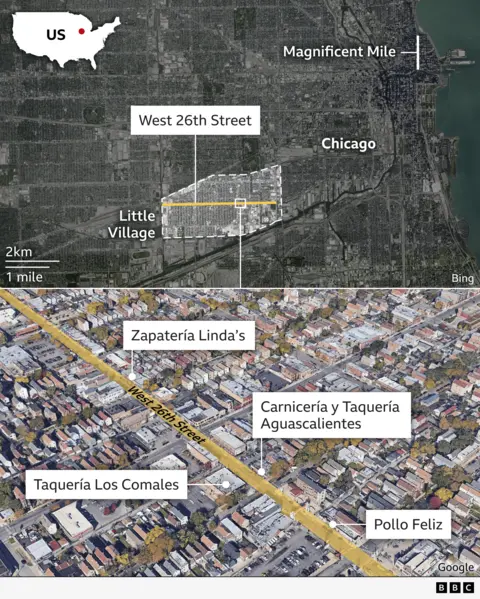
In Little Village - often referred to as the "Mexican Magnificent Mile" - the fear of raids has caused people to stay indoors, turning one of Chicago's key economic hubs into something resembling a ghost town, business owners and city officials say.

"Business has dropped half during the week, sometimes even more than that. People don't want to spend money," says Carlos Macias, who owns the grocery store and restaurant Carniceria y Taqueria Aguascalientes, which his father opened 50 years ago on 26th Street, the main thoroughfare.
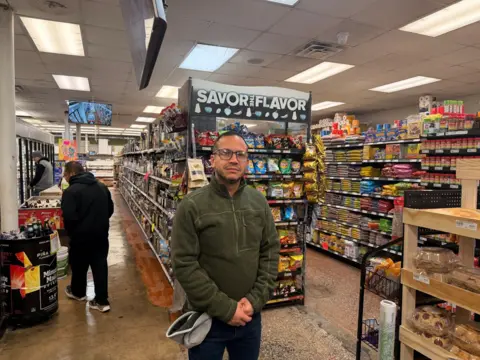
Macias remembers how a raid on his own store spread fear in the community. The agents wore balaclavas partially covering their faces, he says, and some carried rifles while others had handguns in their holsters.
As they moved through the space, they scanned the room, making eye contact with employees and customers. Some people ducked under tables, he recalls, and some began to cry. Others ran towards the back of the building, unsure of the men's intentions. As the tension rose, Macias stepped in.
"This is my property," Macias told them. "You're not allowed in here."
His words had little effect. The incident is still etched in his brain, and one of the reasons he believes that business has slowed.
Watch: Footage shows recent ICE activity in Little Village
But while raids may be keeping people at home, Trump says they are necessary to protect American citizens.
The Department of Homeland Security says it launched Operation Midway Blitz in honour of Katie Abraham, a 20-year-old US student who was killed in a drunk-driving hit-and-run by an illegal immigrant from Guatemala.
The agency says more than 800 undocumented migrants have been arrested, including sex offenders, burglars, murderers and gang members.

The downturn in Little Village is having ripple effects on the wider economy of the city, officials say.
The two-mile corridor is one of Chicago's key economic hubs, generating some of the city's highest tax revenues outside the downtown Magnificent Mile.
And unlike the posh boutiques and flagship international stores that dot that premier North Michigan Avenue address, this street runs through a predominantly Hispanic neighbourhood.
Businesses are locally owned and cater largely to the Latino community - a customer base many say is now staying home out of fear.
Alderman Michael Rodriguez says he has received reports from local restaurants and food vendors indicating sales have dropped by as much as 60%. One local mobile phone shop, he said, reported no sales over a two-week period.
"Since President Trump has been in office, we noticed a major blip in the subsequent days in January and February," Rodriguez says.
"Any detrimental impact on the business environment on 26th Street negatively impacts the region."
But some political leaders support Trump's deportation plan, which was a central plank of his 2024 election campaign.
"I love what he's doing," says Lupe Castillo, a Little Village resident and Republican candidate for Illinois' 4th Congressional District.
"I'm sorry it had to come to this point, but this is the Democrats' fault. There are rules in this country. You can come in, but do it the right way. Then you can stay here and pursue the life you want."
Castillo, who has lived in Little Village for more than 40 years, said this is the first time she has seen federal agents in the neighborhood but residents should continue supporting local businesses.
"Just don't bring any attention to yourself," she said. "I know these people in the neighborhood, they're not bad people, so why would they be afraid? They're only coming after the bad guys."
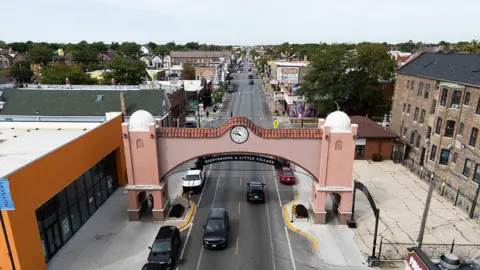 Getty Images
A birds-eye view of 26th street in Little Village
Rodriguez notes that a few businesses have remained steady during these uncertain times, such as some select grocery stores. However, as a lifelong resident of Little Village, Rodriguez says he has never seen anything like this.
"We had public parking available for the first time in my life all across 26th Street," Rodriguez says. "At the lunch hour, where our restaurants are typically full, we saw empty restaurants. Even during the pandemic, it seems like we were more resilient."
In response to the immigration raids, the city of Chicago has launched a programme to provide support to local businesses that have been affected. Ana Valencia, the Chicago city clerk, introduced an initiative called Shopping in Solidarity to encourages residents - and people from across the city - to shop locally and support their neighbours.
"I think Chicagoans have found a way to unite during these crises," Valencia says. "What warms my heart is folks coming in and seeing what a vibrant neighbourhood it is."
Despite these efforts, the result of declining foot traffic is being felt across the corridor, even at long-established restaurants like Taqueria Los Comales, a fixture in Little Village for more than five decades.

Although Little Village's Chamber of Commerce does not have data on daily sales in the neighbourood, Christina Gonzalez, owner of Taqueria Los Comales and a board member of the Chamber of Commerce, says sales at many shops are down 30% to 60%. She says she herself has been forced to cut employees' hours.
"We don't need 10 waitresses to be serving four tables," Gonzalez says. "It just doesn't make sense."
Most employees are hired locally, she added, because residents tend to look for work close to home.
"The community depends on these small businesses for jobs and income," Gonzalez says. "If they don't have the hours to withstand that, then they aren't getting the income that they need and they start cutting out all of their luxuries."
Although it is still too early to know the full economic impact nationwide, economists have argued that mass deportations could harm the GDP, as many migrants work in key sectors, like agriculture, construction and manufacturing.
A 2024 report by the Peterson Institute for International Economics, a nonpartisan think tank, argued that mass deportations could cut the GDP by 7% over three years.
Similarly, a 2024 report from the US Congress Joint Economic Committee found that, depending on the scale of deportations, prices could rise by up to 9.1% by 2028.
But supporters of the president's policies have argued that unchecked immigration ultimately costs more, including by straining public services. In 2024, the Center for Immigration Studies, a think tank that supports lower levels of immigration, testified before Congress that the lifetime fiscal drain (taxes paid minus costs) for each illegal immigrant is about $68,000 (£51,000).
While economists and politicians debate the numbers, for Gonzalez and her employees the concern is more immediate - how to keep the lights on and food on the table.

Adolfo Peña, owner of a shoe store called Zapateria Linda's, says his revenue has fallen by at least half since Trump took office. The decline has been particularly difficult for him. A Trump voter in the last election, Peña describes the outcome as a bitter disappointment.
"This is the worst thing that has happened to us," he says. "Unfortunately, I voted for him. That hurts me the most. I had the confidence that he was going to change things."
Peña said part of the decision to support Trump was driven by his frustration with Joe Biden's border policy. During Biden's presidency, Chicago saw a sharp rise in the number of migrants, with the city receiving over 51,000 arrivals from the southern border. Little Village became a key entry point, with one major shelter in the area housing 220 people in early 2024.
Trump's electoral victory in 2024 was propelled by an uptick in Latino voters like Peña, who were concerned about the economy and the strain of illegal immigration.
But since coming into office, Peña says his bottom line has been hurt more - first when Trump introduced tariffs on multiple countries, including some of his suppliers, and then during Operation Midway Blitz.
"When this problem of ICE came in, everyone disappeared," Peña says.

Inside Pollo Feliz, another restaurant in the neighbourhood, Marya works the register and says she has watched foot traffic dwindle. Those that do come into the restaurant take their order to go.
"Those who come are those that have papers," Marya, who declined to give her last name, says. "Before, people used to come from far away. Since immigration [enforcement] is here, that doesn't happen any more."
Marya says she understands the fear. She has witnessed immigration agents detaining street vendors selling tamales, chicharrónes and empanadas. She also recalls spotting them early in the morning in vehicles with tinted windows, some with their faces covered and rifles protruding.
Rodriguez, the local politician, says the number of vendors is no longer what it once was. Before, several food vendors would arrive early to claim their corner spots, with customers already lining up before stalls were fully set up. In the warmer months, almost every corner of 26th Street was occupied.
That bustle has since faded. Some vendors have stopped selling food altogether, leaving once-crowded corners empty.
"The vendors on the street, who may not have formal documentation status in our country, have expressed to me concern not just for their livelihoods, but for being stripped away from their families," he says. "They're scared that their children won't have their parents at the dinner table."
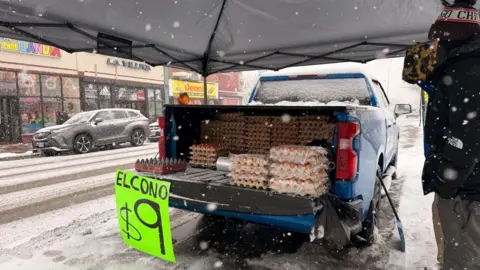
Edwin and Luna, who sell eggs on one of the corners of 26th Street, say street vendors come out less frequently - and for shorter periods.
"They don't want to come out," they say. "We're not scared, but at the same time, we are. They don't respect if you're from here. They don't care."
ICE raids across the US could increase in the coming months.
The Trump administration plans to hire thousands of additional agents, open new detention centres, and work with private companies to locate people without legal status. Congress has also approved $170bn in funding for ICE and Border Patrol through September 2029.
For the people of Little Village, the fear of ICE is ever present.
It shapes who comes out, who works and who shops. Despite the uncertainty, families, businesses and community members remain committed to adapting and persevering in the new normal.
Additional images from Google Street View








 English (US) ·