
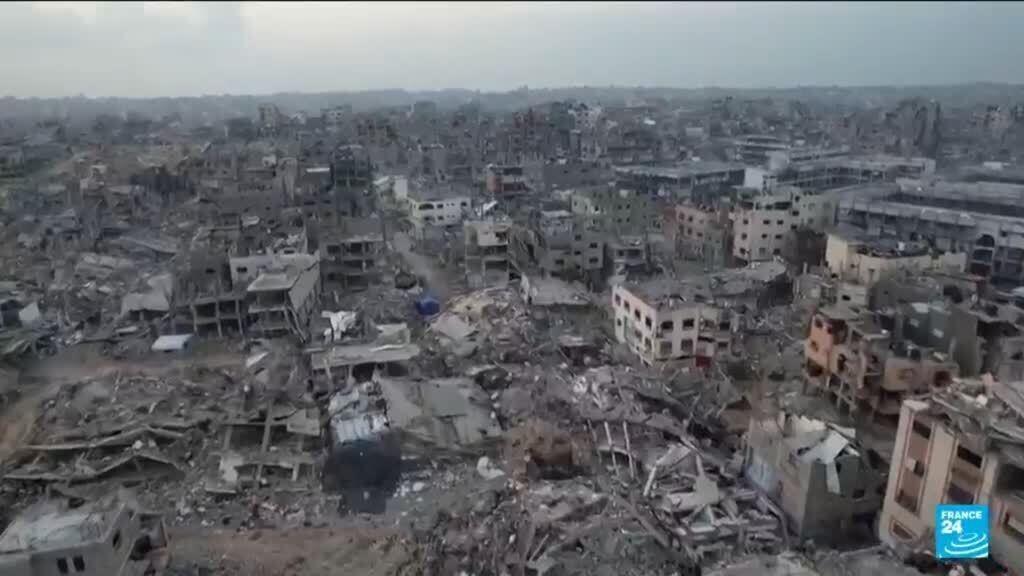
Dozens of world leaders will meet in Washington on Thursday for the inaugural meeting of US President Donald Trump’s Board of Peace. First set up to oversee the Israel-Hamas ceasefire in Gaza and eventual rebuilding of the devastated Palestinian territory, the board’s founding charter – signed at the World Economic Forum's annual meeting in Davos in January – instead outlines a sweeping mandate to pursue peace, stability and “dependable and lawful governance” across the world.
A mission, its preamble makes clear, that calls for “the courage to depart from approaches and institutions that have too often failed”.
Perhaps it’s no surprise, then, that some nations have suggested that the board’s chairman – Trump himself – means to use it to sideline the beleaguered United Nations in favour of his own multilateral body made of a hand-picked membership under a hand-picked executive.
Trump's Board of Peace: 'An attempt to replace existing international institutions like the UN'
To display this content from YouTube, you must enable advertisement tracking and audience measurement.
One of your browser extensions seems to be blocking the video player from loading. To watch this content, you may need to disable it on this site.
 © France 24
12:26
More than two dozen countries have reportedly signed its founding charter, which offers permanent membership to states willing to pay $1 billion into its coffers.
The board’s logo was revealed at the charter’s signing: a globe, wreathed in gold, angled to place North America at the centre of the world.
 US President Donald Trump speaks during a charter announcement for his Board of Peace initiative on the sidelines of the 56th annual World Economic Forum (WEF), in Davos, Switzerland, January 22, 2026. © Jonathan Ernst, Reuters
If the board is intended to be a rival to the UN, its founding comes at a bad time. Secretary-General Antonio Guterres warned in February that the world body was facing “imminent financial collapse” as a result of unpaid member dues and funding cuts.
That includes nearly $4 billion still owed by the US – more than 95 percent of the arrears owed to the UN’s regular budget, officials said. US officials maintain Washington is preparing to start paying its arrears in the coming weeks.
On the eve of the inaugural meeting, FRANCE 24 spoke with Alanna O’Malley, the chair of global governance and wealth and history department head at Rotterdam’s Erasmus University specialising in the United Nations, decolonisation and the Global South.
FRANCE 24: It’s hard not to remark upon the fact that the expanding role of Trump’s Board of Peace comes at a time when the UN is saying it is facing chronic funding difficulties, in particular because of unpaid dues from the US. To what extent are we seeing a desire from the Trump administration to shift Washington’s resources, both in time and money, away from the UN and towards a new multilateral body under permanent US leadership?
Of course the more time that’s put into creating an alternative institution such as the Board of Peace, that’s energy that the US – both in terms of financing but also in terms of manpower, intellectual input, commitment to multilateralism in terms of maintaining relationships and lobbying and building alliances – that’s all energy that’s then not put into the UN. So in many respects, it does present a fundamental challenge to the functionality of the UN, or the functionality of US power at the UN, because of its divergence from that institution.
But the UN has been in a declining position globally for quite a long time, especially in the last five years. And that has to do with this wider context in which the institution seems unwilling or unable to respond in a timely manner to major crises of international relations – including most recently, of course, the Russian aggression against Ukraine and the crisis in Gaza.
And as that happened, the reputation of the UN gets lower and lower and states feel less obliged to meet their mandatory contributions, because the value of those changes as the value of the UN decreases. In this respect the UN is in a very difficult position financially because a lot of members just simply haven't paid their dues. And then of course, this puts a strain on the organisation … and it actually reduces the efficacy of the UN. It's an exacerbatory effect.
Watch moreWill Trump's 'Board of Peace' in Gaza really rival the UN?
But I wouldn't read necessarily the Board of Peace as a response to the crisis of the UN. The genesis of this new proposed institution is quite different – this is very much about the MAGA agenda in foreign policy. This is very much about American power in the world. This is about a wider response of the United States to the aggression of Russia in terms of its outlook in the world, but also to the increasing political might of China.
You see a lot of discussions now that point to a revival of 19th-century ideas about spheres of influence, and certainly Russia and China very much see the world like this. So I think this institution is the expression of America's turn towards thinking about spheres of influence. And we see this kind of hemispheric rhetoric coming a lot out of the Trump administration right now.
The other thing, of course, is that this institution was proposed as part of a peace settlement for Gaza, which was approved by the UN Security Council. But at that time, it seemed that it would be limited to the Gaza crisis, not that it would be expanded into a new institution designed to deal with other crises. This is an effort for the US to embed institutionally their global power, but in an institution that serves their purposes more directly.
A third reason is much more about Trump's ego. The terms of his engagement under this institution would be that he would be chairman for life, and that he would have essentially a veto over all major decisions of the institution. This is a way for him to guarantee a position of what he sees as supremacy in global affairs – even after he is out of office in the US. It's very much an ego project for him. On that basis, of course, it really undercuts any actual value such an institution might have.
What room, if any, does that leave for any kind of reformist push to revitalise the UN and restore a sense of legitimacy or relevance? Or are we going to see a broader sidestepping of the UN in favour of this turn towards spheres of influence?
You have to remember that the UN's popularity and power has waxed and waned over time. This is not the first moment of crisis in 81 years, and it won't be the last – depending on how long the UN will survive. There are 193 members of the UN, 192 without the US, and many of those other countries, including major European states such as France, such as the UK, such as Germany and major Global South actors such as South Africa, India, Brazil, Indonesia, remain extremely committed to the UN and remain vested in preserving its values and preserving its principles and institutions and systems.
What happens when major global powers turn away from institutions oftentimes is that it creates much more room for manoeuvre and a power vacuum within those structures. What is imperative now is that those especially more powerful states are really forthright about their commitment to UN reform.
Read moreTrump charges $1 billion for permanent seat on Gaza ‘Board of Peace’, invites Russia’s Putin
And that's the step that we haven't seen. You've seen a lot of defence of the UN in response to this initiative, and you've seen also a lot of those countries are not going to be members of the Board of Peace. And some have been downright critical of the creation of another institution that might detract from commitment to the UN. And you see this resurgence around the world in the value of multilateralism and commitment to multilateralism, because there seems to be a major shift in the global order.
And at the centre of that, what we haven't seen is those countries make the next step and actually commit themselves to reform of the UN. Now, there is this campaign that's ongoing, the Article 109 campaign – article 109 of the UN charter stipulates that a conference for revision of the charter, to think about reform, should actually be held every 10 years under the UN's own constitution. That's never happened since 1945.
What reforms would you want to see coming out of that conference, should it take place?
I'd like to see a lot more power vested in the General Assembly [than in the Security Council]. In recent years, especially in the last ten years, we've seen a lot more activity and dynamism from the General Assembly, which, to be fair, historically has always been the most dynamic form of the UN and in fact, the most interesting politically.
The General Assembly is really the most accurate barometre for the temperature of the international community on any issue. That came out really clearly over Gaza, where you had those massive votes in support of resolutions on the Gaza crisis and condemning Israel's military action.
But in a more a direct way you also saw the way that the General Assembly recently can reflect new political trends. One of those was the turn away of many Global South countries from European appeals to support resolutions on Ukraine, because that reflects a wider schism in the North-South relationship. There's been a lot of recourse to try to think about doing more at the General Assembly, because the Security Council is essentially deadlocked.
And that's really the elephant in the room on any discussion on UN reform. Because the next article of the charter under 109, the third premise, is that any reform of the UN charter has to be agreed by all of the permanent five members of the Security Council.
So the question is, how do you get a reform proposal across the line and keep the "P-5" happy? You've got to think about reforming the institution in a way that doesn't dilute their power. And one of the big issues is representation on the Security Council.
Given that dynamism, to what extent can we read the Trump administration’s efforts to set up the Board of Peace as a response to Global South countries’ increasing efforts to advance their own interests through the UN?
It's important to understand that Global South countries have had a majority vote in the General Assembly since 1960. They've been using the institution to advance their interests against significant pushback by the West for most of the UN's history.
And that's something that's not often featured in histories of the UN and multilateralism, in our understandings of the institution – it’s often depicted solely as a Western instrument, whereas actually it has been the epicentre for contestations of the liberal world order rather than the execution of liberal internationalist policies.
This is the context in which Global South agency has to be viewed. And that means that the Global South activity around multilateralism and around the UN right now is the continuity of much longer patterns of interaction with the institution.
The US in particular has been frustrated by their efforts to shape the agenda on various questions over time, also because it dilutes their own influence to a certain extent – because, of course, power politics are always at play in all institutions, not just in the UN. So it may be a response to increased Global South agency.
But to a large extent the US is still a major global partner and has a different regional relationships with Latin American states and then again with Asian and Southeast Asian and African states. So I'm not sure that their agency is such a surprise to the US. The only question that the US is really fundamentally squeezed on at the UN is Israel, everything to do with Israel – and that's where the US has used its veto most often at the Security Council.
It's more likely that the Board of Peace is being created for these other reasons – as a way to institutionalise US power under Donald Trump, rather than institutionalise the position of the US in the world. It's a very MAGA agenda.
This interview has been edited for length and clarity.




 English (US) ·