
 3 weeks ago
14
3 weeks ago
14
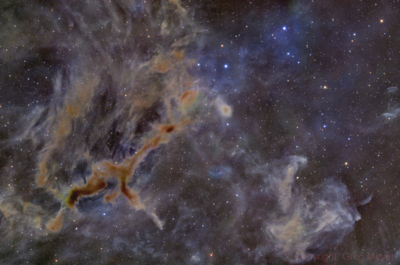
A giraffe-shaped dark nebula against a dense field of stars. (Credit - Greg Meyer)
A dark shape has been moving around social media in recent days, though it is not moving at all. The image comes from deep space and shows a narrow shadow cutting through a crowded field of stars.
It was photographed from Texas and shared by astrophotographer Greg Meyer, who had been working through targets in the constellation Cassiopeia. People noticed the shape before the name. Some saw an animal form, stretched and upright, like a giraffe caught mid-stride. The image travelled quickly, passed along without much explanation. It sits around 1,000 light-years away, though that detail matters less than the outline itself.
The object is known to astronomers, but it is rarely framed this way.
It does not glow. It blocks light. In doing so, it ends up being noticed.
Astrophotographers reveal a giraffe-shaped nebula hidden in the Milky Way
The object is a dark nebula, a patch of dense dust that hides whatever lies behind it. There is no colour pouring out, no energetic gas lighting up the scene. It shows up because the background is bright. The Milky Way fills the frame, and the dust cuts into it. That contrast is what makes the shape clear.
Without the surrounding stars, there would be little to see.
Names exist, but they are not what spread
In catalogues, the cloud is listed as LDN 1245, part of a long survey compiled in the 1960s. Nearby regions carry other numbers, and boundaries blur. Online, those labels barely matter. People have started calling it the Giraffe Nebula, not as a claim, just as a way to point. The name sticks because the outline sticks. A long section rises upward. Smaller pieces angle away.
The suggestion is enough.
The outline depends on where you look from
The giraffe shape is not fixed. Shift the framing or stretch the contrast, and it changes. What looks like a neck in one image becomes a split cloud in another. Along the edges, faint light appears, a soft blue in places. That happens when dust scatters light from nearby stars. It is subtle and easy to miss. In this image, it stays just visible.
A quiet target chosen almost by accident
Meyer has said he could not find other images of this object taken with his telescope on Astrobin. That absence became the reason to try. The equipment, a Sky Watcher Esprit 120, is not unusual.
What matters more is patience. Long exposures, careful alignment, time spent adjusting rather than searching for something new. The result is less about discovery and more about noticing.
Cassiopeia hides many shapes like this
This part of the sky is crowded. Cassiopeia sits along the Milky Way’s plane, full of dust clouds that interrupt the starlight. Most do not carry nicknames. They sit unnamed and unnoticed unless someone frames them just right. Many are tied to regions where stars form, though that story is not visible here.
The image does not explain itself.
Recognition arrives before understanding
The response to the photograph has little to do with catalogues or distances. People react to the shape first. The resemblance feels accidental, which makes it easier to share. It does not ask to be understood. It just looks back at you. The science remains quiet in the background while the outline does the work.








 English (US) ·